GLOBAL ECONOMY | INTERNATIONAL TRADE | GEOECONOMICS | OCTOBER 2026
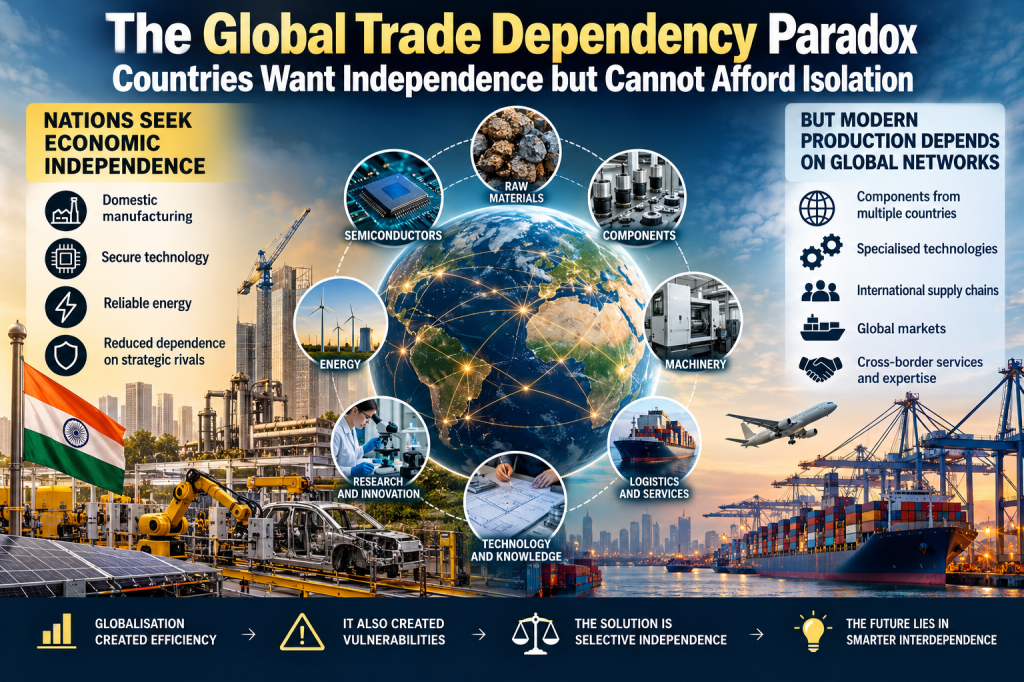
The emerging contradiction of the twenty-first-century economy is that nations want greater economic sovereignty while their prosperity increasingly depends on production networks they cannot control alone. The future of global trade may not be determined by who becomes self-reliant, but by who manages international dependence most intelligently.
The New Economic Contradiction: Sovereignty in an Interdependent World
The world economy is entering an unusual phase. Countries that spent decades promoting globalisation are now investing heavily in economic nationalism. Governments want domestic factories, secure supply chains, independent technological capabilities, reliable energy sources, and reduced exposure to geopolitical rivals. Yet the very industries they seek to protect have become so internationally interconnected that complete economic independence is increasingly difficult, expensive, and sometimes technologically unrealistic.
The United States wants to rebuild manufacturing while remaining dependent on internationally sourced materials, components, equipment, and specialised industrial capabilities. Europe wants strategic autonomy but continues to rely on external energy resources, critical minerals, digital technologies, and manufacturing inputs. China has developed extraordinary industrial capacity but still faces vulnerabilities in certain advanced technologies, equipment, and overseas markets. India seeks greater manufacturing self-reliance while depending on imported energy, electronics, machinery, semiconductor components, and specialised chemicals.
This creates a fundamental economic paradox: the more sophisticated an economy becomes, the more difficult it may be to produce everything domestically.
Modern industrial development is not simply about establishing factories within national borders. It involves access to specialised knowledge, intellectual property, industrial machinery, raw materials, software, logistics, finance, and markets. These capabilities have developed across different countries over several decades.
The real question is therefore no longer whether countries should depend on international trade. It is whether they can manage that dependence without surrendering strategic control over their economic future.
How Globalisation Created Efficiency—and Strategic Vulnerability
The historical development of international trade helps explain this contradiction. During the nineteenth century, industrialisation expanded international commerce through machinery, shipping, railways, and imperial trading systems. Industrial powers concentrated on manufacturing, while many colonies and developing economies supplied agricultural commodities, minerals, and other raw materials.
Following the Second World War, international economic institutions and successive trade agreements encouraged greater market integration. However, it was the period beginning in the late 1980s and accelerating after 1990 that fundamentally transformed global production.
Advances in telecommunications, container shipping, computing, logistics, and trade liberalisation allowed multinational corporations to separate production activities across countries. A product no longer needed to be designed, manufactured, assembled, and marketed in one location.
China emerged as a major manufacturing centre, combining infrastructure, labour availability, industrial ecosystems, state-supported investment, and access to global markets. Western economies increasingly specialised in technology, product development, branding, financial services, and other high-value activities. East Asian economies developed sophisticated electronics and component-manufacturing networks, while several developing countries entered global production through labour-intensive assembly and intermediate goods.
This international division of labour reduced costs, expanded consumer choice, improved production efficiency, and accelerated industrial development in participating economies.
However, it also created a structural weakness that remained underestimated for decades.
The global economy became efficient partly because it concentrated specialised production in relatively few locations. That same concentration created vulnerabilities when political relationships, transportation networks, or supply conditions changed.
The COVID-19 pandemic exposed weaknesses in medical supplies, semiconductors, logistics, and manufacturing networks. Subsequent geopolitical tensions, sanctions, export controls, and disruptions to shipping routes reinforced concerns about excessive dependence.
What had previously been celebrated as international efficiency increasingly came to be viewed as strategic exposure.
The Illusion of National Manufacturing Independence
Consider the production of a modern electric vehicle. Its batteries may require lithium extracted in one country, nickel processed in another, battery materials refined elsewhere, semiconductor chips manufactured through highly specialised international networks, and software developed across several technology centres.
Similarly, manufacturing a smartphone requires advanced processors, display technologies, memory chips, precision components, specialised equipment, software, and intellectual property originating from multiple economies.
Even a country capable of assembling the final product may remain dependent on foreign suppliers for some of its most technologically sophisticated components.
The same applies to pharmaceuticals, renewable energy equipment, aircraft, telecommunications infrastructure, and advanced machinery.
Attempting to reproduce every stage domestically could require enormous investment, prolonged technological learning, and production at scales that domestic markets may not support.
This exposes a weakness in the popular argument that every imported component represents a failure of national industrial policy.
Imports can sometimes indicate industrial weakness, particularly when domestic firms remain permanently dependent on low-value assembly. But they can also reflect successful integration into highly specialised global production systems.
A competitive economy does not necessarily manufacture everything. It develops capabilities in activities where it can create significant value while securing reliable access to complementary inputs.
The Hidden Cost of Economic Nationalism
The renewed emphasis on domestic manufacturing is not without economic justification. National security, employment, technological development, and resilience are legitimate policy concerns.
However, economic nationalism can become counterproductive when political objectives override industrial economics.
A government may impose high tariffs to encourage domestic production. In the short term, this may protect local manufacturers and stimulate investment. But if domestic suppliers cannot match international productivity, quality, or scale, higher input costs may weaken downstream industries.
A protected steel industry, for example, may benefit from import restrictions while machinery, automobile, construction-equipment, and engineering exporters face higher production costs.
Similarly, protecting domestic electronics components without ensuring technological competitiveness could raise costs for manufacturers of finished electronic products.
The result may be a paradox within the protectionist strategy itself: policies intended to strengthen domestic manufacturing can make other domestic manufacturers less internationally competitive.
Subsidies create another complication. Large economies can mobilise substantial public resources to attract strategic industries, while smaller and poorer countries often lack comparable fiscal capacity.
If industrial competition increasingly depends on government subsidies rather than underlying productivity, global manufacturing could become more concentrated in countries with the greatest fiscal resources.
Economic sovereignty would then become a privilege of wealthy governments rather than an opportunity available to all developing economies.
Strategic Dependence Is Not the Same as Economic Dependence
One of the greatest weaknesses in contemporary trade debates is the tendency to treat all imports as equally risky.
Dependence on imported consumer goods is fundamentally different from dependence on a single foreign supplier for critical semiconductor equipment, essential medicines, or military technologies.
The economic consequences of supply disruption depend on several factors: the importance of the product, availability of alternative suppliers, technological complexity, switching costs, inventory requirements, and the time needed to develop domestic capabilities.
A country importing inexpensive household products from multiple competitive suppliers may face little strategic vulnerability. In contrast, dependence on one supplier for a specialised industrial input can create severe risks even when that input accounts for a small share of total imports.
This distinction suggests that economic policy should move beyond simplistic measures such as import reduction and domestic-content targets.
A more meaningful framework would examine the concentration of suppliers, criticality of inputs, domestic technological capability, and potential cost of supply disruption.
Strategic autonomy should therefore be measured not by the absence of imports but by the availability of credible alternatives.
The Emerging Global Order: Selective Independence Rather Than Deglobalisation
The coming decade is unlikely to produce complete economic isolation among major economies. The economic costs would be too substantial, and the technological interconnections are too deeply established.
Instead, the world may move toward a more selective form of globalisation.
Strategically sensitive industries—including advanced semiconductors, defence technologies, critical minerals, certain pharmaceuticals, artificial intelligence infrastructure, and energy systems—may experience greater regionalisation, domestic investment, and government intervention.
Other industries, particularly those producing ordinary consumer goods and internationally traded intermediate inputs, may continue to rely heavily on cross-border specialisation.
The distinction between trusted and untrusted suppliers could become more important, although political alliances will not always coincide with commercial efficiency.
This transformation may produce a world of overlapping production networks rather than one integrated global marketplace.
North America may deepen regional manufacturing relationships. Europe may diversify strategic suppliers while maintaining global commercial ties. East Asia may remain an essential manufacturing centre even as companies establish additional facilities elsewhere.
India, Southeast Asia, Mexico, and other emerging manufacturing locations could benefit from supply-chain diversification. But such opportunities will not automatically translate into durable industrial competitiveness.
Relocating assembly activities is relatively easy compared with developing sophisticated supplier ecosystems, engineering capabilities, industrial research institutions, and internationally recognised quality systems.
The danger is that countries may attract factories without acquiring the knowledge, technology, and high-value functions that determine long-term economic strength.
India’s Industrial Dilemma: Self-Reliance or Competitive Interdependence?
India’s industrial policy faces precisely this challenge.
The ambition to expand domestic manufacturing is economically justified. India needs stronger industrial capabilities, productive employment, technological upgrading, deeper supplier networks, and greater participation in international markets.
However, self-reliance should not be confused with attempting to manufacture every component domestically.
Historically, successful industrialising economies have often relied on imported machinery, technology, intermediate goods, and capital equipment during important phases of development. Imports helped create domestic productive capacity rather than merely replacing domestic production.
India’s challenge is to distinguish between imports that strengthen industrial capabilities and dependencies that restrict technological progress.
For example, importing advanced machinery that improves productivity and enables exports can be economically beneficial. Importing specialised electronic components may allow Indian manufacturers to compete internationally while they gradually develop domestic design and production capabilities.
But an industrial structure that remains permanently concentrated in assembly, with limited domestic value addition and technological learning, would represent a missed development opportunity.
India therefore needs a more sophisticated industrial strategy based on competitive interdependence rather than indiscriminate import substitution.
This requires strengthening domestic suppliers where scale, capabilities, and future demand justify investment. It also requires improving access to internationally competitive inputs where domestic production would be prohibitively expensive or technologically premature.
India’s MSME clusters are particularly important in this transition.
Industrial clusters in engineering, automotive components, textiles, electronics, pharmaceuticals, chemicals, and machinery could become important suppliers to diversified global production networks. However, participation will depend on productivity, quality assurance, technological upgrading, timely delivery, certification, and the ability to meet increasingly complex buyer requirements.
A cluster should not be considered successful merely because it produces more domestically. Its real achievement would be the capacity to supply internationally competitive products while progressively acquiring more sophisticated manufacturing functions.
This also demands a shift in cluster development policy—from infrastructure and common facilities alone toward technological extension, supplier qualification, design capability, testing services, workforce skills, and integration with global buyers.
The Economic Risk of Building Expensive Domestic Industries
There is another question that deserves greater attention: What happens when governments successfully establish domestic industries that remain permanently more expensive than international alternatives?
Industrial protection can be justified when it supports learning, economies of scale, technological upgrading, and eventual competitiveness.
But protection becomes economically damaging when firms have little incentive to improve productivity.
An industry that survives primarily because imports are restricted may generate employment and domestic output while imposing hidden costs on consumers, exporters, and other manufacturers.
Such costs are rarely visible in headline manufacturing statistics.
A country may celebrate increased domestic production while experiencing higher prices, lower export competitiveness, slower technological adoption, and reduced consumer purchasing power.
The central objective of industrial policy should therefore not be domestic production at any cost.
It should be the creation of industries capable of becoming competitive, innovative, and economically sustainable.
That requires periodic evaluation of protection, measurable productivity improvements, export performance, technological learning, and transparent criteria for continuing or withdrawing public support.
The Future: From Supply-Chain Efficiency to Supply-Chain Intelligence
By 2035, economic competitiveness may increasingly depend on how effectively countries combine domestic capability with international access.
The most successful economies may not be those with the highest degree of domestic production, but those capable of identifying critical vulnerabilities, diversifying suppliers, building technological alternatives, and maintaining commercial relationships across geopolitical divisions.
This will require a new approach to economic intelligence.
Governments and industries will need to understand not merely where products are imported from, but where the underlying technologies, materials, patents, specialised equipment, and critical production capabilities are concentrated.
Such information can help distinguish genuine strategic risks from politically convenient arguments for protectionism.
For developing countries, this distinction will be especially important.
Excessive openness without domestic capability building can produce technological dependence. Excessive protection without international competition can produce inefficient industries.
The policy challenge is to find a dynamic balance between these two risks.
A country should remain internationally integrated while progressively strengthening its ability to innovate, adapt, and negotiate from a position of greater economic capability.
The Future Belongs to Countries That Manage Dependence, Not Those That Deny It
The global trade debate is increasingly framed as a choice between national independence and international dependence. This is a misleading distinction.
No major modern economy can realistically eliminate international economic relationships without imposing substantial costs on its industries and consumers.
The real challenge is to determine which dependencies are economically beneficial, which are strategically dangerous, and which can be transformed into opportunities for domestic capability development.
For India, the future lies neither in unrestricted import dependence nor in rigid economic nationalism.
It lies in building competitive domestic manufacturing ecosystems while participating intelligently in international production networks.
Economic sovereignty in the twenty-first century will not mean producing everything within national borders. It will mean possessing the technological capability, productive strength, supplier alternatives, and institutional flexibility to remain economically secure even when global relationships change.
The countries that understand this distinction will be better positioned to prosper in an increasingly fragmented world economy.
Those that confuse self-reliance with isolation risk protecting their industries from foreign competition while simultaneously protecting them from the productivity improvements necessary for long-term success.
The ultimate paradox of global trade is that genuine economic independence may require deeper, smarter, and more diversified international interdependence—not withdrawal from it.
Editorial note: This is an original analytical commentary based on historical economic developments and structural trade-policy reasoning. It intentionally avoids unverified current statistics and distinguishes likely future scenarios from established outcomes.
#GlobalTrade #EconomicSovereignty #Deglobalisation #IndustrialPolicy #GlobalValueChains #IndiaManufacturing #MSME #SupplyChainResilience #InternationalEconomics #EconomicDevelopment


Leave a Reply