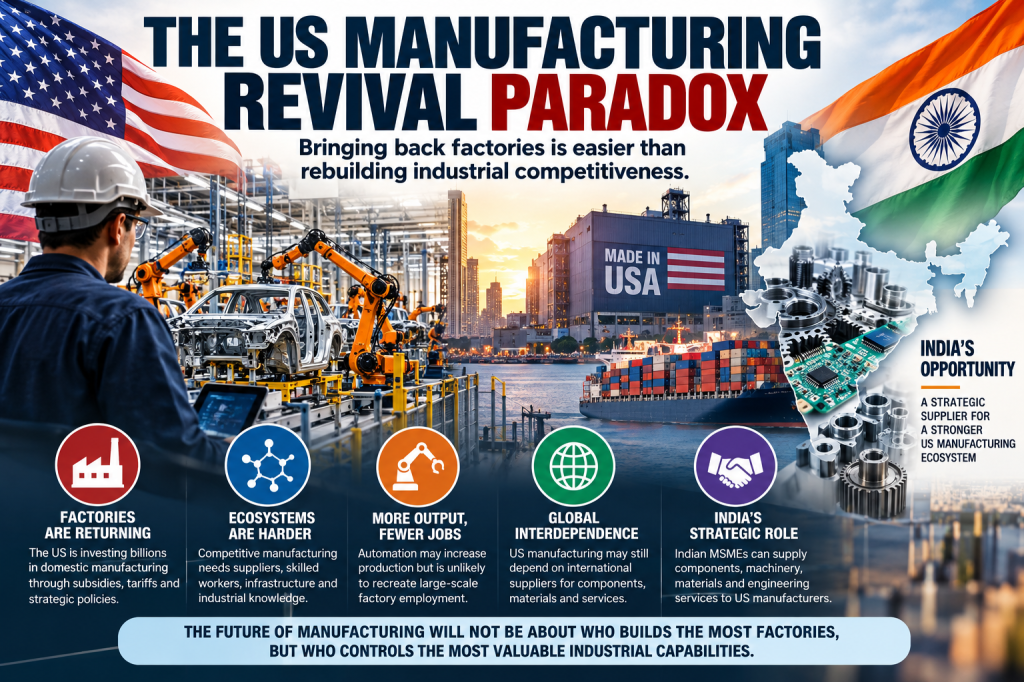
The United States is attempting one of the most ambitious industrial transformations of the twenty-first century. But the central question is not whether America can build new factories. It is whether those factories can become globally competitive without the supplier networks, industrial skills, production efficiencies, and economic relationships that took decades to develop elsewhere.
The Return of Manufacturing to the Centre of American Economic Policy
For nearly three decades, the United States promoted an economic model in which innovation, finance, technology, consumption, and high-value services became increasingly important, while substantial portions of physical production moved overseas. Globalisation was expected to distribute manufacturing activities according to comparative advantage, allowing American corporations to concentrate on research, product development, branding, intellectual property, and market control.
That model produced enormous benefits for multinational corporations and consumers. American companies gained access to lower-cost production, global supplier networks, and expanding international markets. However, the same process contributed to the erosion of manufacturing employment and industrial capabilities in several regions of the United States.
Today, Washington is attempting to reverse some of these developments through industrial subsidies, tariffs, strategic procurement, investment incentives, and restrictions on sensitive technologies.
The CHIPS and Science Act, the Inflation Reduction Act, and other industrial initiatives have demonstrated a significant shift in American economic thinking. Industrial policy, once treated with considerable suspicion in mainstream American economic debates, has returned as an instrument of national security, technological leadership, and economic resilience.
Yet an important contradiction lies at the centre of this transformation.
America can subsidise the construction of factories, but it cannot automatically subsidise the emergence of competitive industrial ecosystems.
A semiconductor fabrication plant can be constructed through enormous capital investment. An electric vehicle battery factory can receive financial incentives. A steel plant can benefit from tariff protection. But none of these measures automatically guarantees internationally competitive production costs, dependable suppliers, skilled technicians, technological learning, or sustainable commercial demand.
The distinction between establishing manufacturing capacity and rebuilding manufacturing competitiveness may become one of the defining economic questions of the coming decade.
How America Became an Industrial Superpower: The Forgotten Importance of Ecosystems
American industrial leadership did not emerge simply because the country possessed large factories.
During the late nineteenth and twentieth centuries, the United States developed an extraordinary combination of natural resources, transportation infrastructure, engineering institutions, financial markets, domestic demand, and industrial entrepreneurship.
Railways connected production centres with markets. Universities and technical institutions supplied engineers and researchers. Steel, machinery, automobiles, chemicals, electrical equipment, and aerospace industries developed mutually reinforcing production networks.
Detroit was not merely a collection of automobile assembly plants. It represented a complex industrial system involving steel producers, machine-tool manufacturers, component suppliers, engineering companies, specialised workers, logistics providers, and financial institutions.
Similarly, American aerospace leadership depended on thousands of specialised firms producing components, instruments, materials, and precision engineering systems.
The American industrial revolution was therefore not simply a story of factory expansion. It was a story of institutional coordination, technological accumulation, and interconnected industrial capabilities.
After the 1970s, this structure began changing.
Japanese manufacturing challenged American automobile and electronics producers through superior production management, quality control, and supplier integration. Subsequently, East Asian economies expanded their industrial capabilities through export-oriented manufacturing.
China’s integration into the global economy accelerated the geographical redistribution of manufacturing activities. American companies increasingly separated product design, technology ownership, marketing, and distribution from physical production.
Over time, many American corporations became exceptionally successful at controlling global value chains without necessarily manufacturing most of their products domestically.
This created an unusual economic arrangement: the United States retained considerable control over high-value economic functions while allowing substantial parts of its manufacturing supply chains to develop abroad.
Reversing this arrangement is considerably more difficult than establishing a new factory.
The Factory Without the Ecosystem: America’s Industrial Reconstruction Problem
The most serious obstacle to American manufacturing revival may not be the shortage of investment capital. It may be the absence or weakness of supporting production networks in particular industries.
A modern manufacturing facility requires hundreds or sometimes thousands of inputs. These include specialised machinery, electronic components, precision tools, chemicals, industrial materials, maintenance services, packaging, logistics, and technical expertise.
When these capabilities are geographically concentrated, firms benefit from lower transaction costs, faster deliveries, specialised labour markets, and continuous technological interaction.
China’s manufacturing strength illustrates this advantage. Its competitiveness does not arise exclusively from relatively low labour costs. It also reflects the density of industrial clusters, supporting infrastructure, supplier availability, production experience, and large domestic markets.
An electronics manufacturer operating within a mature Asian production cluster may access multiple suppliers of components, moulds, packaging materials, machinery, and engineering services within a relatively small geographical area.
An equivalent facility established in the United States may initially need to import many of these inputs.
Consequently, domestic assembly may increase without a corresponding increase in domestic value addition.
This creates the possibility of a new industrial contradiction: factories located in America but structurally dependent on foreign industrial ecosystems.
The geographical location of final assembly cannot, by itself, establish the economic nationality of an entire production system.
The Subsidy Trap: When Industrial Protection Becomes Permanent Dependence
Industrial subsidies can be economically justified when they address market failures, national security vulnerabilities, technological spillovers, or the initial disadvantages of emerging industries.
Historically, successful industrial economies have used different combinations of protection, public investment, procurement, and technological support.
However, subsidies become problematic when firms begin treating government assistance as a permanent component of their business models.
A factory that remains commercially viable only because of continuing tax concessions, protective tariffs, or government purchasing commitments may create employment and strategic capacity without generating sustainable competitiveness.
The challenge becomes particularly serious when several countries simultaneously subsidise the same strategic industries.
Semiconductors, batteries, electric vehicles, renewable energy equipment, and advanced materials have become major areas of international industrial competition.
Governments increasingly compete to attract investment by offering financial incentives, infrastructure, favourable regulations, and preferential procurement.
Such competition can accelerate technological development, but it can also produce excess capacity, inefficient investment, and costly duplication.
The economic danger is that industrial policy becomes a contest over which government can absorb the largest commercial losses.
The success of American industrial policy should therefore be measured not by the value of subsidies announced or factories constructed, but by whether supported industries eventually become productive, innovative, and commercially sustainable.
This requires clear performance benchmarks, technological upgrading obligations, supplier-development targets, and credible mechanisms for reducing support when it is no longer justified.
Tariffs Can Protect Markets, But They Cannot Manufacture Productivity
Tariffs have become a central instrument in America’s effort to restructure international production.
The economic logic appears straightforward. By making imported goods more expensive, tariffs can encourage domestic production and reduce dependence on foreign suppliers.
However, the actual consequences are more complicated.
A tariff imposed on finished products may protect domestic manufacturers. But tariffs on imported intermediate goods can simultaneously increase production costs for American industries that depend on those inputs.
For example, higher costs for imported steel, machinery, electronic components, or industrial chemicals can weaken the competitiveness of downstream manufacturers.
The resulting industrial structure may become more domestically oriented but less internationally competitive.
This distinction is important because import substitution and export competitiveness are not necessarily the same objective.
An industry may successfully replace imports within a protected domestic market while remaining unable to compete in international markets without similar protection.
There is also a risk of retaliatory tariffs, reduced export access, and disruption of established supplier relationships.
The deeper economic question is whether tariff protection creates the time and incentives required for productivity improvement or merely reduces competitive pressure.
History suggests that protection works best when it is linked to technological learning, investment discipline, and measurable industrial upgrading.
Without these conditions, tariffs can preserve high-cost production rather than create globally competitive industries.
The Automation Paradox: More Manufacturing Without More Factory Workers
Perhaps the most politically uncomfortable dimension of America’s manufacturing revival concerns employment.
The traditional industrial economy associated manufacturing expansion with large-scale employment generation. Automobile plants, steel mills, textile factories, and machinery producers once employed substantial numbers of workers.
Modern manufacturing operates under very different technological conditions.
Robotics, artificial intelligence, advanced sensors, digital twins, automated inspection, and intelligent production systems are progressively reducing labour requirements per unit of output.
A new semiconductor fabrication facility may require billions of dollars in investment while directly employing far fewer workers than traditional labour-intensive factories of comparable economic significance.
Similarly, automated warehouses, robotic assembly lines, and digitally controlled machinery can expand production without proportionate increases in employment.
This produces a paradox.
The United States may successfully increase domestic manufacturing output and technological sophistication without recreating the scale of factory employment that characterised its earlier industrial economy.
The implications extend beyond economics.
Many American communities affected by deindustrialisation are seeking the return of stable, well-paid industrial jobs. Yet the most internationally competitive new factories may be precisely those that minimise routine labour requirements.
Consequently, industrial revival may improve national technological capabilities without fully resolving regional economic inequality or employment insecurity.
Future industrial policy must therefore distinguish between three objectives: increasing domestic production, strengthening strategic capabilities, and generating broad-based employment.
These objectives overlap, but they are not identical.
The Skills Contradiction: Capital Can Move Faster Than Industrial Knowledge
One of the least appreciated features of manufacturing competitiveness is the importance of accumulated production knowledge.
Industrial expertise is not confined to formal engineering qualifications.
It includes machine maintenance, process optimisation, quality assurance, materials handling, production scheduling, supplier coordination, and practical problem-solving.
Much of this knowledge develops through repeated production experience.
When manufacturing activities disappear from a region, the associated technical capabilities can weaken across generations.
Rebuilding them requires more than constructing technical colleges or recruiting engineers.
It requires apprenticeships, experienced production supervisors, specialised technicians, supplier training, and continuous interaction between industry and educational institutions.
The United States possesses exceptional research universities, scientific institutions, and advanced technological capabilities. However, excellence in scientific research does not automatically translate into the availability of technicians and production workers needed for large-scale industrial operations.
This creates another important contradiction.
America may possess world-leading technological knowledge while facing shortages of particular forms of practical manufacturing expertise.
Industrial competitiveness requires both.
The future success of reshoring may depend as much on vocational education, apprenticeships, immigration policy, and supplier learning as on semiconductor research or artificial intelligence.
The New Geography of American Manufacturing: Selective Revival Rather Than Universal Reshoring
The future of American manufacturing is unlikely to involve the wholesale return of industries that moved abroad during previous decades.
Instead, a more selective industrial structure may emerge.
Semiconductors, aerospace, defence equipment, advanced pharmaceuticals, specialised machinery, critical minerals processing, and certain clean-energy technologies are likely to remain strategically important areas for domestic capacity development.
These industries combine national security considerations, technological intensity, substantial capital requirements, and the potential for high domestic value addition.
By contrast, large-scale reshoring of labour-intensive consumer goods may remain economically difficult.
Products such as basic garments, footwear, household goods, and many low-margin components are strongly influenced by labour costs, supplier density, and economies of scale.
Automation may alter these calculations for selected products, but it will not necessarily eliminate the advantages of established international manufacturing locations.
The emerging American manufacturing system may therefore become more capital-intensive, technologically sophisticated, and strategically concentrated.
This would represent an industrial transformation rather than a restoration of the manufacturing economy of the 1960s or 1970s.
The distinction matters because political expectations of manufacturing revival may be much broader than its economically realistic outcomes.
The Global Value Chain Paradox: America May Need More International Integration to Reshore Successfully
One of the most unconventional implications of American reshoring is that successful domestic manufacturing may initially require deeper international production relationships rather than their elimination.
New factories require equipment, components, specialised materials, engineering expertise, and supplier capabilities.
Many of these inputs are currently produced most efficiently outside the United States.
Attempting to localise every stage of production simultaneously could increase costs, delay investment, and reduce productivity.
A more economically sustainable approach would involve selectively domesticating strategic production activities while maintaining diversified international supply chains for other inputs.
In such a system, economic security would depend less on complete self-sufficiency and more on avoiding excessive dependence on individual countries, suppliers, or technologies.
This suggests that the future of manufacturing may not be determined by a simple choice between globalisation and deglobalisation.
Instead, production networks may be reorganised around strategic trust, technological control, geographic diversification, and supply-chain resilience.
The United States could increase domestic manufacturing while simultaneously expanding trade with selected partner economies.
The resulting system would be less globally uniform but not necessarily less internationally interconnected.
India’s Opportunity: Becoming a Strategic Supplier Rather Than a Passive Observer
For India, the American manufacturing revival presents both opportunities and risks.
A simplistic interpretation would regard American reshoring as a threat to Indian exports because production currently undertaken abroad may shift to the United States.
However, the actual implications are likely to be more differentiated.
If American manufacturing expands in technologically sophisticated sectors, demand may also increase for intermediate goods, specialised components, industrial materials, engineering services, and supporting technologies.
India could participate in this emerging industrial architecture through precision engineering, auto components, electronics subassemblies, specialty chemicals, pharmaceutical intermediates, industrial machinery, castings, forgings, and technical services.
The most promising opportunity may lie in becoming a complementary manufacturing economy.
For example, an American company establishing a new industrial facility may prefer domestic production for strategically sensitive operations while sourcing less sensitive components from qualified international suppliers.
Indian firms could occupy these supplier positions if they meet demanding standards of quality, reliability, traceability, and delivery performance.
However, this opportunity should not be exaggerated.
American industrial policy may increasingly favour domestic sourcing, and country-of-origin rules, tariffs, procurement restrictions, and security screening can limit access for foreign suppliers.
India will also face competition from Mexico, Vietnam, South Korea, Japan, European economies, and other established manufacturing partners.
Geographical proximity, preferential market access, industrial agreements, and existing supplier relationships may provide these competitors with advantages.
India therefore cannot assume that diversification away from China will automatically translate into increased Indian exports.
It must compete for specific positions within newly configured value chains.
India’s MSME Clusters: The Missing Link in the American Reshoring Opportunity
The most important institutional implication concerns India’s MSME clusters.
India possesses numerous industrial concentrations with considerable manufacturing experience. These include engineering clusters, automobile component centres, foundry clusters, machine-tool industries, electronics production centres, and specialised chemical manufacturing regions.
However, many clusters remain constrained by limited technological upgrading, inadequate testing facilities, fragmented supplier networks, insufficient process certification, and weak integration with global industrial procurement systems.
Traditional cluster-development programmes have frequently concentrated on common infrastructure, training, credit access, and marketing assistance.
These interventions remain relevant, but they may be insufficient for the emerging industrial environment.
The next generation of cluster development should focus on international supplier qualification and technological integration.
A precision engineering cluster should be assessed not merely by the number of firms or its total production, but by its ability to meet the requirements of American aerospace, machinery, medical-device, or advanced manufacturing buyers.
An electronics cluster should be evaluated by its component-level capabilities, process reliability, engineering depth, and participation in product development.
An auto component cluster should demonstrate not only price competitiveness but also material traceability, advanced testing, environmental compliance, and dependable delivery systems.
This requires a transition from general cluster promotion to strategic global value-chain positioning.
Indian industrial institutions could establish dedicated programmes to identify procurement gaps arising from American reshoring, map Indian production capabilities against those gaps, and support supplier qualification.
Industry associations, technical institutions, export promotion organisations, and cluster development agencies could jointly create supplier-development platforms connecting Indian MSMEs with American manufacturers.
Such programmes should move beyond organising trade delegations and exhibitions.
They should facilitate technical audits, prototype development, production trials, quality certification, joint engineering, and long-term procurement relationships.
The objective should not simply be to export more products. It should be to embed Indian industrial capabilities within emerging international production systems.
Beyond 2030: The Industrial Competition Will Be About Capabilities, Not Factory Numbers
The next decade may fundamentally change how industrial competitiveness is measured.
Traditional indicators such as manufacturing investment, factory construction, industrial employment, and gross production will remain important.
But they will not fully explain which countries control the most valuable functions of manufacturing.
Future industrial leadership may depend increasingly on ownership of production technologies, access to specialised materials, supplier-network coordination, engineering capabilities, intellectual property, industrial data, and the ability to redesign production systems rapidly.
Artificial intelligence could accelerate this transformation.
Factories may become more autonomous, production processes more adaptive, and supplier relationships more digitally integrated.
These developments could improve the economics of manufacturing in high-wage economies by reducing dependence on routine labour.
However, they may also increase the importance of capital, advanced technical skills, proprietary software, and technological infrastructure.
Countries with strong industrial ecosystems may benefit disproportionately because new technologies often build upon existing capabilities.
The United States has significant advantages in advanced research, finance, software, aerospace, and frontier technologies. But these advantages do not automatically resolve weaknesses in every segment of its manufacturing supply chains.
China and other Asian manufacturing economies possess accumulated production experience and supplier-network density that cannot be replicated overnight.
India’s strategic opportunity lies between these two structures.
It can develop competitive manufacturing capabilities while connecting with diversified international production networks.
But achieving this will require moving beyond low-cost production and conventional export incentives toward engineering excellence, industrial learning, and specialised supplier development.
Conclusion: America Can Bring Back Factories, But Can It Bring Back Competitiveness?
The American manufacturing revival represents a major change in international economic policy.
It reflects growing concerns about national security, technological dependence, regional inequality, and the vulnerabilities created by geographically concentrated supply chains.
These concerns are economically and strategically significant.
However, the central challenge is not simply the return of industrial investment to American territory.
It is the reconstruction of the capabilities that make manufacturing productive, innovative, and internationally competitive.
Subsidies can attract factories. Tariffs can protect domestic markets. Procurement policies can generate demand. Automation can reduce production costs.
But none of these instruments independently creates the complex networks of suppliers, skilled workers, engineering institutions, technological learning, and competitive discipline that sustain industrial leadership.
America’s greatest industrial challenge may therefore be institutional rather than financial.
A successful manufacturing revival will require policies that create self-sustaining industrial capabilities rather than permanently subsidised production.
For India, the implications are equally profound.
The objective should not be to compete with America for every factory or to wait passively for production to move away from China.
It should be to identify the industrial functions that American manufacturers will continue to source internationally and build internationally competitive capabilities around them.
The future of manufacturing will not belong simply to countries that build the most factories. It will belong to countries that develop the strongest industrial capabilities, control critical technologies, and connect their production systems intelligently with global markets.
The real paradox of American reshoring is that the United States may need internationally competitive suppliers to rebuild domestic manufacturing competitiveness.
And the real opportunity for India is to become one of those indispensable suppliers.
The central economic lesson is that industrial sovereignty and industrial self-sufficiency are not the same thing. In the emerging global economy, the strongest manufacturing nations may be those that know what to produce domestically, what to source internationally, and which capabilities they must never lose.
US Manufacturing Revival, Reshoring, Industrial Policy, Global Value Chains, India–US Trade, MSME Clusters, Industrial Competitiveness, Automation, Supply Chain Resilience, Strategic Manufacturing.


Leave a Reply