A small enterprise can carry the same label in two countries and inhabit entirely different economic worlds. One may supply precision components to an international manufacturer. Another may operate from a household workshop, depend on informal credit and struggle to secure payment. Calling both MSMEs creates an administrative category. It does not create a common development strategy.
This is the central challenge raised by the supplied summary of Akhilesh Kumar Sharma’s ISID Working Paper 316, MSMEs in BRICS Economies: Structure, Performance, Transformation and Policy Perspectives. Its comparative approach offers an important warning: countries should understand the institutions behind an apparent success before importing the policy associated with it.
For India, the useful question is therefore practical. Which functions help small enterprises become more productive, retain more value and negotiate better terms—and who can deliver those functions locally?
The comparison begins before the numbers. International MSME comparisons often move quickly to enterprise counts, employment shares, credit access and export performance. Yet the meaning of these numbers depends on which businesses enter the calculation.
Definitions based on employment, investment or turnover draw different boundaries. Registration systems capture different portions of economic activity. A database dominated by registered enterprises cannot be compared casually with an estimate that includes household businesses and informal establishments.
An increase in recorded enterprises may reflect improved registration rather than new business creation. Higher average productivity may partly reflect the exclusion of the smallest firms. Better reported credit access may describe businesses already visible to banks while overlooking those outside the formal system.
These distinctions have direct policy consequences. A misleading comparison can encourage a government to solve the wrong problem with considerable confidence.
History explains why schemes travel poorly. Small enterprises develop within wider industrial systems. Their prospects depend on infrastructure, banking practices, technical education, public procurement, large-company purchasing and the strength of local institutions. These relationships accumulate over decades.
A supplier-support programme may work because manufacturers share specifications, engineers help firms improve production and buyers honour payment commitments. Copying its subsidy structure without these relationships reproduces only one part of the system.
Similarly, a technology centre becomes useful through the problems it solves. Buildings and equipment alone cannot ensure that enterprises receive timely diagnosis, affordable trials, operator training and continued support.
BRICS cooperation can expand opportunities for learning. However, membership of a common grouping does not make national industrial systems interchangeable.
India needs functions with accountable providers. The policy implications emerging from the supplied research summary are especially relevant to cluster development. Supplier information, cash-flow finance, technology extension and export-compliance support address recognisable business constraints. Their design should begin with those constraints.
Consider a supplier database. Its value depends on whether a buyer can identify a suitable enterprise and trust the information provided. A directory containing names and telephone numbers offers limited assistance. A regularly updated system showing verified processes, production capacity, quality capabilities and delivery performance could reduce the cost of finding and qualifying suppliers.
The difficult work is verification and maintenance. A portal launched without an institution responsible for those tasks can quickly become an expensive collection of outdated entries.
Cash-flow finance requires similar discipline. Orders, invoices and payment histories can help lenders understand a business beyond its collateral. Their usefulness still depends on buyer credibility, dispute resolution and reliable records. Financing an invoice from a persistently late-paying buyer may merely transfer the pressure elsewhere.
The objective should be to improve the enterprise’s working-capital position, with borrowing costs, payment delays and executed orders used to judge results.
The missing service often sits between advice and adoption. Many small firms need help applying available technology to a specific production problem. A workshop may require assistance reducing rejection rates. A garment unit may need to improve cutting efficiency. A food processor may need a more reliable process for maintaining product quality.
A demonstration or training session can introduce an option. Adoption usually requires further work: testing suitability, estimating returns, arranging finance, training workers and correcting problems after installation.
Technology-extension services should therefore be judged by sustained improvements inside enterprises. Counting visits, workshops or machines purchased reveals activity; it provides a limited account of transformation.
Cluster institutions could organise this support around recurring problems shared by groups of firms. That approach can spread the cost of specialised expertise while keeping assistance close to production.
Large buyers must participate in supplier development. Integration with a large enterprise can offer a smaller firm stable demand, technical learning and access to wider markets. It can also create dependence when the supplier bears investment costs, accepts delayed payments and remains uncertain about future orders.
Policy should examine the terms of the relationship. Useful supplier development requires clear specifications, realistic qualification pathways, technical cooperation and predictable commercial conduct.
Public support for lead firms could include measurable commitments to supplier improvement. The relevant outcomes would include successful qualification, better process capability and repeat business. Attendance at a vendor meeting offers much weaker evidence of progress.
Future competitiveness will include the ability to prove capability. As buyers seek more reliable information about products and suppliers, smaller enterprises may face growing demands for testing, documentation and traceability. These demands can absorb scarce managerial time before a firm secures an order.
Shared support can reduce this burden where firms face common requirements. Cluster-level services could help enterprises interpret buyer specifications, prepare records, access testing and maintain documentation. However, shared assistance must preserve responsibility for the accuracy of each firm’s claims.
Digital tools could make these services cheaper and faster. Their value will depend on the quality of the underlying information and the availability of people who can resolve practical problems. Automating an unreliable record simply distributes the error more efficiently.
BRICS learning should proceed through tested adaptation. The research described in the supplied summary is predominantly comparative and institutional. It can identify differences, raise questions and suggest useful functions. It cannot establish that a particular policy caused superior enterprise performance.
India should treat promising foreign practices as propositions to test. A cluster could pilot verified supplier records, another could trial transaction-based lending, and another could strengthen technical extension. Each intervention should begin with a clear problem, a baseline and outcomes that can be observed over time.
Success would mean firms producing more reliably, receiving payment sooner, securing repeat orders or retaining more value. Independent assessment should also examine which enterprises were excluded and whether benefits continued after support ended.
The most valuable BRICS MSME agenda would make practical knowledge easier to exchange while allowing delivery to differ. Countries could share methods for supplier qualification, technical assistance and programme evaluation without assuming that the same scheme belongs everywhere.
India’s small enterprises need institutions that can convert opportunity into capability. International comparison becomes useful when it helps build those institutions—and when it gives policymakers enough confidence to adapt a model rather than merely announce its adoption.
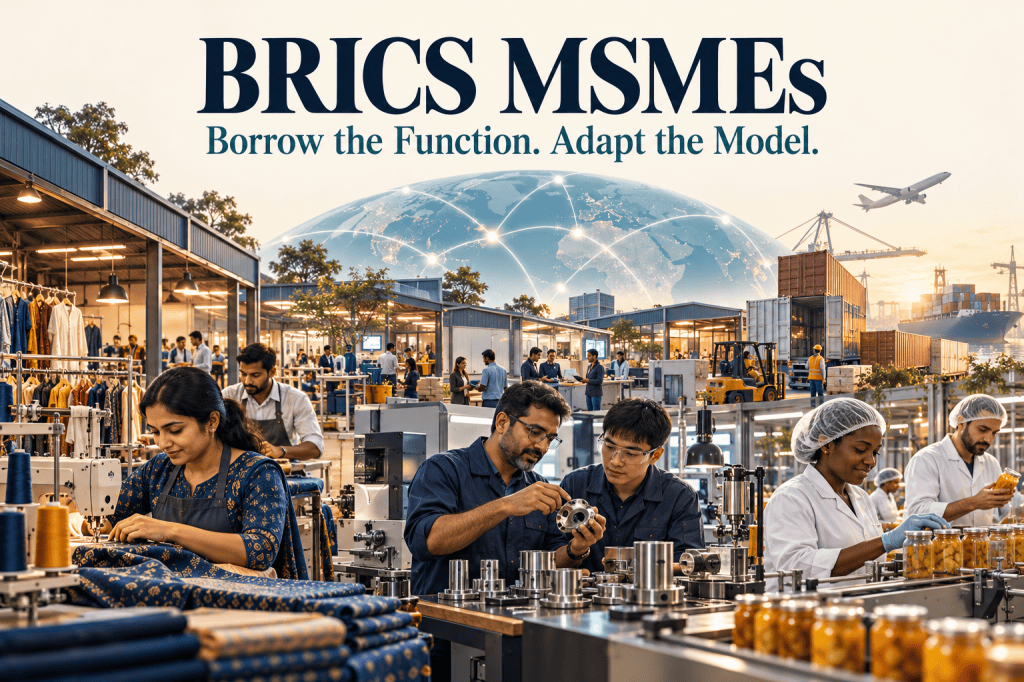
BRICS MSMEs: Borrow the Function, Question the Model


Leave a Reply