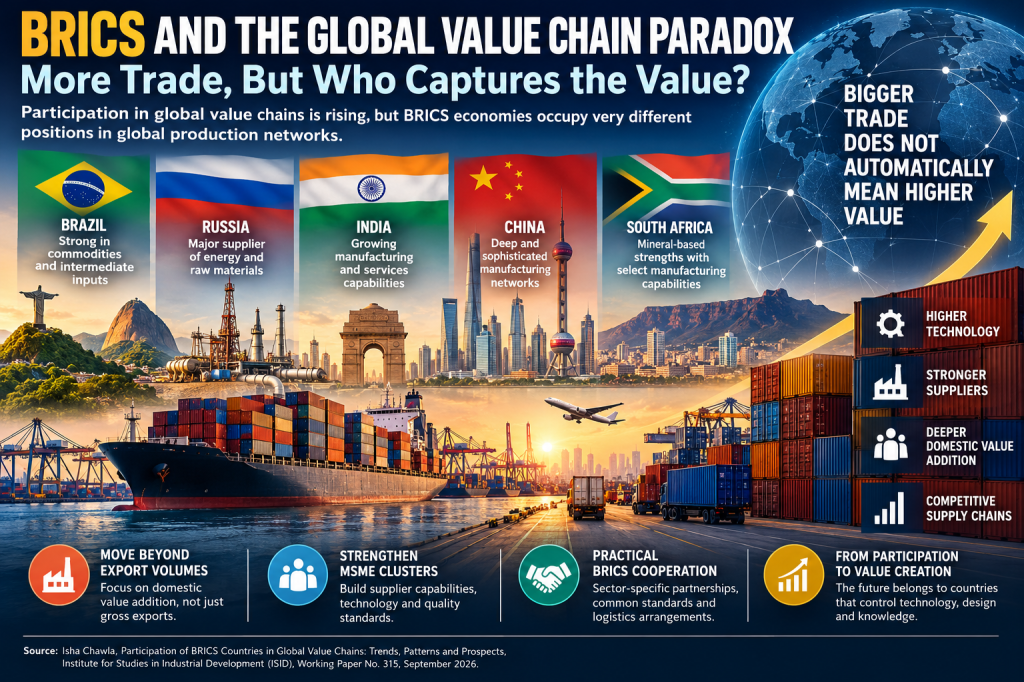
More Trade, But Who Captures the Value?
Why the future of BRICS will depend less on the volume of trade among its members and more on who controls technology, production, design and value addition.
The Rise of BRICS: Economic Size Is Not Industrial Power
The emergence of BRICS represents one of the most important changes in the global economic landscape since the end of the Cold War. For decades, international production networks were largely organised around advanced industrial economies, with developing countries participating as suppliers of raw materials, inexpensive labour and intermediate goods. Globalisation gradually changed this arrangement, but it did not necessarily change who controlled the most profitable parts of production.
BRICS was expected to challenge this historical imbalance. Its members collectively possess enormous markets, natural resources, industrial capacity, technological capabilities and expanding consumer demand. Yet an important question remains unanswered: Can BRICS transform its economic weight into collective industrial competitiveness, or will it remain a grouping of economies occupying very different positions in global production networks?
The September 2026 working paper Participation of BRICS Countries in Global Value Chains: Trends, Patterns and Prospects, by Isha Chawla of the Institute for Studies in Industrial Development (ISID), provides an important basis for examining this contradiction.
The central message emerging from the comparative analysis is that BRICS countries do not participate in global value chains in the same way. Some supply primary commodities and intermediate inputs, while others have developed extensive manufacturing networks. Their participation rates may appear impressive, but these figures reveal little about who captures the highest value.
This distinction is fundamental. A country can become deeply integrated into international trade without becoming technologically advanced, economically independent or industrially competitive.
The Historical Mistake: Confusing Participation with Development
The history of globalisation demonstrates that participation in international production is not automatically a route to prosperity.
During the nineteenth century, many developing economies supplied agricultural commodities, minerals and other primary products to industrialising Europe. They were connected to global markets, but the more profitable activities of processing, machinery manufacturing, finance, shipping and marketing remained concentrated elsewhere.
The second half of the twentieth century introduced a different model. Japan, followed by South Korea, Taiwan and eventually China, demonstrated that participation in international production could become a mechanism for industrial transformation. Their success, however, did not come simply from exporting more. It emerged from a gradual movement into increasingly sophisticated production activities.
China provides perhaps the most striking example. Its early integration into global manufacturing relied heavily on labour-intensive assembly, imported components and foreign investment. Over time, domestic supplier networks, engineering capabilities, infrastructure and technological investment helped it expand into more sophisticated activities.
The critical lesson is that global value chains become engines of development only when countries use participation to acquire capabilities that allow them to perform higher-value tasks.
This is precisely where the BRICS comparison becomes important.
The Hidden Geography of BRICS Production
Global value chains are commonly examined through two forms of participation.
Backward participation measures the foreign value added embodied in a country’s exports. It indicates the extent to which exported products depend on imported inputs, components and services.
Forward participation measures the domestic value added that enters other countries’ exports. It captures the role of an economy as a supplier of inputs used in production elsewhere.
Neither measure is inherently superior. A high forward participation rate may reflect sophisticated intermediate manufacturing or the export of raw materials. Similarly, high backward participation may indicate technological dependence, but it may also reflect efficient integration into advanced manufacturing networks.
The real question is what activities an economy performs within these networks.
China has developed extensive industrial ecosystems encompassing components, machinery, electronics, chemicals and increasingly sophisticated manufacturing. India has important capabilities in pharmaceuticals, engineering, automobiles and knowledge-intensive services, but its manufacturing integration remains uneven across sectors and enterprise sizes.
Brazil and Russia have significant natural-resource and intermediate-input strengths, although their industrial structures differ considerably. South Africa combines mineral-based activities with selected manufacturing capabilities, including automotive production.
The enlarged BRICS grouping introduces further diversity through economies with different combinations of energy resources, logistics advantages, industrial ambitions and consumer markets.
Consequently, the idea of BRICS as a unified manufacturing bloc is economically misleading.
Its members are not simply complementary partners. They are also competitors, often dependent on the same international technologies, buyers, financial institutions and export markets.
The Value Capture Problem: Exporting More Can Still Mean Earning Less
If export volumes double without a corresponding improvement in domestic technological and supplier capabilities, the economy may remain dependent on imported components and foreign expertise.
This is why gross export growth alone is an inadequate indicator of industrial success.
There is also a deeper issue. Domestic value added does not automatically mean domestic ownership of profits or technological control. A foreign-owned enterprise may generate substantial domestic wages and production value while retaining strategic decision-making, intellectual property and profits within its multinational network.
Future industrial policy must therefore examine three distinct dimensions: domestic value addition, domestic capability development and the distribution of economic gains.
India’s BRICS Opportunity: From Manufacturing Locations to Manufacturing Ecosystems
For India, the implications are particularly significant.
India has increasingly pursued industrial development through production-linked incentives, infrastructure investment, industrial corridors, electronics manufacturing programmes and export promotion.
These initiatives can create production capacity, employment and market access. However, expanding manufacturing facilities is not the same as developing an integrated industrial ecosystem.
A large electronics assembly plant may generate impressive exports while depending heavily on imported semiconductors, displays, specialised materials and precision components.
Similarly, automotive production may expand without domestic suppliers acquiring the engineering capabilities required for electric powertrains, advanced sensors, power electronics and embedded software.
The central challenge is therefore not merely attracting factories. It is developing the domestic capabilities surrounding those factories.
India’s industrial strategy must gradually move from measuring investment commitments and export volumes to measuring supplier upgrading, technological learning, engineering employment and domestic value retention.
This requires a fundamental change in how industrial success is evaluated.
The Missing Middle: Why MSME Clusters Matter More Than Industrial Megaprojects
India’s greatest opportunity to improve its position in global value chains may lie outside its largest industrial investments.
It lies in thousands of small and medium enterprises operating in engineering, electronics, pharmaceuticals, textiles, automotive components, food processing and specialised manufacturing clusters.
These enterprises represent the potential foundation of deeper domestic supply chains. Yet many remain excluded from higher-value international production because they lack advanced testing facilities, internationally recognised certifications, product-development capabilities, affordable finance and direct relationships with global buyers.
Industrial policy has frequently concentrated on attracting anchor investors while assuming that domestic supplier networks will emerge automatically.
Historical experience suggests otherwise.
Supplier development requires deliberate coordination among manufacturers, technology institutions, testing laboratories, financial organisations and industrial associations.
For example, an electronics cluster needs more than assembly units. It requires component suppliers, design facilities, reliability-testing laboratories, precision-tooling capabilities, technical training and mechanisms for joint product development.
An automotive cluster needs suppliers capable of meeting evolving quality, traceability and engineering requirements.
A textile cluster needs design, advanced processing, sustainability compliance, technical textiles and direct market intelligence rather than relying exclusively on low-cost production.
The future competitiveness of Indian manufacturing will increasingly depend on the depth of its supplier ecosystems rather than the size of its industrial estates.
Can BRICS Build Its Own Production Networks?
BRICS has an important opportunity to develop more diversified international production relationships.
Its members possess complementary strengths in energy, minerals, agriculture, pharmaceuticals, engineering, manufacturing, logistics and digital services.
In principle, these capabilities could support new cross-border value chains.
However, economic complementarity does not automatically create commercial integration.
A Brazilian producer will not purchase Indian machinery simply because both countries belong to BRICS. An Indian electronics manufacturer will not switch suppliers unless alternatives satisfy requirements relating to price, quality, reliability, certification and delivery.
Political declarations cannot substitute for functioning supply chains.
Meaningful BRICS industrial cooperation would therefore require sector-specific arrangements involving common testing protocols, recognised standards, supplier databases, logistics coordination, technology partnerships and predictable trade procedures.
Consider pharmaceuticals. Cooperation could extend beyond finished medicines into active pharmaceutical ingredients, specialised chemicals, packaging technologies, laboratory equipment and regulatory testing.
In renewable energy, collaboration could connect critical minerals, processing technologies, electrical machinery, batteries, power electronics and recycling capabilities.
In agricultural machinery, members could establish supplier partnerships around affordable mechanisation, irrigation equipment, precision agriculture and equipment servicing.
Such initiatives would convert broad diplomatic cooperation into commercially measurable industrial relationships.
The New Geopolitics: BRICS Is Not Immune to Fragmentation
The global trading system is entering a period in which geopolitical considerations increasingly influence investment, technology access and supply-chain decisions.
Export controls, industrial subsidies, sanctions, investment screening and technological restrictions are changing the economics of international production.
BRICS countries may seek greater cooperation partly to reduce vulnerabilities associated with these developments.
Yet the grouping itself contains substantial structural contradictions.
Its members have different geopolitical relationships, industrial priorities, technology dependencies and competitive interests. Some rely heavily on Western consumer markets. Others depend on international finance, advanced manufacturing equipment or foreign technological ecosystems.
These differences make the emergence of a self-contained BRICS production system unlikely in the foreseeable future.
Nor would complete separation necessarily be economically desirable.
The more realistic opportunity is to create additional production options while maintaining commercially beneficial relationships with existing global networks.
For India, this means diversification without isolation.
The objective should not be replacing one form of international dependence with another. It should be developing enough technological, supplier and market capabilities to reduce vulnerability to disruptions originating anywhere.
The Data Problem: What Global Value Chain Statistics Cannot Tell Us
The ISID paper also raises an important methodological issue.
International input-output statistics provide valuable information about the structure of production and trade. However, they generally operate with significant time lags and broad sector classifications.
They cannot fully reveal differences between large multinational corporations and small domestic enterprises.
They may also conceal variations in technology ownership, product sophistication, regional production capabilities and the distribution of profits.
For example, two countries may record similar domestic value-added shares in electronics exports while possessing very different engineering and technological capabilities.
One may specialise in routine assembly using imported designs. The other may produce advanced components and control critical manufacturing processes.
Aggregate statistics alone cannot adequately distinguish these situations.
Future GVC analysis therefore needs to combine trade-in-value-added indicators with enterprise-level evidence, supplier relationships, technology capabilities and cluster-level information.
This is particularly important for India, where industrial performance varies sharply across regions and enterprise categories.
The Next Frontier: Measuring the Tasks Countries Control
The next generation of industrial competitiveness will be determined not only by what countries manufacture but by the tasks they can perform independently and competitively.
These tasks include product design, materials engineering, component development, precision manufacturing, software integration, testing, certification, branding, distribution and after-sales services.
Artificial intelligence, automation, advanced materials and digital manufacturing may further alter the distribution of value across these activities.
Routine assembly could become less labour-intensive, while engineering knowledge, production software, data systems and specialised services become increasingly important.
This creates a serious challenge for countries relying primarily on inexpensive labour as their international competitive advantage.
India must anticipate this transition.
Its industrial clusters need to evolve from concentrations of production units into networks of technological learning, specialised services and collaborative innovation.
The government should establish sector-specific value-chain dashboards tracking domestic value added, imported-input dependence, supplier qualification, technology adoption and movement into more sophisticated production tasks.
These dashboards should become instruments of policy decisions rather than statistical reporting exercises.
Incentives should increasingly reward verified supplier development and technological upgrading, while public support for common facilities should be linked to measurable enterprise adoption and commercial outcomes.
BRICS 2035: Three Possible Futures
The coming decade could produce three different outcomes for BRICS participation in global value chains.
In the first scenario, BRICS remains primarily a diplomatic and commercial grouping. Trade expands, but production structures change slowly. Resource-rich economies continue supplying commodities, while manufacturing remains concentrated in a few established industrial centres.
In the second scenario, selective cooperation develops in pharmaceuticals, energy, agricultural equipment, minerals processing and digital services. Bilateral and regional supplier relationships deepen, but broader integration remains limited by differences in standards, infrastructure and industrial competitiveness.
In the third and more transformative scenario, BRICS members establish commercially credible production partnerships supported by technology collaboration, supplier upgrading, interoperable standards and reliable logistics.
Under this scenario, countries would gradually acquire more sophisticated production tasks, increasing their domestic value addition and reducing excessive dependence on a narrow set of global suppliers.
The third scenario offers the greatest development potential, but it also requires the strongest institutional capabilities.
It cannot emerge through declarations alone.
The Final Question: Will BRICS Become a Production Power or Remain a Trading Association?
The most important contribution of Isha Chawla’s September 2026 study is its challenge to the assumption that BRICS economies constitute a coherent production bloc merely because they belong to the same international grouping.
Their positions within global value chains differ significantly. Their development opportunities are therefore equally diverse.
For India, the lesson is clear.
The country must stop treating export expansion, foreign investment and aggregate GVC participation as sufficient evidence of industrial transformation.
The more meaningful questions are whether domestic enterprises are acquiring advanced capabilities, whether smaller suppliers are entering sophisticated production networks, whether technological dependence is declining and whether a greater share of value is retained within the domestic economy.
BRICS cooperation can support this transformation, but it cannot replace domestic industrial upgrading.
Ultimately, the global economy will not be divided simply between countries that participate in international production and those that remain outside it.
It will increasingly be divided between economies that control critical technologies, capabilities and production decisions and those that remain dependent on decisions made elsewhere.
The future of BRICS will not be decided by how much its members trade with the world, but by how much value, knowledge and industrial capability they create and retain through that trade.
And for India, the real ambition should not be to become merely a larger participant in global value chains. It should be to become an economy capable of shaping them.
Research foundation: Isha Chawla, Participation of BRICS Countries in Global Value Chains: Trends, Patterns and Prospects, ISID Working Paper No. 315, September 2026. This is an original analytical interpretation based on the study summary supplied. The forward-looking scenarios and policy proposals are independent analysis, not findings attributed to the author.


Leave a Reply