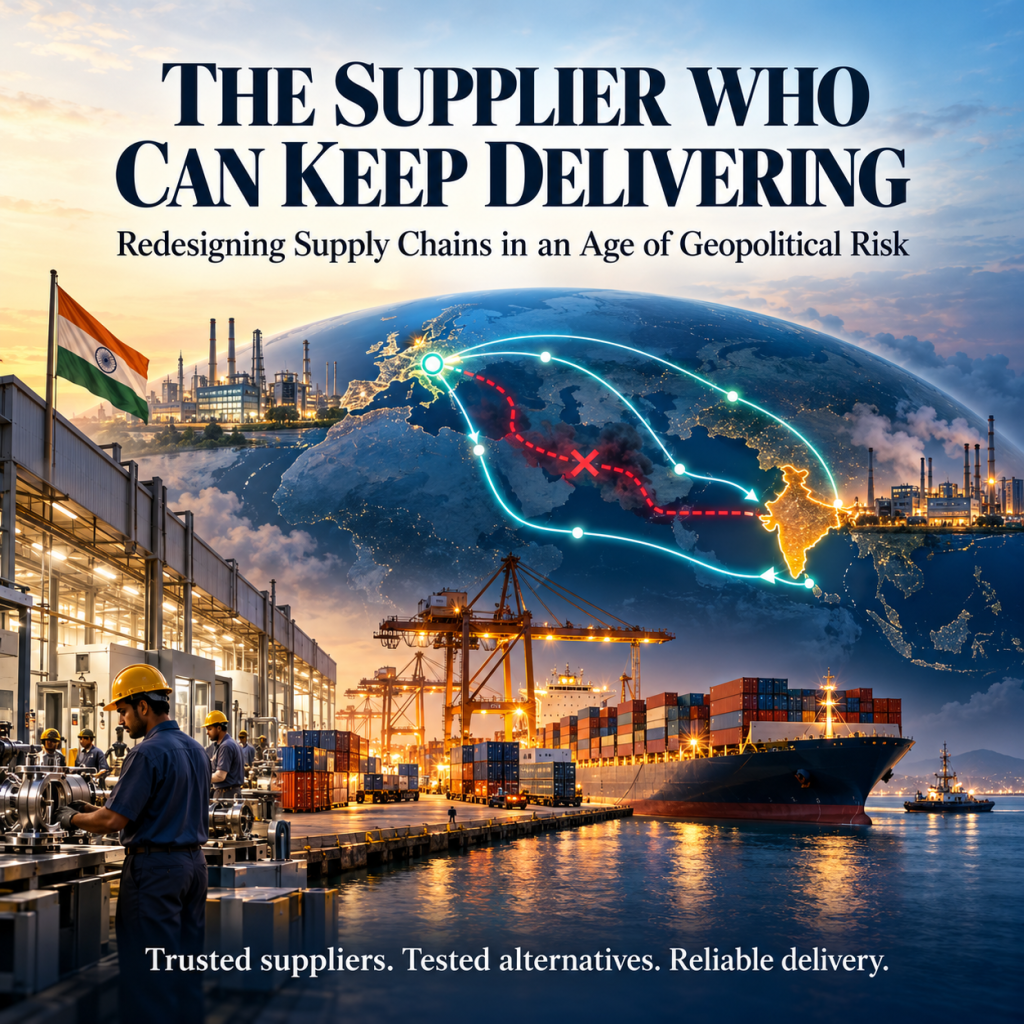
Europe’s supply-chain redesign and the next challenge for Indian export clusters
A factory can offer an excellent product at a competitive price and still become a risky supplier. Its weakness may lie in one imported component, one overseas customer, one transport route or one document it cannot produce. When that weakness interrupts delivery, years of cost efficiency can disappear within weeks.
This is the commercial question behind Europe’s changing supply chains: how much is a low price worth if the next order cannot be delivered?
The European Investment Bank and European Commission’s DG GROW study, Redesigning Supply Chains: EU Firms in a Time of Geopolitical Risk, published on 17 September 2026, documents a significant shift. Drawing on two 2025 surveys, it finds that tariffs and regulatory requirements have overtaken logistics disruptions and input shortages as prominent trade barriers. Firms are moving beyond emergency stockpiling towards diversification of suppliers and trading partners. Geopolitical uncertainty is increasingly shaping business strategy.
From managing shipments to managing exposure. The familiar logic of international sourcing rewarded specialisation, scale and low costs. Production could be spread across countries as long as the savings outweighed transport and coordination costs. That logic remains valuable, but firms must now give greater weight to whether a sourcing relationship will remain commercially workable when trade rules change.
A warehouse can provide protection against a delayed shipment. It cannot, by itself, resolve a new restriction on market access or establish the origin of an inadequately documented input. Different disruptions require different responses. Buying more stock is useful only when the stock addresses the actual vulnerability.
For Indian exporters, the implication is substantial. European buyers seeking alternatives may create new opportunities, but attracting an enquiry and becoming an approved supplier are separate achievements. A buyer needs confidence in quality, documentation, production capacity and continuity. An attractive quotation begins that conversation; evidence sustains it.
Preparedness is a claim until it is tested. The EIB reports that 64% of EU firms consider themselves prepared for geopolitical risks. However, preparedness varies sharply by size: the proportion reaches 73% among the largest businesses and falls below half among SMEs. These are firms’ own assessments, which should not be confused with demonstrated performance during disruption.
A company may have an alternative supplier on a spreadsheet without having tested its material. It may have a continuity plan without knowing whether its bank will finance a more expensive emergency purchase. It may identify another shipping route without checking whether the buyer can accept the revised delivery date.
Useful preparedness therefore requires practical answers. How long would switching take? Which approvals would be needed? Who would authorise the extra expenditure? How many days could production continue before the missing input stopped the line?
These questions reveal more than a declaration that the firm is ready.
Diversification must reach beneath the invoice. Buying from three suppliers does not necessarily provide three independent sources of security. All three may depend on the same upstream producer, use the same port or source a critical material from the same country. The number of supplier names can rise while the underlying exposure remains unchanged.
Indian export clusters should begin with a manageable map of their most consequential dependencies. Which inputs could stop production? Which customers account for a large share of sales? Which materials have long replacement times? Where would an alternative require fresh testing or buyer approval?
The first exercise need not be an expensive digital platform. A carefully maintained record of critical inputs, supplier locations, delivery times and approved substitutes could expose weaknesses that routine purchase accounts conceal. Technology becomes useful when it improves decisions about those weaknesses.
The cluster can make continuity affordable. Individual MSMEs may struggle to investigate alternative suppliers, interpret changing requirements or finance trial batches. Cluster institutions can organise some of this work collectively.
An engineering cluster could coordinate testing of alternative materials. An apparel cluster could help firms qualify additional fabric and accessory sources. A food-processing cluster could develop shared testing arrangements and alternative packaging options. Firms would retain responsibility for their own contracts, while gaining access to services they could rarely sustain alone.
This also requires care. A shared facility can itself become a common point of failure. Collective arrangements should include backup capacity, clear service responsibilities and safeguards for confidential commercial information. Cooperation should reduce exposure rather than concentrate it in a new institution.
Who pays for a more dependable supply chain? Resilience has costs. Qualifying a second supplier takes staff time and testing expenditure. Keeping selected reserves ties up working capital. Maintaining complete records requires disciplined processes.
If buyers demand these investments while awarding contracts entirely on the lowest immediate price, smaller suppliers face a difficult choice. They may absorb costs they cannot sustain or provide assurances they cannot fulfil.
A more workable relationship would connect continuity requirements with commercial commitments: longer order visibility, contributions towards qualification costs, agreed procedures for exceptional cost changes or purchasing commitments that support supplier investment. Dependability needs a business model.
Public support should purchase demonstrated capability. Resilience grants should start with a specific vulnerability and a measurable improvement. Funding could help a firm qualify an alternative input, test a backup production arrangement or complete a simulated disruption exercise. Success should be assessed through shorter switching times, fewer unprotected dependencies and stronger delivery performance.
Generic inventory subsidies offer weaker assurance. They can reward expenditure without establishing whether the additional stock protects production. For some inputs, carefully sized reserves are sensible. For others, faster substitution, better documentation or access to emergency finance may provide greater protection.
European findings also need careful adaptation. Indian MSMEs operate with different financing conditions, bargaining power and institutional support. The surveys provide useful descriptive evidence; they do not establish which intervention will deliver the best results in every Indian cluster. Local pilots and measured outcomes should guide expansion.
The next export advantage will have to survive disruption. India’s opportunity is to make its production networks easier for buyers to understand and more dependable under pressure. That requires investment in the less visible foundations of trade: supplier qualification, technical records, working capital, alternative inputs and tested decisions.
The decisive question for an export cluster is becoming more demanding than how much it can produce.
How much can it still deliver when its most important assumption fails?


Leave a Reply