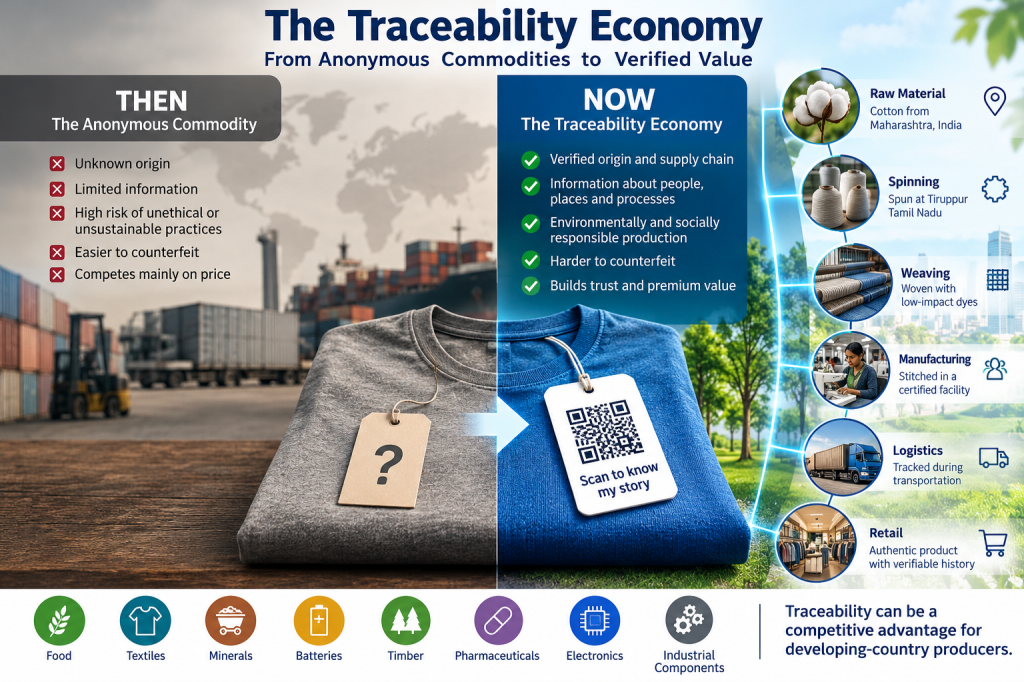
The End of the Anonymous Commodity
For centuries, international trade operated on a relatively simple principle: buyers were primarily interested in what a product was, how much it cost, and whether it met the required quality standards. Where the raw materials originated, who processed them, how workers were treated, and what environmental damage occurred along the way were often secondary concerns.
That economic model is beginning to change.
The next generation of global trade may not allow products to remain anonymous. A cotton shirt, a lithium battery, a pharmaceutical ingredient, a wooden chair, or an electronic component may increasingly need to carry a verifiable history of its journey from raw material to finished product.
This represents something much larger than another regulatory requirement. It signals the emergence of a new economic system in which information about a product becomes part of the product’s commercial value.
The traditional commodity economy rewarded producers for delivering acceptable quality at competitive prices. The emerging traceability economy will increasingly reward those who can also demonstrate origin, authenticity, environmental responsibility, production conditions, and supply-chain integrity.
The future competition may therefore be between products that merely exist and products that can explain their existence.
From Industrial Secrecy to Supply-Chain Visibility
The historical evolution of industrial production helps explain this transformation.
During the Industrial Revolution, manufacturers competed through mechanisation, scale, access to raw materials, and lower production costs. The twentieth century added mass production, standardisation, branding, and global distribution.
Globalisation subsequently separated production into multiple countries. Cotton could be grown in India, spun into yarn elsewhere, converted into fabric in another economy, stitched into garments in a fourth country, and sold in Europe or North America.
This fragmentation reduced costs and expanded international trade. However, it also created an enormous information gap.
A company selling a finished product often knew its immediate supplier but had limited visibility into the earlier stages of production.
Global value chains became economically integrated but informationally fragmented.
For decades, this weakness remained manageable because markets largely trusted declarations, certificates, supplier relationships, and periodic inspections.
That arrangement is becoming increasingly inadequate.
Concerns about forced labour, deforestation, counterfeit medicines, conflict minerals, carbon emissions, unsafe production, and environmental degradation have increased pressure for more credible supply-chain information.
Digital technologies are also making previously invisible production histories easier to record, connect, and verify.
The result is a gradual movement from a global economy organised around the physical movement of goods towards one increasingly dependent on the parallel movement of trusted information.
The Product Is Becoming a Data Carrier
Consider the future of a simple cotton shirt.
Its commercial identity may eventually include the geographical origin of cotton, the location of spinning and weaving, chemical treatments, water consumption, energy sources, labour-related information, recycled content, and the environmental characteristics of manufacturing.
Similarly, a battery may need to disclose information about mineral sourcing, processing, carbon footprint, recycled materials, and end-of-life recovery.
Food products may carry farm-level information concerning pesticides, processing, storage temperatures, and transportation.
Timber may require evidence connecting harvesting locations with legal sourcing and forest-management requirements.
Pharmaceutical companies already operate under extensive systems of batch identification, manufacturing records, and product verification. These systems may become more integrated across international supply chains.
Industrial machinery and electronic components may increasingly require documentation establishing component origin, technical conformity, material composition, and manufacturing history.
Not every product will require the same information. Requirements will differ across industries and markets. Nevertheless, the direction is becoming clearer.
The physical product and its digital identity are gradually becoming inseparable.
This transformation could redefine what buyers understand by quality.
A product may be technically excellent but commercially disadvantaged if its manufacturer cannot provide credible information about its production history.
In sophisticated markets, an undocumented product may increasingly be treated as a higher-risk product.
The New Geography of Economic Trust
The traceability economy could produce an unexpected change in international competitiveness.
Traditionally, developing countries competed through inexpensive labour, abundant raw materials, and lower manufacturing costs.
Developed economies controlled a larger share of branding, technology, finance, distribution, and customer relationships.
Traceability introduces another dimension: the capacity to produce reliable and internationally acceptable information.
Countries that develop this capability may gain stronger positions in global value chains.
Countries that fail may discover that their products remain physically competitive but become commercially difficult to sell.
This creates a new form of economic inequality.
Large multinational corporations can invest in digital systems, enterprise software, certification, testing laboratories, and specialised compliance teams.
Small producers frequently operate through informal transactions, fragmented subcontracting, handwritten records, and limited digital infrastructure.
A small garment exporter may manufacture excellent products but struggle to establish the origin of every input.
A furniture producer may know the timber supplier but lack reliable documentation of the original harvesting location.
A small food-processing enterprise may maintain acceptable quality but lack integrated farm-to-market records.
The problem is not necessarily poor production. It is insufficiently documented production.
The next global divide may therefore be between traceable and untraceable producers, rather than simply between developed and developing countries.
This distinction has major implications for international development policy.
Traceability Can Become a New Non-Tariff Barrier
The emerging system contains an important contradiction.
Traceability can improve transparency, reduce fraud, protect consumers, and support environmental responsibility. Yet the same requirements can also become expensive barriers to market entry.
Every additional documentation obligation imposes costs.
Firms may need digital identification systems, laboratory tests, supplier verification, audits, training, software subscriptions, and specialised personnel.
For large companies, these costs can be distributed across substantial production volumes.
For smaller enterprises, they may represent a significant share of operating margins.
There is also a danger that importing countries will develop incompatible traceability requirements.
A producer supplying three major international markets could face different reporting formats, verification standards, data platforms, and certification procedures.
The resulting fragmentation may benefit large firms while excluding smaller competitors.
This raises a fundamental policy question.
Will traceability become an instrument for making international trade more trustworthy, or will it evolve into another mechanism through which powerful markets control access to global value chains?
The answer will depend heavily on international interoperability, mutual recognition, proportional compliance requirements, and affordable verification systems.
Transparency should not become a privilege available only to firms large enough to purchase it.
From Compliance Cost to Competitive Advantage
The most important opportunity lies in changing how developing countries approach traceability.
If treated merely as a foreign regulatory requirement, it will become another compliance expense.
If developed as a productive capability, it could generate substantial economic value.
Consider India’s agricultural economy.
Millions of farmers produce products with distinctive geographical, climatic, and cultural characteristics. Yet these attributes are often lost when produce passes through multiple intermediaries.
A reliable traceability system could connect agricultural products with their geographical origins, farming practices, processing methods, and quality characteristics.
This could strengthen differentiation, improve market access, and support premium positioning where buyers recognise these attributes.
Similar opportunities exist in Indian textiles, handlooms, handicrafts, leather products, spices, essential oils, pharmaceuticals, engineering goods, and traditional products.
A traceable handwoven textile can communicate not only its material composition but also its weaving cluster, production technique, and authenticity.
A traceable spice can demonstrate its origin, processing history, and quality verification.
A traceable engineering component can establish its manufacturing batch, technical specifications, and inspection history.
For geographical indication products, traceability could become particularly valuable.
A GI registration establishes a recognised link between a product and its geographical origin. However, registration alone does not necessarily ensure that every product sold under that identity is authentic.
Digital traceability, combined with credible physical verification, could help close this gap.
It could convert geographical reputation into a stronger commercial asset.
The opportunity is to move from selling anonymous products to selling verified identity, quality, and origin.
The Cluster Will Become the Natural Unit of Traceability
One of the greatest mistakes would be expecting every MSME to establish a complete traceability infrastructure independently.
Small firms cannot efficiently duplicate expensive digital platforms, laboratories, certification systems, and specialist services.
This is where industrial clusters acquire renewed importance.
A cluster is not simply a geographical concentration of enterprises. It can become a shared institutional system through which firms access capabilities that would otherwise remain unaffordable.
Textile clusters such as Tiruppur, Surat, Ludhiana, Panipat, and Bhiwandi could develop common systems for tracking fibres, yarn, fabric processing, chemical inputs, and production batches.
Food-processing clusters could establish integrated farmer registration, raw-material identification, laboratory testing, storage monitoring, and processing records.
Engineering clusters could develop common component identification, material certification, testing, and supplier-verification services.
Handloom and handicraft clusters could combine artisan identification, geographical authentication, production records, and digital product histories.
These systems should not be designed as isolated databases.
They should connect suppliers, manufacturers, testing agencies, logistics providers, exporters, and buyers through interoperable information standards.
Cluster associations, producer organisations, common facility centres, and specialised service providers could become important institutional intermediaries.
The economics are compelling.
When the cost of verification infrastructure is shared across hundreds or thousands of enterprises, the cost per producer can decline substantially.
A cluster-based approach can also improve data consistency and create stronger incentives for collective reputation management.
The future industrial cluster may be defined as much by its shared information infrastructure as by its shared physical infrastructure.
The Rise of a New Traceability Services Industry
The traceability economy will not merely transform existing manufacturing. It could create an entirely new generation of service businesses.
Digital product identification, supply-chain mapping, testing, certification, sustainability accounting, data verification, product authentication, and lifecycle documentation may become increasingly important commercial activities.
Artificial intelligence could help identify inconsistent supplier records, detect unusual transactions, analyse sourcing risks, and reduce the administrative burden of documentation.
Digital platforms could connect information across production stages.
Sensors and connected equipment could capture manufacturing and environmental data automatically.
Blockchain-based systems may be useful in selected applications requiring shared, tamper-evident records, although they cannot independently establish whether the original information was truthful.
This distinction is critical.
A digital record is not automatically a trustworthy record.
False information entered into a sophisticated platform remains false information.
The real economic value will therefore lie in combining digital infrastructure with credible verification, institutional accountability, and physical evidence.
For developing countries, this opens opportunities to build domestic industries around traceability technologies and services.
India could potentially become both a major user and an exporter of affordable traceability solutions, particularly for fragmented supply chains and MSME-intensive industries.
Its experience with digital public infrastructure, combined with its large industrial and agricultural base, provides a possible foundation.
However, that opportunity will require deliberate investment in standards, interoperability, data protection, verification capacity, and industry-specific applications.
Who Will Own the Product’s Information?
A deeper question is emerging beneath the discussion of traceability.
Who will control the information generated by millions of producers?
A small manufacturer may be required to disclose extensive details about suppliers, processes, costs, inputs, and production practices.
That information could be stored on platforms controlled by international buyers, technology companies, certification agencies, or dominant intermediaries.
Over time, these organisations could accumulate valuable intelligence about production networks, supplier capabilities, pricing structures, and commercial relationships.
The manufacturer may supply the data without retaining meaningful control over how it is used.
This could create a new asymmetry in global value chains.
Developing countries may continue supplying physical products while foreign platforms capture the economic value of production information.
Traceability policy must therefore address data ownership, confidentiality, portability, cybersecurity, and commercial rights.
The objective should be to establish trustworthy product histories without forcing smaller suppliers to surrender unnecessary commercially sensitive information.
The danger is that the producer becomes transparent while the platform controlling the producer’s information remains economically opaque.
India’s Opportunity: Build the Infrastructure Before the Obligation
India has a narrow but important strategic opportunity.
Instead of responding separately to every new foreign regulation, the country could develop a common national framework supporting traceability across multiple sectors.
Such a framework need not become one centralised database.
A more practical approach would involve interoperable standards, secure digital identities, recognised verification mechanisms, sector-specific data requirements, and shared infrastructure accessible to MSMEs.
Industrial clusters could serve as implementation laboratories.
Government support should focus less on subsidising individual certificates and more on financing durable institutional capabilities.
Common testing facilities, digital supplier registries, affordable software, training systems, and internationally recognised verification services could deliver benefits across thousands of enterprises.
Export promotion agencies should also change their approach.
Trade promotion cannot remain limited to exhibitions, buyer meetings, and marketing assistance.
It must increasingly help producers establish the information credibility required to participate in international markets.
A practical starting point would be to select major export clusters and develop traceability readiness assessments, common data standards, shared verification facilities, and measurable adoption programmes.
The performance indicator should not simply be the number of enterprises trained.
It should include the proportion of firms maintaining usable records, the percentage of production batches traceable to required stages, the cost of verification per unit, and improvements in buyer acceptance.
The challenge is not to create another scheme.
It is to build an economic capability.
The Future: Products Will Compete Through Their Histories
Over the next decade, traceability could become an increasingly important feature of international trade.
Its expansion will not be uniform. Some industries will move rapidly because of regulation, safety requirements, or buyer pressure. Others will adopt traceability more gradually as digital systems become affordable and commercial benefits become clearer.
Three broad futures are possible.
In the first, traceability becomes an expensive compliance system dominated by large corporations and sophisticated importing markets. Smaller producers face rising costs and greater exclusion.
In the second, countries develop fragmented national systems that increase paperwork without generating reliable information or meaningful market benefits.
In the third, interoperable and affordable traceability systems become shared economic infrastructure. Small producers gain credibility, buyers reduce uncertainty, consumers receive more reliable information, and developing countries capture greater value from their products.
The third outcome is possible, but it will not emerge automatically.
It requires cooperation between governments, industry associations, technology providers, standards institutions, and international buyers.
Most importantly, it requires recognising that traceability is not merely a technical exercise.
It is becoming part of the architecture of economic power.
The Final Question: Who Captures the Value of Trust?
The twentieth-century industrial economy was largely organised around the ability to manufacture products efficiently.
The early twenty-first century increasingly rewarded the ability to coordinate global supply chains.
The next phase may reward the ability to establish trustworthy, verifiable, and commercially useful information about everything moving through those chains.
This creates a profound opportunity for developing economies.
A small producer with a distinctive product, credible origin, verified quality, and reliable production records may be able to compete on attributes that go beyond price.
But a producer without access to affordable verification infrastructure may find that even excellent products struggle to enter demanding markets.
The real question is therefore not whether traceability will expand. The more consequential question is who will own the systems, who will bear the costs, and who will capture the value created by greater transparency.
For India and other developing countries, the objective should not be to become passive suppliers of data to global buyers.
It should be to build the institutional and technological capacity to convert verified production histories into stronger bargaining power, market access, and higher value addition.
The anonymous commodity may gradually disappear from sophisticated markets. But the greater economic transformation will occur when producers stop selling only what they manufacture and begin capturing the value of what they can credibly prove.
The future of global trade may belong not simply to those who produce efficiently, but to those who can prove what they produce, where it comes from, how it was made, and why it deserves to be trusted.
TraceabilityEconomy #GlobalTrade #MSME #IndustrialClusters #SupplyChainTransparency #DigitalTransformation #ExportCompetitiveness #MakeInIndia #SustainableManufacturing #GlobalValueChains


Leave a Reply