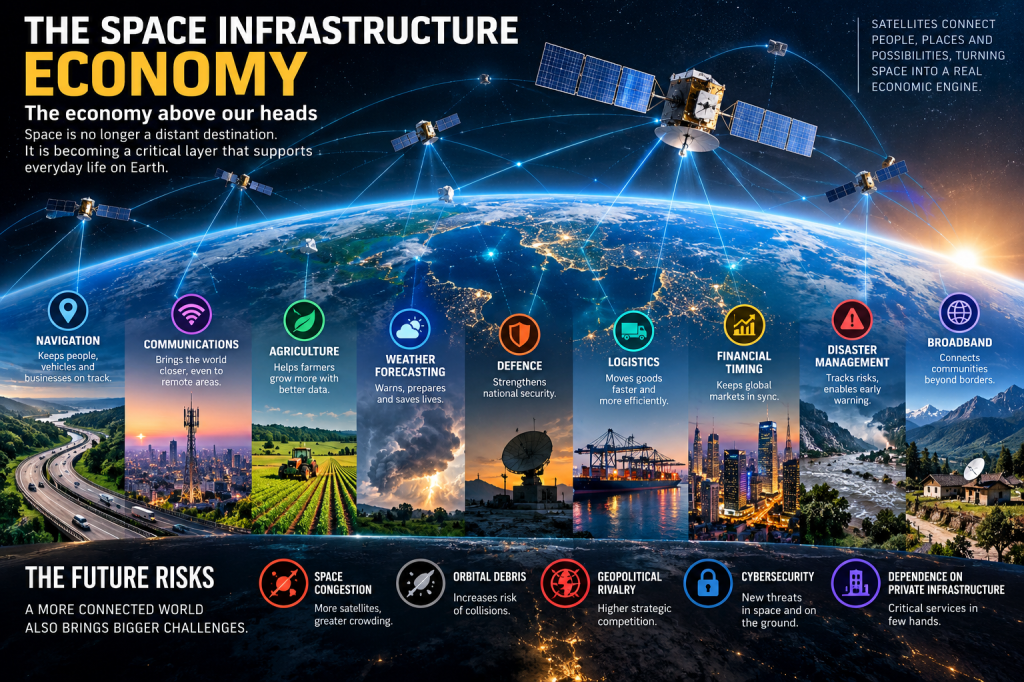
For most of human history, space was something people looked at. Today, it is something economies depend on. The change has happened so quietly that most people hardly notice it. A farmer checking rainfall, a truck finding its destination, an aircraft navigating across continents, a bank recording the exact time of a financial transaction, a government tracking a cyclone and a family using broadband in a remote village may all be using infrastructure located hundreds or thousands of kilometres above Earth. Space is no longer simply a destination. It is becoming infrastructure.
From Exploration to Infrastructure The first space age was largely about national prestige. The Soviet Union launched Sputnik in 1957. The United States responded with enormous investment in science, rockets and eventually the Moon programme. Space was closely connected with the Cold War and military power. Governments dominated because launching anything into orbit required huge amounts of money, technology and institutional capacity. But history often turns yesterday’s strategic technology into tomorrow’s ordinary infrastructure. Railways began as engineering wonders before becoming the backbone of industrial economies. Electricity moved from scientific experimentation to an essential utility. The internet began as specialised infrastructure and eventually became part of everyday economic life. Space appears to be travelling along a similar road.
The Invisible Economy Above Us The interesting thing about the space economy is that much of its economic value is actually created on Earth. Satellites support navigation, telecommunications, television, weather forecasting, agriculture, mapping, shipping, aviation, defence, disaster management and increasingly broadband connectivity. Modern logistics depends heavily on knowing where goods are. Precision agriculture increasingly depends on knowing what is happening to land, crops, moisture and weather. Financial networks require extremely accurate timing. Governments need Earth observation for everything from flood assessment to infrastructure planning. Space therefore should not be viewed simply as another industry alongside automobiles, pharmaceuticals or textiles. It is increasingly becoming an enabling layer underneath many industries.
This changes the economics completely. The important question is no longer how large the space industry itself becomes. The bigger question is how much of the wider economy becomes dependent on space infrastructure.
The Falling Cost Changes Everything Historically, the greatest barrier to the space economy was the extraordinary cost of reaching orbit. That barrier is weakening. Reusable rockets, smaller satellites, mass manufacturing, improved electronics and private launch companies are changing the economics of deployment. Instead of a small number of extremely expensive satellites designed to operate for many years, companies can now build networks containing hundreds or thousands of smaller satellites.
That sounds like progress, and much of it is. But cheaper access creates its own contradiction. When something becomes cheaper, more people use it. When more satellites are launched, orbital space becomes more crowded. The success of the space economy can therefore create one of its greatest future problems.
Orbit Is Not Infinite Space looks endless from Earth, but economically useful orbital locations are not unlimited in the same sense. Satellites must operate within particular orbital environments, communicate through limited spectrum and avoid collisions with other spacecraft and debris. Every launch potentially adds another object to an increasingly complicated traffic system.
Humanity spent two centuries discovering that oceans, forests and the atmosphere were not limitless dumping grounds. There is a danger of repeating the same mistake above Earth. Orbital debris is not simply an environmental problem. It is an economic problem. A collision can destroy valuable infrastructure and create thousands of additional fragments capable of threatening other satellites.
The future space economy may therefore require something that sounds surprisingly ordinary: traffic rules, insurance, waste management, standards, monitoring and enforcement.
Civilisation may have reached the stage where it needs municipal management for space.
Private Infrastructure, Public Dependence Another uncomfortable question is emerging. Much of the next generation of space infrastructure may be owned and operated by private companies while governments, businesses and citizens become increasingly dependent upon it.
This creates a new form of infrastructure concentration.
A country may possess roads, airports, power plants and telecommunications networks within its borders, but critical satellite services may depend on corporations headquartered somewhere else. If communication, navigation, mapping or broadband becomes concentrated among a small number of global providers, commercial decisions can acquire strategic consequences.
The future debate over sovereignty may therefore extend far beyond territory. Governments will increasingly ask who owns the satellites, who controls the data, who operates the ground stations, who writes the software and who has the power to interrupt a service.
The Cybersecurity Problem Moves Into Orbit There is another vulnerability that is easy to underestimate. Satellites are computers connected through communications networks. That means the cybersecurity problem of Earth is travelling into space.
A future conflict may not begin with missiles destroying satellites. It could begin with interference, jamming, spoofing, software attacks or disruption of ground infrastructure. The more economic activity depends on satellite systems, the greater the potential economic cost of disruption.
Resilience will therefore become as important as capability. Countries and companies will need backup navigation systems, alternative communications channels, stronger cybersecurity, distributed satellite networks and greater interoperability between systems.
Efficiency built without redundancy may eventually prove extremely expensive.
Space May Become the Next Infrastructure Divide There is also a development question. The industrial revolution divided countries partly according to their access to machinery, energy and capital. The digital revolution created another divide around computers, telecommunications and data. The space infrastructure economy could create yet another.
Countries capable of building satellites, launching them, analysing Earth observation data and integrating space services into agriculture, logistics, telecommunications and defence may gain productivity advantages. Countries that merely purchase these services may remain dependent users.
The real space race may therefore not be about planting flags on distant planets. It may be about who controls the infrastructure that improves economic activity on Earth.
For countries such as India, this creates a particularly important opportunity. The economic value of space should not be measured only by rockets and satellite manufacturing. The larger opportunity lies in connecting space technology with ordinary economic problems: crop productivity, fisheries, disaster warning, urban planning, logistics, telecommunications, mineral exploration, infrastructure monitoring and rural connectivity.
The most successful space policy may eventually be the one that makes space technology almost invisible because it becomes embedded everywhere.
The Next Industrial Geography May Include Orbit Economic geography traditionally studied ports, roads, industrial clusters, cities, energy networks and trade corridors. That map is becoming three-dimensional. Future economic geography may include terrestrial infrastructure, undersea cables, cloud infrastructure, data centres and orbital networks operating together.
Ports may communicate continuously with satellites. Autonomous vehicles may depend on satellite positioning. Farms may combine sensors, artificial intelligence and Earth observation. Insurance companies may assess risks through satellite imagery. Governments may monitor infrastructure almost continuously. Remote factories, mines and communities may obtain high-speed connectivity without waiting for traditional terrestrial networks.
In such an economy, orbital infrastructure becomes part of national competitiveness.
The Most Important Space Economy May Remain on Earth Humanity naturally gets excited about Moon bases, Mars missions and distant planets. They capture imagination. But the deeper economic transformation may be much closer.
Space is quietly becoming part of the operating system of Earth.
And that creates a strange historical reversal. Humanity once looked upward because space represented escape from Earth. Increasingly, we will look upward because everyday life on Earth depends on what is operating above us.
The great challenge of the next space age will therefore not simply be reaching farther. It will be learning how to govern, protect and share the infrastructure we place above the planet.
Because once navigation, communication, agriculture, finance, logistics, defence and disaster response depend heavily on orbital systems, space will no longer be remote.
It will be critical infrastructure.
And critical infrastructure always raises the same difficult question: what happens when society cannot function without something it does not fully control?
🚀 The Space Infrastructure Economy: The Economy Above Our Heads
Space is no longer only about rockets, astronauts and exploration. It is quietly becoming part of the basic infrastructure of the global economy.
Navigation, communications, agriculture, weather forecasting, logistics, financial timing, disaster management, defence and broadband increasingly depend on satellites.
But there is a contradiction. The more dependent we become on space, the more vulnerable we become to orbital congestion, debris, cyberattacks, geopolitical rivalry and concentration of critical infrastructure in a few private hands.
The next space race may therefore not be about who reaches the Moon or Mars first. It may be about who owns, controls and protects the infrastructure operating above Earth.
The future economic map will no longer be only about ports, roads, factories and power grids. It will extend into orbit.
Space is becoming part of the operating system of Earth.
#SpaceEconomy #SpaceInfrastructure #Satellites #DigitalEconomy #EconomicGeography #FutureEconomy #Infrastructure #Innovation #Geopolitics #India


Leave a comment