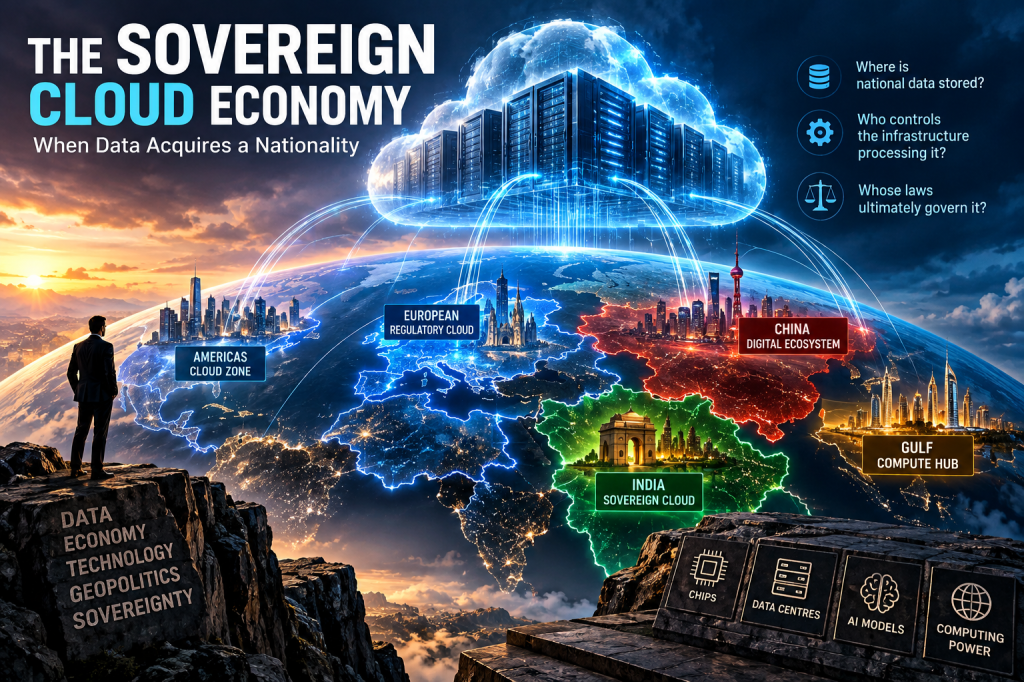
For most of economic history, sovereignty was visible. A country controlled territory, borders, ports, currencies, natural resources and strategic infrastructure. The industrial age added railways, electricity grids, telecommunications and oil pipelines to this list. The digital age is adding something far less visible but potentially just as strategic: the cloud. Governments are beginning to realise that an economy can be politically sovereign while much of its digital memory, computational capacity and technological intelligence operates through infrastructure controlled elsewhere. The emerging question is therefore no longer simply where data is stored. It is who ultimately controls the machines on which the modern economy thinks.
From Oil Dependence to Compute Dependence
The twentieth century taught governments that excessive dependence on foreign energy could become a strategic vulnerability. The twenty-first century may teach the same lesson about computing infrastructure. Banks, hospitals, manufacturers, universities, defence establishments, government departments, retailers and increasingly even small businesses depend on remote computing systems. Artificial intelligence intensifies this dependence because enormous computing capacity is required not only to store information but also to train models, process data and generate decisions.
This creates an unusual economic structure. Countries may generate enormous quantities of valuable data domestically while the infrastructure used to store, analyse and monetise that data belongs largely to corporations headquartered elsewhere. Data may be national in origin but multinational in processing.
That distinction is becoming politically important.
Data Centres Are Becoming the New Strategic Infrastructure
The first generation of the internet was built around the assumption that information should move freely across borders. Efficiency favoured global networks. Companies placed computing resources wherever scale, electricity, connectivity and cost made economic sense.
Sovereign cloud thinking introduces a different logic.
Governments increasingly ask whether sensitive public-sector, financial, health, defence or citizen data should remain within national jurisdiction. But physical location alone does not create sovereignty. A server can sit inside a country while its software architecture, encryption systems, administrative controls, intellectual property and corporate decision-making remain dependent on an overseas provider.
The real sovereign-cloud question therefore has at least three layers: where the data resides, who operates the infrastructure, and under whose law ultimate control can be exercised.
This is where a technical discussion becomes an economic and geopolitical one.
The Efficiency Paradox: Sovereignty Has a Price
The global cloud industry became powerful precisely because scale dramatically reduced computing costs. A hyperscale provider can spread investment in cybersecurity, processors, software, cooling systems and engineering talent across millions of customers.
Fragmenting this architecture into separate national systems may therefore create an economic contradiction. Governments may gain greater jurisdictional control while businesses lose some benefits of global scale.
Data-localisation requirements can encourage domestic investment in data centres and digital infrastructure, but excessive localisation can also increase compliance costs, duplicate infrastructure and complicate cross-border business. Smaller economies face an even harder problem: building genuinely independent cloud ecosystems requires enormous capital, reliable electricity, advanced cybersecurity capabilities, specialised engineers and access to sophisticated semiconductors.
Digital sovereignty without technological capability can easily become expensive digital isolation.
The Cloud Is Becoming an Industrial Policy
This is why sovereign cloud strategies should not be viewed merely as data regulations. They are gradually becoming industrial policies.
Countries and regions will increasingly compete for data centres, semiconductor capacity, cloud regions, cybersecurity firms, AI infrastructure and specialised digital talent. Energy policy will become deeply connected to cloud policy because large-scale computing requires enormous quantities of reliable electricity. Water availability, grid stability, fibre connectivity and land will increasingly influence where computational infrastructure is built.
An unexpected geography of economic power could emerge. Locations once considered peripheral to the technology economy may become strategically valuable if they possess abundant renewable electricity, reliable grids, suitable climate conditions, connectivity and political stability.
The industrial park of the twentieth century may increasingly coexist with the compute park of the twenty-first.
The Internet May Become Less Global Than Its Architecture Suggests
The deeper risk is fragmentation.
The world could gradually develop overlapping digital jurisdictions: European regulatory clouds, Chinese digital ecosystems, American hyperscale networks, Gulf-based compute hubs, Indian sovereign infrastructure and specialised national clouds for sensitive government functions.
The internet would technically remain connected, but economically it could become increasingly compartmentalised.
Companies operating internationally might therefore confront something resembling digital customs borders: different requirements for data residency, cybersecurity certification, cloud procurement, encryption, AI governance and cross-border data transfer.
The irony is striking. Globalisation reduced many physical barriers to trade just as digitalisation may be creating a new generation of invisible ones.
Artificial Intelligence Changes the Meaning of Sovereignty
AI makes the sovereign-cloud debate considerably more consequential. Data storage is relatively passive. Artificial intelligence converts data into predictions, knowledge, automation and economic power.
A country that controls its data but lacks the computing infrastructure, models and technological capabilities required to use it may possess data sovereignty without intelligence sovereignty.
This could become one of the defining development divides of the 2030s.
Historically, countries worried about whether they controlled factories producing steel, machinery, chemicals or automobiles. Future governments may ask whether they possess sufficient domestic capacity to train models, run critical algorithms and maintain essential digital services during geopolitical or commercial disruption.
Compute capacity could therefore begin to resemble electricity generation: something governments consider too fundamental to leave entirely to external dependency.
The Dangerous Illusion of Complete Digital Independence
Yet the pursuit of complete technological self-sufficiency would itself be dangerous. No major cloud ecosystem exists independently of global semiconductor supply chains, networking equipment, software libraries, undersea cables, intellectual property and specialised talent.
The practical objective should therefore not be technological autarky.
It should be strategic redundancy.
Countries need enough domestic capability to protect critical systems while retaining access to global innovation. Governments may increasingly favour hybrid architectures combining domestic infrastructure, trusted foreign providers, interoperable standards and geographically diversified backup systems.
The strongest digital economies may not be those that isolate themselves from global networks, but those that can remain connected without becoming dangerously dependent on any single external system.
From Global Cloud to Sovereign Cloud Economy
The cloud was originally sold as infrastructure without geography. Economics and geopolitics are bringing geography back.
Over the coming decade, the location of data centres, ownership of computing infrastructure, availability of advanced chips, control of AI models, access to electricity and jurisdiction over data could increasingly become parts of the same strategic equation.
This creates a new economic principle:
Data is becoming an asset. Compute is becoming infrastructure. Cloud capacity is becoming industrial power. And control over the digital stack is becoming a dimension of sovereignty.
The great competition of the industrial era was over factories, oil fields, shipping routes and financial centres. The next competition will include something far less visible: warehouses filled with servers quietly processing the information on which economies increasingly depend.
The cloud may remain invisible to ordinary citizens, but economically it is becoming territory.
And once infrastructure begins to resemble territory, nations inevitably start asking who controls it.
SovereignCloud #DigitalSovereignty #CloudComputing #ArtificialIntelligence #DataEconomy #DigitalInfrastructure #DataCentres #EconomicSovereignty #FutureEconomy #Geopolitics


Leave a comment