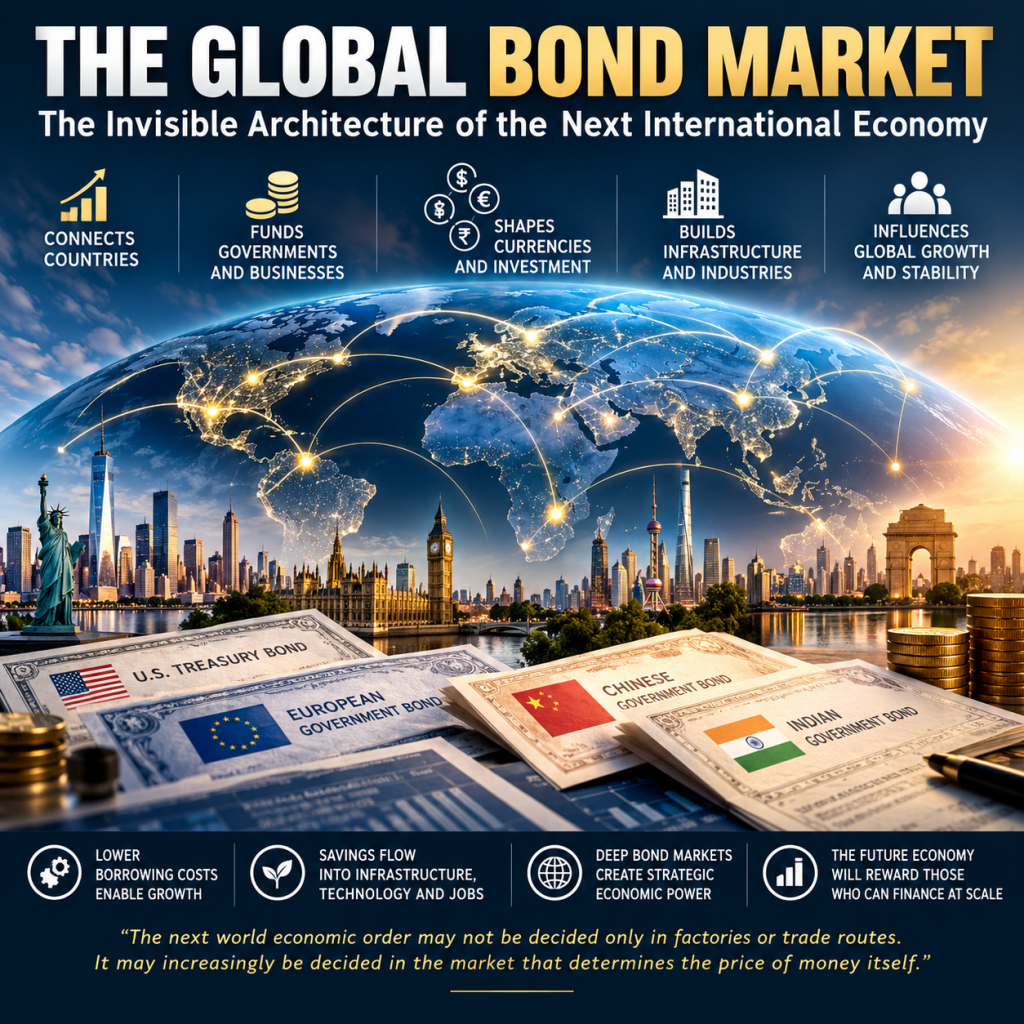
The world talks about trade, but money often moves first. For much of modern economic history, international power was explained through factories, commodities, shipping routes and trade surpluses. But behind this visible economy sits another system that is less visible and, in many ways, more powerful: the global bond market. Governments borrow from investors. Companies issue debt across borders. Pension funds buy sovereign securities thousands of kilometres away. Central banks hold foreign government bonds as reserves. Banks use sovereign debt as collateral. A decision on interest rates in one major economy can therefore travel through bond markets and affect currencies, investment, government budgets and household borrowing across dozens of countries. The international economy is increasingly connected not simply through what countries sell to each other, but through what they owe to each other.
From the age of trade to the age of balance sheets. The nineteenth-century international economy was built around trade routes, colonial finance, gold and financial centres such as London. After the Second World War, the Bretton Woods architecture placed the dollar near the centre of the monetary system. Over subsequent decades, liberalisation of capital accounts, growth of institutional investors and expansion of global financial markets created something much larger: an international marketplace for government and corporate debt. Today, the economic relationship between two countries may be expressed not only through exports and imports but through holdings of each other’s financial assets. A country can have relatively modest trade with another economy while its pension funds, banks, insurers and asset managers hold billions in that country’s bonds.
The bond market has become the price-setting machine of the international economy. Bond yields appear technical, but their consequences are remarkably physical. They influence the cost of building highways, factories, power plants, houses, data centres and industrial corridors. When government bond yields rise, the cost of capital tends to rise across the economy. When yields fall, governments and companies can finance investment more cheaply. This means the future geography of industrialisation may increasingly depend on the geography of finance. Countries competing for semiconductor plants, renewable-energy systems, defence manufacturing or artificial-intelligence infrastructure will not compete only through labour costs and subsidies. They will also compete through their cost of capital.
The dangerous assumption is that sovereign debt is purely domestic. It increasingly is not. A government may borrow in its own currency, but its bonds can be owned by foreign institutions. Domestic banks may hold large quantities of government securities. Pension systems may depend on sovereign yields. Exchange rates may react to changing international demand for those securities. This creates a chain connecting fiscal policy, monetary policy and international capital flows. A fiscal announcement in one country can therefore influence bond yields, which influence currencies, which influence capital movements, which influence borrowing costs somewhere else. Financial contagion does not require ships, containers or factories. It can travel across screens in seconds.
This creates a new hierarchy among countries. Not all sovereign debt is treated equally. Some governments can borrow enormous amounts in their own currencies because international investors regard their markets as deep, liquid and relatively dependable. Other countries must offer substantially higher yields to attract capital. The difference is not merely financial. It becomes a development advantage. A country borrowing cheaply can finance infrastructure, technology and industrial transformation at a lower cost than a country paying a persistent risk premium. The future global divide may therefore be partly between low-cost-of-capital economies and high-cost-of-capital economies.
The dollar remains powerful because the system around it is powerful. Discussion about de-dollarisation often concentrates on trade settlement. But reserve-currency power cannot be understood only by asking which currency is used to buy oil or machinery. The deeper question is where the world can safely park enormous pools of savings. A currency becomes globally powerful when it is supported by large, liquid and trusted financial markets capable of absorbing capital at scale. This is why the future monetary order will depend as much on bond-market depth, convertibility, institutional credibility and financial infrastructure as on the currency chosen for individual trade transactions. Replacing a payment currency is easier than replacing an entire financial ecosystem.
But the international bond market is entering a more difficult age. Governments across advanced and emerging economies face enormous financing requirements. Ageing populations increase pension and healthcare expenditure. Defence budgets are rising. Climate adaptation requires capital. Energy transition needs massive infrastructure investment. Artificial intelligence demands electricity grids, data centres and semiconductor capacity. At the same time, governments must finance traditional infrastructure and social expenditure. The great economic competition of the coming decades may therefore become a competition for global savings.
That creates an uncomfortable possibility. Governments may increasingly compete with companies for capital. If sovereign borrowing remains very large, governments can absorb savings that might otherwise finance private investment. The old crowding-out debate could return in a new international form. It will no longer be only whether government borrowing crowds out domestic companies. Large sovereign borrowers may indirectly influence the financing conditions facing businesses and governments across the world.
The next financial fault line could be the sovereign-bank relationship. Banks traditionally consider government securities among their safest assets. Governments simultaneously depend on banks to purchase their debt. This creates stability during normal periods but dangerous circularity during crises. If confidence in sovereign finances weakens, banks holding those bonds can come under pressure. If banks weaken, governments may have to support them. The supposed safe asset and the institution holding the safe asset can therefore become dependent on each other. Future financial crises may emerge not simply from reckless private lending but from the interaction between heavily indebted governments and highly interconnected financial institutions.
Emerging economies face an even sharper contradiction. They need enormous capital for urbanisation, infrastructure, energy, manufacturing and employment creation. Yet international capital can be most expensive precisely when they need it most. When global risk appetite falls, investors often move toward perceived safe assets. Currencies of vulnerable economies weaken, yields rise and refinancing becomes more difficult. The countries requiring long-term development capital can therefore experience the greatest volatility in its price. This is one of the fundamental structural inequalities of international finance.
For countries such as India, the strategic objective should consequently be larger than attracting foreign portfolio investment. The deeper objective is to build a broad, liquid and credible domestic bond market capable of financing long-duration development. Infrastructure cannot sustainably depend on short-duration banking finance alone. Pension funds, insurance capital, municipal bonds, infrastructure debt, corporate bonds and eventually deeper international participation can become part of a much larger financial architecture. The country that develops its domestic savings into patient capital gains strategic autonomy.
The future may also produce a multipolar bond world. The United States will remain enormously important, but Europe, China, India and other large economies will continue developing their financial markets. Gulf sovereign capital is becoming increasingly influential. Asian pension and insurance pools are expanding. Development banks and sovereign wealth funds are financing strategic infrastructure. Green bonds, transition bonds, infrastructure bonds and other instruments are widening the definition of international finance. The future system may therefore become multipolar without becoming fully de-dollarised.
That distinction matters. Multipolarity does not necessarily mean replacing one dominant financial centre with another. It may mean several overlapping pools of capital, currencies and financial institutions connecting different economic regions.
Technology could change the bond market more profoundly than most people expect. Tokenisation, digital settlement, programmable financial instruments and potentially central-bank digital currencies could reduce settlement times and make cross-border securities markets more accessible. Smaller investors may eventually gain exposure to instruments historically dominated by large institutions. But faster markets can also transmit panic faster. Technology reduces friction; it does not eliminate financial risk.
The biggest future risk may therefore be synchronisation. Globalisation connected production systems. Financial globalisation connected balance sheets. Digitalisation is now connecting reactions. If algorithms, institutional investors and risk-management systems respond simultaneously to inflation, war, fiscal deterioration or monetary tightening, capital can move with extraordinary speed. A diversified global financial system can paradoxically behave like a single machine during moments of stress.
The next international economy may ultimately be determined by who can finance the future. The twentieth century rewarded countries capable of producing oil, steel, automobiles and manufactured goods at scale. The twenty-first century will still require production, but another capability is becoming equally important: the ability to mobilise enormous quantities of long-term capital at affordable rates.
The critical strategic asset of the future may therefore not simply be the factory.
It may be the interest rate at which the factory can be financed.
And this changes the meaning of economic power. A nation with technology but expensive capital may struggle to scale. A nation with resources but unstable financial markets may remain dependent. A nation with strong savings, credible institutions, deep bond markets and productive investment opportunities can convert financial confidence into industrial strength.
The international bond market is therefore not merely a market for debt. It is becoming an invisible infrastructure connecting governments, savings, currencies, industries and geopolitical power.
The next world economic order may not be decided only in ports, factories or trade negotiations.
It may increasingly be decided in the market that determines the price of money itself.
#BondMarkets #GlobalEconomy #InternationalFinance #India #CapitalMarkets #SovereignDebt #EconomicGrowth #Infrastructure #EmergingMarkets #FutureEconomy


Leave a comment