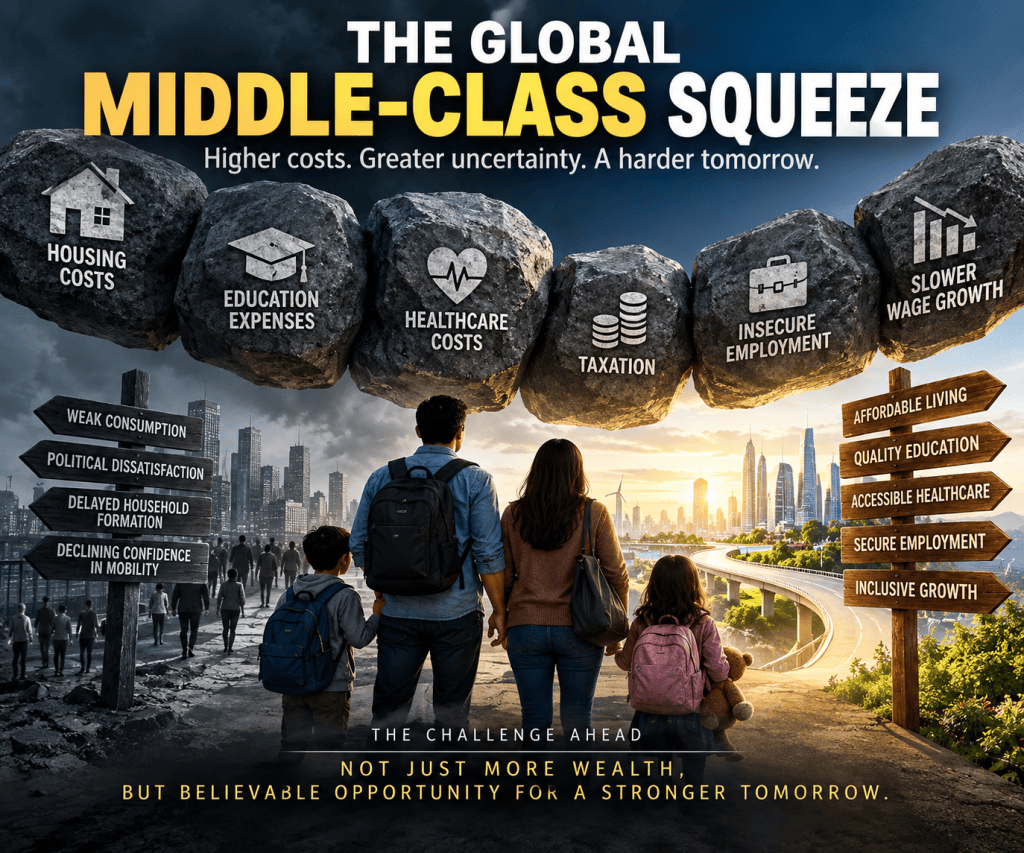
The Class That Made Modern Capitalism Stable
The great economic achievement of the twentieth century was not simply mass production. It was the creation of mass economic security. Industrialisation produced factories, but rising wages, affordable housing, public education, pensions, healthcare systems and expanding consumer credit gradually created something politically even more important: a large middle class. Millions of households came to believe that tomorrow could be better than today. A job could finance a home, education could improve the prospects of the next generation, savings could create security, and retirement could be planned rather than feared.
That expectation became an invisible pillar of modern economies.
The middle class performed an unusual double role. Economically, it became the great consumer of houses, automobiles, appliances, education, travel, insurance and financial products. Politically, it became a stabilising force because people who believed they had something to gain from the existing economic system had less reason to reject it.
Today, that bargain is under pressure.
The New Problem Is Not Poverty Alone—It Is the Cost of Normal Life
The emerging middle-class crisis is different from traditional poverty. Many households facing the squeeze are employed, educated and earning more money in nominal terms than previous generations. Yet the price of entering and maintaining a middle-class life is rising faster than their sense of security.
Housing illustrates the contradiction most clearly. Economic success has made many globally connected cities enormously productive while simultaneously making residence in them increasingly expensive. The worker may find the opportunity in the city but struggle to afford the city.
Education creates another paradox. As economies become more knowledge-intensive, qualifications become increasingly important. Families therefore spend more to educate their children, while degrees themselves no longer guarantee the occupational security they once appeared to provide.
Healthcare, childcare, transportation, insurance and retirement savings add further layers of expenditure. Taxation can intensify the perception of pressure when households feel that rising contributions are not matched by improvements in public services.
The result is an unusual economic condition: income can rise while the feeling of prosperity falls.
From Wage Economy to Asset Economy
An even deeper transformation is taking place beneath household budgets.
For much of the post-war period, wages were the principal ladder into the middle class. Increasingly, ownership of appreciating assets—property, equities, businesses and inherited wealth—can matter as much as occupational income.
This changes the economics of mobility.
Two people earning similar salaries may live in completely different economic worlds. One may have inherited a house or received family assistance for a down payment. The other may spend decades paying rent while trying to accumulate enough savings to enter a housing market whose prices continue moving ahead.
The traditional divide between rich and poor is therefore being supplemented by another divide: those who entered the asset economy early and those still trying to buy the admission ticket.
If this continues, inheritance may become more important to middle-class formation than education in some societies. That would represent a remarkable reversal of the meritocratic promise on which modern market economies have partly justified themselves.
The Employment Paradox: More Opportunity, Less Certainty
Technology is creating new occupations while simultaneously changing the meaning of employment.
Digital platforms, outsourcing, automation, artificial intelligence and flexible contracting can increase productivity and widen access to work. But they can also transfer economic risk from organisations to individuals.
The traditional employee received not merely a wage but a package of predictability: relatively stable working hours, benefits, career progression and some visibility over future income. The emerging worker may have greater flexibility but also greater responsibility for healthcare, skills, retirement, insurance and periods without work.
This creates what may become one of the defining contradictions of the next economy: workers may become technologically more productive while feeling economically less secure.
AI could sharpen this contradiction. If productivity gains flow mainly toward capital owners, technology companies and highly specialised workers while middle-income occupations face continuous restructuring, technological progress could coexist with weakening household confidence.
The central question of the AI economy will therefore not simply be how much productivity it creates. It will be how productivity gains are distributed through wages, prices, ownership and public services.
When the Middle Class Stops Spending
The squeeze is not merely a social problem. It can become a macroeconomic problem.
Middle-income households are the consumption engine of most large economies. When housing, education, healthcare and debt absorb growing shares of disposable income, discretionary spending weakens.
Families postpone automobiles, travel, appliances and other purchases. Young adults remain with parents longer. Marriage and childbirth may be delayed. Home ownership moves further into the future.
Each decision may appear personal, but millions of similar decisions become macroeconomics.
A society that makes household formation increasingly expensive eventually weakens demand for the very industries built around household formation.
This creates a dangerous feedback loop: insecure households spend cautiously; weaker consumption restrains business expansion; slower investment limits wage growth; weaker wage expectations reinforce household caution.
The middle-class squeeze can therefore gradually become a growth squeeze.
Developing Economies Face a Different Version of the Same Problem
In advanced economies, the anxiety often concerns losing established living standards. In emerging economies, the frustration may arise because people can see middle-class lifestyles before they can securely afford them.
Digital technology has globalised aspirations much faster than it has globalised incomes.
A young professional in Delhi, Jakarta, São Paulo, Lagos or Manila can observe lifestyles, products, careers and housing standards across the world every day. Expectations have become global while wages, infrastructure and public services remain intensely local.
This creates an important new economic phenomenon: the aspiration-income gap.
India illustrates both the opportunity and the challenge. A growing consuming population can become one of the world’s largest economic assets. But the quality of middle-class expansion matters as much as its numerical size. If families must privately purchase education, healthcare, transport, housing security and retirement protection, apparently rising incomes can be substantially diluted by the cost of services required to maintain their social position.
The future middle class cannot therefore be measured by income thresholds alone. It must increasingly be measured by disposable security—what remains after the unavoidable costs of a reasonably secure life have been paid.
The Political Economy of Broken Expectations
Economic systems are judged not only by absolute living standards but also by expectations.
A household can tolerate difficulty when it believes conditions are temporary and mobility remains possible. The deeper danger begins when people conclude that effort no longer reliably produces advancement.
That changes political behaviour.
The critical divide of the coming decades may therefore not simply be left versus right, labour versus capital or developed versus developing economies. It may increasingly be between people who believe the economic system still offers upward mobility and those who believe access to prosperity has become structurally restricted.
History suggests why this matters. Stable societies are easier to sustain when large numbers of citizens expect their children to live better than they did. When that expectation reverses, dissatisfaction can grow even in countries that remain wealthy by historical standards.
The most dangerous economic statistic of the future may therefore be one that national accounts do not directly measure: the percentage of people who have stopped believing that they can move upward.
The Next Economic Competition Will Be About Affordability
For decades, governments competed through tax rates, infrastructure, industrial incentives and labour costs. The next competitive advantage may be different.
Countries and cities capable of combining productive employment with affordable housing, reliable healthcare, effective education, efficient transport and reasonable family costs may attract both talent and investment.
Affordability could become economic infrastructure.
This requires a shift in policy thinking. Governments cannot permanently compensate for structural cost escalation through subsidies alone. If housing supply is constrained, education becomes excessively expensive, healthcare costs continuously outpace incomes and employment becomes increasingly insecure, transferring additional money to households may treat symptoms without correcting the underlying economics.
The objective should not simply be raising nominal incomes. It should be reducing the cost of economic security.
The Middle Class of 2040 May Look Very Different
The future middle class may no longer be defined primarily by owning a house, car and collection of consumer goods. Security may increasingly depend on access: affordable housing, portable social protection, continuous learning, healthcare, digital infrastructure, retirement assets and the capacity to survive employment transitions.
This demands a new social contract for an economy in which careers may change repeatedly and technology may continuously alter the value of skills.
The central economic question of the coming decades is therefore larger than inequality.
It is whether modern economies can continue producing economic mobility at scale.
Capitalism proved extraordinarily powerful when productivity, wages, ownership and aspiration broadly moved in the same direction. Its next test arrives when these forces begin moving apart.
A society can remain statistically richer while becoming psychologically poorer. GDP can grow while confidence in progress declines. Technology can advance while household security retreats.
And that is why the global middle-class squeeze should not be dismissed as merely a cost-of-living problem.
The middle class is not simply another income category. It is the economic space where people develop confidence in the future. If that space keeps shrinking, the world may discover that the greatest shortage of the next economy is not capital, technology or even jobs—it is believable upward mobility.
MiddleClass #GlobalEconomy #CostOfLiving #EconomicMobility #FutureOfWork #Housing #Inequality #EconomicGrowth #AI #FutureEconomy


Leave a comment