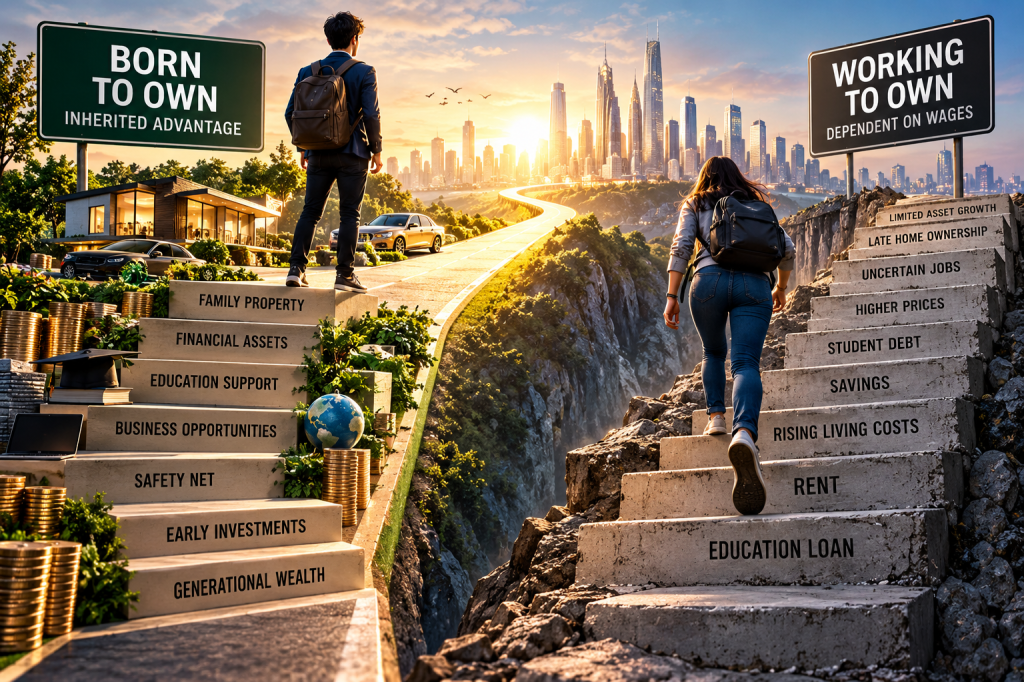
The old economic promise was simple: work, save, progress. The emerging economy is quietly rewriting it: inherit, own, appreciate.
For much of the twentieth century, the idea of economic progress was closely connected with employment. Education improved the probability of getting a better job; a better job produced a higher income; higher income created savings; and savings eventually allowed a household to acquire a home, financial assets and greater security. The system was never perfectly equal, but wages provided an important bridge between generations. Today, in many economies, that bridge is becoming weaker. The increasingly important divide may no longer be simply between high-paid and low-paid workers. It may be between those who already own appreciating assets and those who must purchase them from future wages.
From the Wage Economy to the Asset Economy. The distinction is fundamental. A salary is a flow: it arrives every month and is taxed, consumed and saved. Property, equities, land and ownership stakes are stocks: once accumulated, they can appreciate, generate income, provide collateral and eventually be transferred to the next generation. When asset prices rise persistently faster than wages, the economic advantage of ownership compounds. A worker may receive a 5 or 6 percent salary increase, but if the home that worker hopes to buy appreciates much faster over several years, higher income can coexist with declining affordability. The person is earning more but falling further behind the ownership threshold.
This creates an unusual economic paradox: society can become richer while economic mobility becomes harder. Rising house prices increase the measured wealth of existing homeowners but simultaneously raise the entry price for people who do not own homes. A booming equity market increases household wealth, but primarily for households already possessing significant financial assets. Asset inflation therefore has two faces. For an owner, it is wealth creation. For an aspiring owner, it is often an increase in the price of admission.
History Is Beginning to Turn Backwards. Industrialisation gradually weakened the economic importance of inherited land. Human capital became increasingly important. Engineers, doctors, managers, entrepreneurs and skilled workers could build wealth through education and employment even without inheriting large estates. The twentieth-century expansion of mass education, housing finance, pension systems and organised employment strengthened this movement. Economic position increasingly appeared achievable rather than simply inheritable.
The twenty-first century could partially reverse that historical transformation—not by restoring feudal estates, but through modern asset ownership.
Consider two young professionals with similar education, ability and salaries. One receives parental assistance for a housing deposit and the other does not. The first purchases a property earlier. Housing appreciation increases equity. That equity can support another investment or business loan. Lower housing uncertainty makes retirement saving easier. Eventually, these assets can be transferred to the next generation. The second professional continues renting while trying to accumulate a deposit against a moving property price. Their original difference may have been modest. Compounding can turn it into a structural divide.
The critical variable is therefore increasingly not only what you earn, but when you enter ownership.
Inheritance Is Becoming Economic Infrastructure. Traditionally, inheritance was considered something received near the end of a parent’s life. The emerging pattern is potentially more consequential: wealth is transferred while younger households are making economically decisive choices. Parents may finance education, housing deposits, businesses, migration, childcare or periods of unemployment. Family wealth becomes a private insurance system.
This changes the meaning of inequality. Two people earning exactly the same salary may possess radically different economic security. One can take entrepreneurial risks because family assets provide a cushion. Another must protect monthly cash flow because one employment interruption could threaten rent, loan payments or family obligations. Wealth therefore affects not merely consumption but the capacity to take risk.
And risk-taking is central to economic mobility.
This creates another uncomfortable possibility. Entrepreneurship may appear meritocratic while becoming increasingly dependent on family balance sheets. Starting a company, accepting a lower-paid innovative job, relocating to an expensive technology centre or undertaking advanced education becomes easier when someone else can absorb the downside. The wealth divide can consequently reproduce itself through opportunities long before inheritance formally occurs.
The Housing Market Could Become the Great Generational Gatekeeper. Housing deserves special attention because it simultaneously functions as shelter, investment, collateral and inheritance. When governments celebrate continuously rising property values, they should recognise the distributional contradiction involved. A house cannot indefinitely become a superior investment for one generation without eventually becoming a more expensive purchase for another.
The political economy is difficult. Existing homeowners benefit from appreciation and naturally resist policies that might reduce scarcity or prices. Younger households need greater supply and affordability. Governments therefore face incentives to protect asset values while simultaneously promising affordable housing. These objectives can conflict.
The result can be a peculiar economy in which governments subsidise first-time buyers so that they can afford assets whose prices have partly risen because supply remains constrained. Demand subsidies without adequate supply can simply strengthen the price mechanism they were intended to overcome.
Education Alone Cannot Solve an Asset-Price Problem. This is where conventional policy thinking may become outdated. Governments frequently respond to economic insecurity by recommending more education and better skills. Skills remain essential for productivity, but qualifications cannot by themselves solve a structural imbalance between wages and asset prices.
If millions of highly educated workers compete for houses whose supply grows slowly, additional degrees do not create additional houses. If financial wealth compounds faster than labour income, additional training cannot automatically close the accumulated capital gap.
The future inequality debate therefore needs to move beyond income redistribution toward asset formation.
This does not mean weakening incentives for saving, investment or entrepreneurship. It means widening participation in ownership. Affordable housing supply, employee ownership, broad-based retirement savings, accessible diversified investment, matched savings, financial education and mechanisms allowing ordinary households to acquire productive assets could become as important to social mobility as traditional wage policy.
Technology Could Make the Divide Better—or Much Worse. Artificial intelligence introduces another dimension. If AI significantly increases returns to intellectual property, computing infrastructure, proprietary data and corporate capital while reducing the bargaining power of some categories of labour, the gap between capital ownership and labour income could widen further.
The central question surrounding AI may therefore not simply be whether it destroys jobs. A more important question could be: who owns the productivity gains?
An economy can experience extraordinary technological progress while many households experience economic insecurity if productivity gains become concentrated in asset valuations rather than broadly distributed income. The AI economy could therefore make ownership architecture one of the defining policy questions of the 2030s.
The opposite is also possible. Digital platforms can dramatically lower the minimum amount required to invest. Fractional ownership, low-cost diversified funds, digital pension systems and new financing structures could broaden participation in capital markets. Technology therefore does not predetermine inequality. Institutional design will determine whether technology democratises capital or concentrates it.
A New Class Divide May Be Emerging. The traditional vocabulary of upper, middle and working class may increasingly fail to describe economic reality. A more revealing classification could eventually be: asset-rich households, asset-building households and permanently asset-poor households.
This distinction cuts across professions. A relatively modest-income household that purchased property decades ago may possess considerably greater net wealth than a younger professional earning a much higher salary. Income can therefore give an increasingly incomplete picture of economic position.
The danger is not inequality alone. It is immobility.
People tolerate substantial differences in economic outcomes when they believe movement remains possible. The deeper social problem begins when young people conclude that education, effort and employment cannot realistically reproduce the living standards of their parents without inheritance. At that point inequality changes character. It stops looking like a difference in outcomes and begins looking like a difference in starting positions.
The Next Social Contract Must Democratise Ownership. The twentieth century built mass prosperity partly by democratising education, employment, housing and pensions. The twenty-first century may have to go further and democratise participation in appreciating and productive assets.
The objective should not be to make assets stop appreciating. Nor should policy punish families for saving successfully. The challenge is to prevent ownership from becoming a closed club whose entrance fee rises faster than newcomers’ capacity to pay.
That requires thinking differently about housing supply, taxation, pensions, capital markets, employee ownership, entrepreneurship and intergenerational transfers. Governments should increasingly measure not only income inequality but also the age at which households acquire assets, the proportion of young households owning productive assets, the dependence of first-home purchases on parental transfers and the concentration of capital gains across generations.
The most dangerous inequality of the future may not be between those earning more and those earning less. It may be between those whose money works for them and those who can only work for money.
If that divide becomes permanent, economic inheritance will increasingly determine economic destiny. And that would represent a remarkable historical reversal: after two centuries in which industrial society gradually reduced the importance of inherited position, the advanced economy could recreate inheritance as one of the most powerful determinants of opportunity—not through aristocratic titles or landed estates, but through property deeds, equity portfolios and family balance sheets.
The defining economic question of the coming decades may therefore be much larger than how to raise wages. It may be how to build an economy in which the next generation can become owners without first having to be born to owners.
#IntergenerationalWealth #WealthInequality #FutureOfEconomy #AssetEconomy #Housing #YoungGeneration #EconomicMobility #FutureOfWork #InclusiveGrowth #EconomicPolicy


Leave a comment