Moving from the chip to the machines behind the chip
Industrial history carries a lesson that is easy to overlook: countries rarely become manufacturing powers simply by producing more finished goods. They become powerful when they learn to build, improve and maintain the machines that make those goods. Britain’s industrial revolution was built around machinery as much as textiles. Germany created enduring strength through machine tools and industrial engineering. Japan turned production systems, precision equipment and continuous improvement into competitive advantages. East Asia’s semiconductor rise followed a similar path. The deeper capability was not merely making the product; it was learning how production itself works.
India may now be approaching this question in semiconductors. The first phase of the electronics journey was largely about assembly. The next phase is moving towards design, packaging and semiconductor fabrication. But an even deeper phase is beginning to appear: who will make the machines, components and production systems behind these factories?
This is why the announcement by Applied Materials on 17 September of plans to invest about US$5 billion in India over ten years deserves attention beyond the headline number. The proposed investment focuses on research, supply-chain development and workforce capabilities. Applied Materials is important because it operates upstream of semiconductor production: it provides sophisticated equipment and technologies used in making chips. Yet there is an important distinction. A ten-year investment commitment is a direction of travel. It is not the same as US$5 billion already invested, machines installed, suppliers qualified or products commercially produced.
India must learn to distinguish semiconductor announcements from semiconductor capability
India has moved considerably further into the semiconductor value chain than it had a few years ago. Multiple semiconductor projects have been approved and packaging operations have begun commercial activity. At the same time, India has yet to demonstrate large-scale domestic wafer fabrication at commercial scale. Delays associated with major fabrication projects are therefore more than project-management issues. They reveal how difficult it is to convert financial approvals, land and construction into functioning semiconductor ecosystems.
This distinction will become increasingly important. Semiconductor development passes through very different stages: project approval, land preparation, construction, equipment installation, process qualification, trial production, commercial production and finally competitive yield. These stages should never be collapsed into one statistic called semiconductor capacity. Packaging output is also economically valuable, but packaging a chip and fabricating wafers are fundamentally different technological capabilities.
India therefore needs a semiconductor dashboard that measures conversion rather than announcements.
The real industrial battle is taking place beneath the cleanroom
The spectacular part of a semiconductor project is the fabrication plant. The strategically interesting part may lie underneath it.
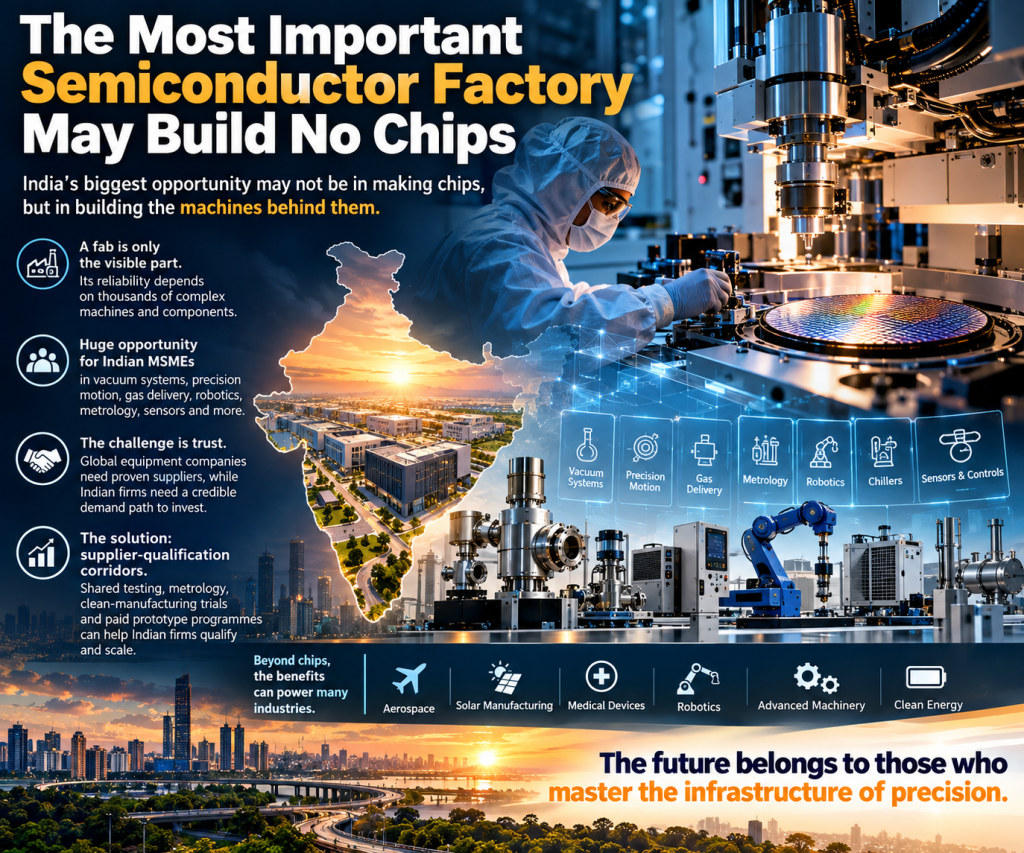
A modern semiconductor facility depends on an enormous network of less visible technologies: vacuum systems, pumps, gas-delivery equipment, ultrapure materials, precision motion systems, chillers, robotics, power electronics, sensors, control systems, specialised valves, metrology instruments, contamination-control equipment and highly sophisticated maintenance services.
A component costing a tiny fraction of the fabrication line can interrupt equipment costing millions of dollars.
That changes the semiconductor opportunity for Indian industry. India does not need thousands of companies trying to manufacture chips. It needs hundreds of specialised companies capable of solving extremely difficult manufacturing problems around the chip.
This is where the semiconductor strategy begins to intersect with India’s MSME and capital-goods strategy.
The supplier gap is actually a trust gap
There is, however, a difficult circular problem.
A semiconductor-equipment company cannot easily put an untested component into a highly sensitive production system. The consequences of failure are simply too expensive. But an Indian MSME cannot spend several years developing and qualifying an advanced component without reasonable visibility of future demand.
The equipment company asks for proof before purchasing.
The supplier needs purchasing possibilities before investing enough to produce the proof.
This is one of the most important industrial-policy problems India needs to solve.
The real significance of large international equipment investments will therefore depend on whether they break this circle. Engineering centres, research employment and service operations are valuable, but they should not automatically be interpreted as domestic equipment manufacturing capability. An Indian engineering centre servicing imported equipment can improve semiconductor productivity while the underlying technological dependence remains largely unchanged.
That difference matters enormously over the next twenty years.
From semiconductor clusters to qualification corridors
India consequently needs something more ambitious than semiconductor parks. It needs supplier-qualification corridors.
Dholera, Bengaluru, Hyderabad and Chennai can become important semiconductor nodes, while established engineering centres such as Pune and Coimbatore can provide complementary manufacturing depth. The connections between these locations may eventually matter more than administrative boundaries around individual semiconductor parks.
Shared facilities could provide precision metrology, clean-manufacturing trials, materials characterisation, contamination analysis, reliability testing, calibration and internationally acceptable documentation systems. Such facilities should not become another generation of impressive buildings with underused machines. Their performance should be measured by suppliers qualified, components substituted, prototype-to-order conversion, testing time reduced and export customers acquired.
Anchor companies can contribute by publishing non-sensitive subsystem road maps. Instead of merely telling MSMEs that semiconductor manufacturing offers opportunities, they can identify categories where localisation is technically possible over three, five and ten years.
Paid prototype programmes would be particularly important. Asking small companies repeatedly to develop sophisticated components at their own cost is not industrial development. Qualification itself has to become an investible economic activity.
Universities must study the factory, not only the chip
India’s semiconductor education debate also needs broadening. Chip design attracts understandable attention because India already possesses substantial engineering capability in this field. But the future semiconductor ecosystem will also require knowledge of plasma processes, vacuum engineering, advanced materials, thermal management, robotics, precision mechanics, contamination control, industrial software and process metrology.
Universities should therefore study how semiconductor factories work, not merely how chips are designed.
This could produce a much larger technological spillover than semiconductor policy alone suggests.
A precision vacuum company developed around semiconductor demand could later serve aerospace. Advanced motion-control capability could enter robotics. Metrology companies could support medical devices. Power electronics and thermal-management expertise could move into renewable-energy manufacturing. Advanced materials knowledge could strengthen batteries and defence production.
The semiconductor programme can therefore become a technological school for Indian manufacturing.
The next industrial policy should finance learning
Traditional industrial policy often finances assets: land, buildings, machinery and infrastructure. Advanced manufacturing requires financing something less visible—learning.
An MSME may need hundreds of engineering iterations before a component meets semiconductor standards. Qualification can take longer than ordinary commercial lenders are willing to finance. State agencies and development institutions therefore need instruments linked to technological milestones: prototype completion, testing, certification, qualification and first commercial supply.
Government support should progressively move from simply subsidising factories towards reducing the cost and risk of technological learning.
That would represent a major evolution in India’s manufacturing policy.
The factory without chips
The biggest strategic opportunity created by India’s semiconductor push may ultimately extend well beyond semiconductors.
Imagine a network of Indian companies producing precision vacuum systems, specialised valves, advanced sensors, robotics, control equipment, metrology instruments, clean-manufacturing systems and high-reliability industrial components. Some may never manufacture a single semiconductor. Yet collectively they could become one of the most valuable outcomes of India’s semiconductor programme.
Because industrial sovereignty does not come simply from owning a factory.
It comes from knowing how the factory works, how to repair it, how to improve it and eventually how to build the next generation of its machines.
The twentieth century rewarded countries that mastered mass production. The twenty-first century may reward countries that master the infrastructure of precision.
India’s semiconductor ambition should therefore be judged not only by how many fabs finally appear on the landscape or how many chips leave their gates. The deeper test is whether, ten years from now, an Indian semiconductor factory can look down its production line and find increasingly sophisticated Indian technology inside it.
If that happens, the most consequential semiconductor factory India creates may indeed be one that produces no chips at all.
It may be the distributed factory of suppliers building the machines behind the chips.
#Semiconductors #CapitalGoods #Manufacturing #MSME #Electronics #AdvancedManufacturing #IndustrialPolicy #MakeInIndia #MachineTools #Technology #SupplyChain #ClusterDevelopment


Leave a comment