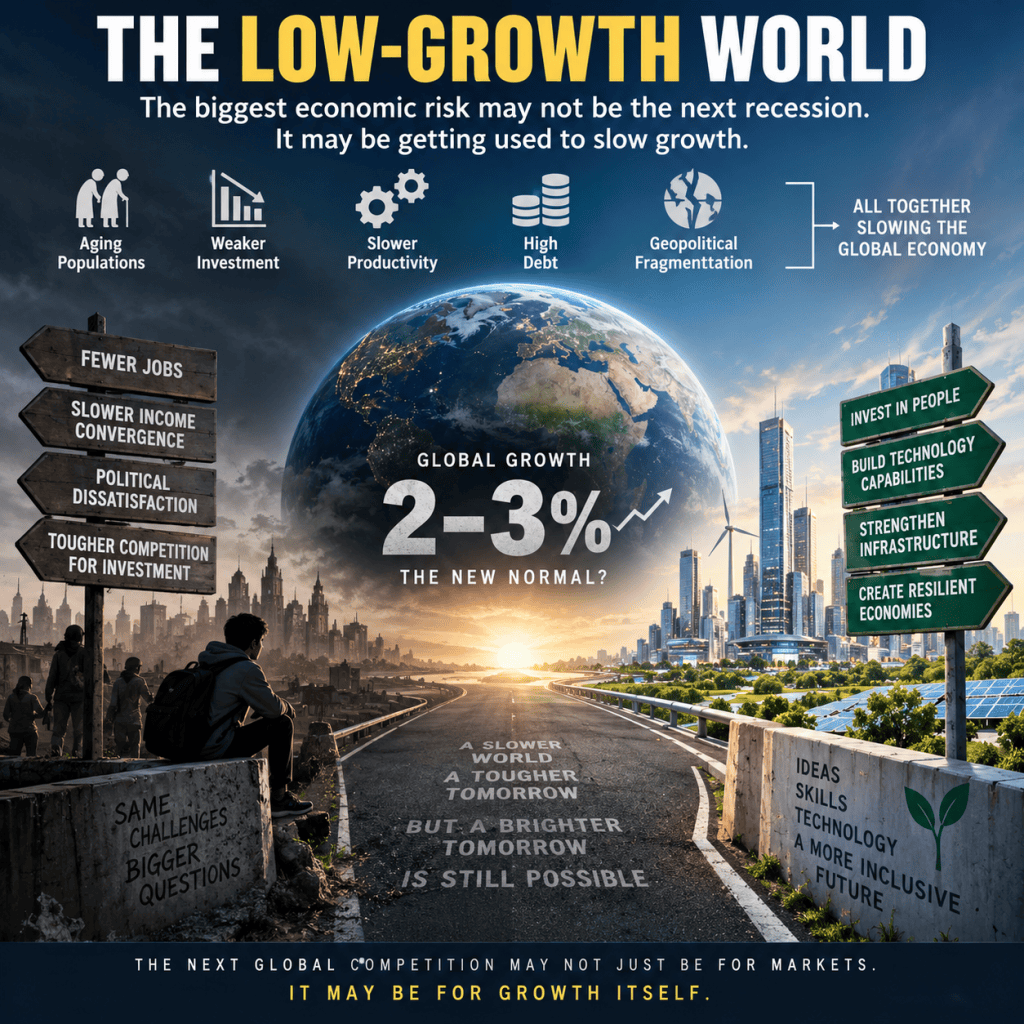
The danger is not recession. It is normality.
For much of modern economic history, weak growth was treated as a temporary problem. Economies slowed, governments responded, interest rates changed, investment returned and another expansion began. The more uncomfortable possibility facing the world today is different. What if slow growth is no longer a passing phase? What if a global economy expanding at only 2 to 3 percent becomes the normal condition of the next decade?
The latest numbers make this question difficult to dismiss. In June 2026, the World Bank projected global growth of only 2.5 percent for 2026, down from 2.9 percent in 2025, before a possible recovery to 2.8 percent in 2027. Even that projected recovery would leave growth below the average of the 2010s. The deeper problem is therefore not simply another disappointing year. It is the gradual lowering of the economic speed limit itself.
From the age of acceleration to the age of friction
The period after the Second World War was built around expansion. Reconstruction created demand. Young populations supplied workers. International trade widened markets. New technologies raised productivity. Investment created infrastructure and industrial capacity. Later, China, Eastern Europe and other developing economies became deeply integrated into global production. Containerisation, telecommunications and the internet dramatically reduced economic distance.
Globalisation was never smooth or equally beneficial, but its economic architecture generally rewarded expansion.
That architecture is changing.
The labour force is aging in many major economies. Investment growth has weakened. Productivity improvements have slowed. International trade is expanding much more slowly than during its earlier high-growth period. The World Bank’s work on long-term growth prospects finds that global potential growth is heading toward a three-decade low during the remainder of the 2020s. Its analysis identifies slower labour-force growth, declining investment growth and weaker productivity as important structural forces behind the slowdown.
But something else has entered the equation: friction.
Trade restrictions, industrial subsidies, technology controls, geopolitical rivalry, supply-chain duplication and economic-security policies increasingly influence where companies produce and invest. Countries are deliberately accepting some additional cost in return for resilience and strategic autonomy.
The old economy searched for the cheapest supplier.
The emerging economy increasingly asks whether that supplier can still be trusted during the next crisis.
Debt is quietly consuming tomorrow
There is another constraint that receives less attention than trade wars or artificial intelligence: governments have less room to manoeuvre.
High debt means that a growing share of public resources can be absorbed by interest payments and existing commitments. That matters because the investments required to escape slow growth are expensive: infrastructure, education, energy systems, climate adaptation, research, digital networks and industrial upgrading.
This creates a dangerous circle.
Weak growth makes debt harder to manage. High debt restricts productive public investment. Weak investment reduces future growth. Lower future growth then makes existing debt even more burdensome.
The world could therefore enter a period in which governments desperately need to invest in future productive capacity precisely when their fiscal capacity to do so is becoming constrained.
The biggest casualty may be convergence
Slow global growth does not affect every country equally.
A wealthy economy growing at 1.5 percent may remain wealthy. A developing economy growing at 3 or 4 percent may still be growing faster, but not fast enough to transform employment, infrastructure and household incomes quickly or to close the enormous income gap with advanced economies.
The warning signs are already visible. The World Bank reported in June 2026 that developing economies other than China and India are on course collectively to reach 2028 after nearly a decade without narrowing their per-capita-income gap with advanced economies.
This is perhaps the most serious consequence of the low-growth world.
For decades, development strategy rested partly on convergence. Poorer countries could industrialise, absorb technology, attract investment, export into expanding markets and gradually become richer.
That ladder has not disappeared. But it is becoming harder to climb.
Investment may become the new geopolitical competition
When global investment was expanding rapidly, many countries could participate in the same growth cycle. In a slower world, investment becomes more contested.
Countries will increasingly compete for the same semiconductor plant, battery factory, data centre, pharmaceutical facility, renewable-energy supply chain or advanced manufacturing project. Governments with deep fiscal resources can offer subsidies, tax incentives, cheap finance, infrastructure and guaranteed procurement.
The result could be an unusual form of protectionism.
Instead of preventing imports at the border, governments may increasingly attract production behind the border.
The competitive question will therefore shift from who has the lowest labour cost to who can offer the strongest industrial ecosystem: electricity, logistics, skills, suppliers, technology, finance, policy stability and market access.
For developing economies, this changes the development challenge dramatically. Cheap labour alone will become progressively less powerful as automation, AI and advanced machinery reduce the labour component of production.
A 2.5 percent world will feel much slower than the number suggests
Global GDP statistics can hide human consequences.
A world growing at 2.5 percent is still becoming richer in aggregate. But population growth absorbs part of that increase. Productivity gains may be concentrated in a small number of firms and countries. Capital-intensive sectors can expand without producing employment on the scale created by earlier industrialisation.
That creates a strange economic possibility: GDP continues rising while societies increasingly feel that economic opportunity is shrinking.
Young workers may enter labour markets faster than good jobs are created. Middle-class households may experience weaker income mobility. Governments may struggle to finance pensions and healthcare for aging populations. Developing countries may discover that exporting their way toward prosperity is harder when external markets themselves are expanding slowly.
Economic dissatisfaction could therefore rise even without a conventional recession.
That is politically important because people experience the economy through opportunity, not through global GDP tables.
AI could break the slowdown—or deepen it
There is one major technological wildcard.
Artificial intelligence, robotics, biotechnology, advanced materials and cheaper renewable energy could generate a new productivity cycle. If AI allows workers and firms to produce substantially more with the same resources, today’s pessimistic potential-growth assumptions could eventually prove too conservative.
But technology does not automatically diffuse evenly.
The productivity gains may initially concentrate in countries possessing computing infrastructure, inexpensive reliable electricity, advanced chips, research institutions, capital, skilled workers and large pools of usable data.
A technology capable of raising global productivity could therefore simultaneously widen international productivity differences.
The future growth divide may increasingly separate economies that use technology from economies that merely consume technology.
The low-growth trap is not inevitable
There is an important distinction between a forecast and destiny.
Earlier World Bank analysis estimated that global potential growth could fall to around 2.2 percent annually over 2022–30 under prevailing trends, but it also stressed that stronger investment, productivity-enhancing reforms and international cooperation could raise that trajectory.
The question is therefore not whether governments can manufacture growth through endless stimulus. It is whether economies can rebuild their capacity to become more productive.
That requires moving the policy conversation away from headline investment announcements and towards capability: better infrastructure, competitive firms, functioning cities, deeper capital markets, technological absorption, workforce skills and institutions that reduce the cost of doing business.
For emerging economies such as India, this distinction will become particularly important. A low-growth world can actually create opportunities for countries capable of taking investment and production away from slower, aging or geopolitically exposed locations. But capturing that opportunity will require more than being cheaper. It will require becoming more dependable, technologically capable and productive.
The next global race may be for growth itself
The twentieth century contained struggles over territory, resources, ideology and trade. The coming decades may contain another competition: the struggle to maintain economic dynamism.
Capital will search harder for productivity. Governments will compete more aggressively for investment. Workers will compete with automation as well as workers elsewhere. Countries will compete for technology, talent, energy and strategic industries.
In that environment, 2–3 percent global growth may look statistically respectable while producing increasingly intense economic competition underneath.
That is the paradox of the low-growth world.
When the global economic pie expands rapidly, countries can become richer together. When it expands slowly, the argument increasingly becomes about who captures the next slice.
The real danger is therefore not simply that the world grows more slowly.
It is that societies become accustomed to slow growth, governments learn to distribute scarcity rather than create productivity, businesses protect existing markets rather than build new ones, and an entire generation begins to regard economic stagnation as normal.
A recession eventually ends.
A low-growth mindset can last much longer.The latest World Bank evidence strengthens the central argument: the June 2026 outlook puts global growth at 2.5% this year, while its longer-term research describes a structural decline in potential growth rather than merely a cyclical slowdown.
#GlobalEconomy #EconomicGrowth #Productivity #Investment #Geopolitics #AI #Manufacturing #DevelopingEconomies #India #FutureOfGrowth
 "Connecting communities, empowering nations: Unifying the Regional and Global Economy ."
Leave a comment