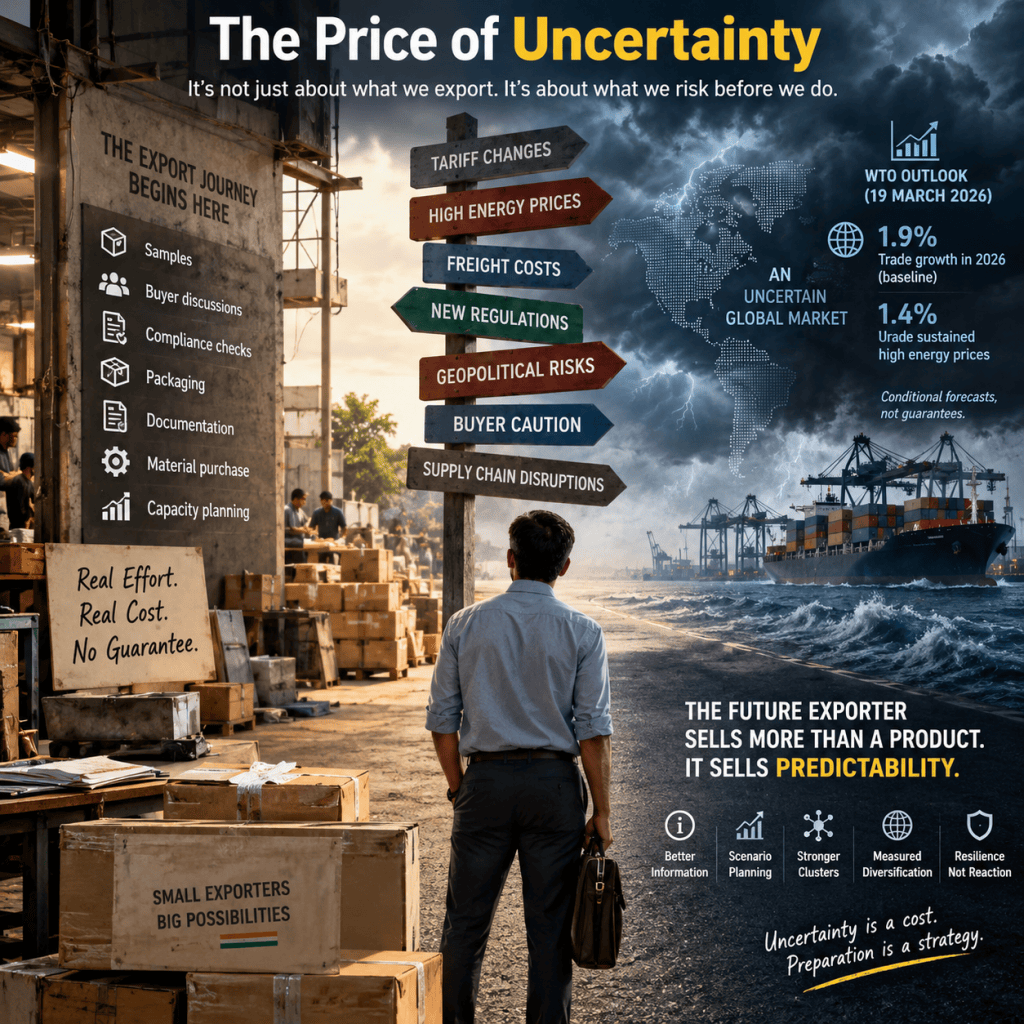
The Invisible Export Loss — Trade statistics are good at counting what crosses a border. They are much weaker at counting what almost crossed it. A container that leaves an Indian port becomes an export. An order abandoned three weeks earlier because the exporter could not confidently quote a price, promise a delivery date or estimate compliance costs disappears from economic history. Yet money may already have been spent on samples, product modification, buyer discussions, testing, certification, packaging design and documentation. For a small exporter, uncertainty therefore has a price even when no shipment takes place. This is one of the least visible barriers to internationalisation.
From Tariff Risk to Uncertainty Risk — Historically, exporters worried mainly about identifiable barriers. A tariff had a number. Freight had a quotation. Customs procedures could eventually be understood. Exchange rates fluctuated, but firms could learn to manage them. The emerging trading environment is more difficult because several variables can move together. Energy prices can change freight and production costs. Trade measures can alter landed prices. New standards can require additional documentation. Geopolitical disruption can affect routes and delivery schedules. Buyers themselves become cautious. The problem is therefore shifting from the cost of trade towards the cost of not knowing the eventual cost of trade.
This distinction matters. A high but predictable cost can often be priced into an order. An uncertain cost is harder to price because the exporter does not know how much contingency to include. Quote too high and the buyer disappears. Quote too low and the exporter may win an order that later destroys the margin.
The Workshop Now Feels the World Economy — Global uncertainty no longer remains in financial markets, ministries or newspaper headlines. It enters the factory through very ordinary decisions. Should raw material be purchased today? Should production capacity be reserved for an overseas buyer? How long should a quotation remain valid? Should the exporter absorb a freight increase or renegotiate the price? Can a delivery commitment still be honoured if a shipping route is disrupted?
The WTO outlook released on 19 March 2026 illustrates why such questions matter. It projected merchandise trade growth of 1.9 per cent for 2026 under its baseline assumptions, falling to 1.4 per cent under a scenario of sustained high energy prices. These were conditional forecasts made at a particular point in time, not realised trade outcomes. That distinction is important. Forecasts should not be treated as facts about the future. Their real value is that they show how quickly the commercial environment can change when one major variable changes.
The Small Exporter Pays More for the Same Uncertainty — Uncertainty is not evenly distributed. A large exporter may spread market research, compliance teams, certification, legal advice and buyer-development expenses across hundreds of transactions. A small firm may recover the same type of expenditure from five orders, two orders or perhaps only one. A failed attempt to enter a new market can therefore be disproportionately expensive.
This creates an uncomfortable paradox. The firms that most need diversification may be the least able to afford the experimentation required to achieve it. An MSME dependent on one market is frequently advised to diversify. But every new destination creates fresh costs: finding buyers, understanding product standards, checking tariffs, adapting packaging, testing logistics and sometimes changing the product itself. Diversification is therefore not free insurance. Poorly planned diversification can simply multiply uncertainty.
The Future Exporter Will Sell Certainty — The next stage of export competitiveness may consequently be less about offering the cheapest factory price and more about reducing uncertainty for the buyer. A supplier capable of giving a reliable landed-cost estimate, realistic delivery window, correct documentation and rapid response to regulatory changes creates economic value even when its production cost is slightly higher.
This changes the meaning of competitiveness. The traditional exporter sold a product. The future exporter will increasingly sell a product plus predictability.
That requires a different kind of capability. Before accepting an order, firms should be able to test alternative scenarios: what happens to the margin if freight rises by 15 per cent, the currency moves by 5 per cent, an input becomes more expensive, delivery takes two additional weeks or another compliance requirement appears? Scenario analysis need not become a sophisticated financial exercise. Even a simple spreadsheet can reveal whether an apparently attractive export order remains viable when conditions deteriorate.
Clusters Should Become Uncertainty-Reduction Systems — This is where industrial clusters and business associations can acquire a much more important role. Their future value should not be measured merely by the number of seminars they organise. They can become shared intelligence systems.
A cluster can maintain updated information on product classification, destination requirements, documentation, certification, packaging, freight options and logistics costs. It can identify which regulatory announcements are confirmed, which are proposals and which are simply market speculation. Common testing facilities, export help desks, shared logistics arrangements and specialised service providers can spread fixed costs across many enterprises.
The economic logic is powerful. If twenty small firms independently purchase the same information twenty times, the cluster is wasting resources. If reliable information is produced once and intelligently shared, uncertainty itself becomes cheaper.
Diversify Slowly, Learn Quickly — The fashionable answer to geopolitical and trade risk is diversification. But a small enterprise should not confuse geographical spread with resilience. Entering five unfamiliar markets simultaneously can create five sets of mistakes. A more credible strategy may be to identify one adjacent market, understand it deeply, test a limited number of buyers, learn from the first transactions and then expand.
Future export strategy may therefore resemble experimentation more than expansion. Small commitments, rapid learning and controlled scaling can become safer than large irreversible bets.
The New Export Infrastructure Is Information — India has traditionally thought of export infrastructure in physical terms: ports, roads, warehouses, industrial estates and logistics corridors. All remain essential. But the coming trade environment requires another infrastructure that is much less visible: trusted information.
An exporter needs to know not merely what a rule says today, but whether it is final, when it becomes effective, which products it covers, how much it changes landed cost and what practical response is available. In an age of continuous digital information, the scarcity is no longer information itself. The scarcity is verified, relevant and actionable information.
This may become particularly important for MSMEs. Large corporations can maintain specialist teams to interpret trade developments. A small manufacturer cannot employ an expert for every export destination. Institutions therefore have to convert complex global developments into simple business decisions.
The Competitive Advantage of Calm — The deepest danger in an uncertain world is that firms begin reacting to every headline. One announcement changes the sourcing plan. Another triggers a search for a new market. A geopolitical event causes orders to be postponed. A rumour about tariffs produces another strategy meeting. Constant reaction eventually becomes its own business cost.
The durable response is almost the opposite. Firms need better information, explicit risk pricing, stronger fulfilment systems and disciplined decision-making. Associations need to separate confirmed policy changes from political statements, proposals and speculation. Governments need to recognise that the cost of uncertainty can discourage exports before customs authorities ever see a shipment.
The next generation of trade statistics may still count containers. But the real competitiveness battle will increasingly happen before the container exists.
The exporter of the future will not be the firm that successfully predicts every shock. That is impossible. It will be the firm that can remain commercially dependable even when predictions fail.
And that may be the most valuable export capability of all: not certainty about the world, but the capacity to operate intelligently in an uncertain one.
Exports #MSME #Trade #ExportCompetitiveness #IndustrialClusters #GlobalTrade #SupplyChains #India
 "Connecting communities, empowering nations: Unifying the Regional and Global Economy ."
Leave a comment