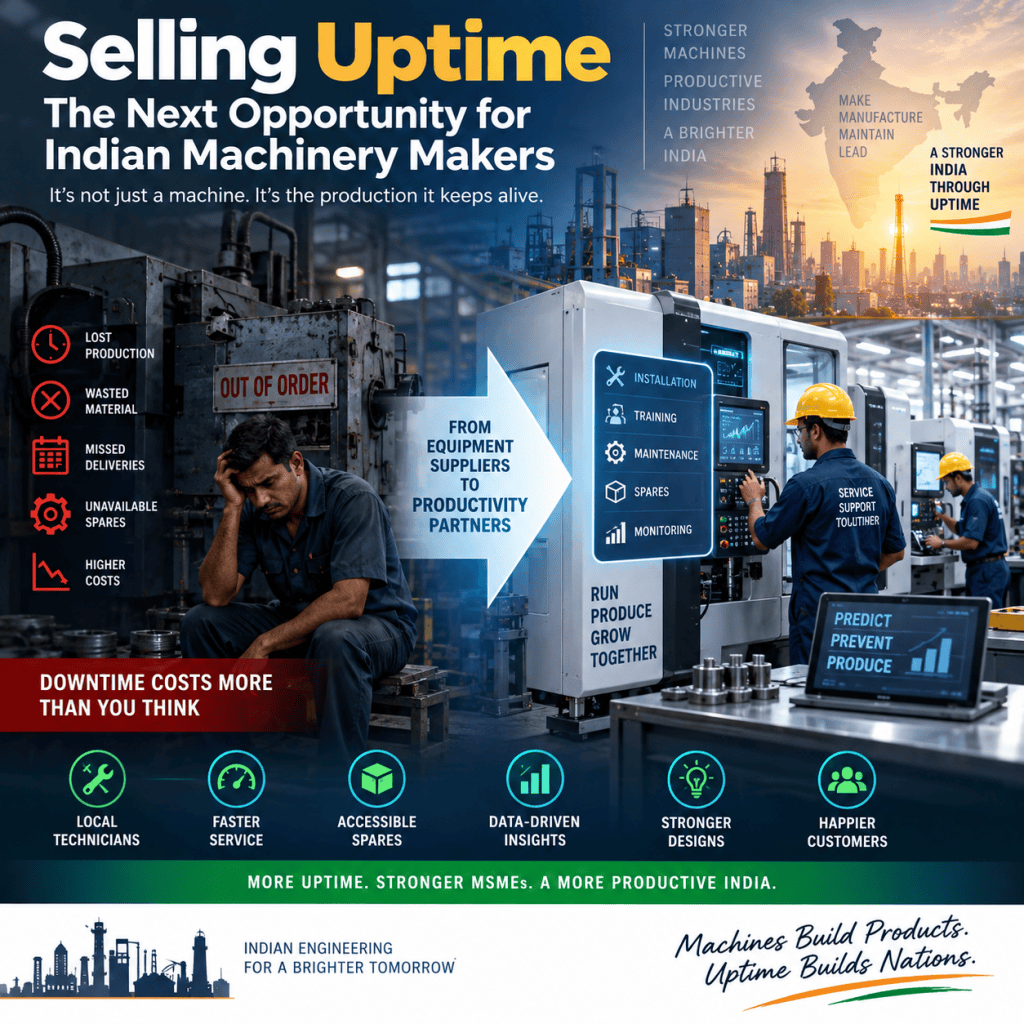
The Most Expensive Machine Is Sometimes the One Standing Still — Indian manufacturing has spent decades discussing the price of machinery. The next industrial debate should be about something more important: the price of downtime. For a small factory working against a delivery date, a machine stopping for two days can be more damaging than paying slightly more for the machine itself. Production stops, workers wait, material may be wasted, delivery schedules slip and the customer may move elsewhere. This changes the economics of machinery completely. The future machinery company may therefore sell something much larger than equipment. It will sell uptime.
From Selling Machines to Selling Production — Historically, Indian engineering developed around manufacturing and selling physical equipment. Once a machine was installed, much of the responsibility gradually shifted to the buyer. That model worked when machines were relatively simple, production schedules were less compressed and global competition was weaker. Modern manufacturing is different. Buyers increasingly need installation, operator training, preventive maintenance, rapid repairs, spare parts and predictable performance. A machine is no longer a finished product at the factory gate. It becomes productive only when it continues to work reliably inside the customer factory. The real product is therefore not the machine. It is the production that the machine enables.
Industrial Infrastructure Is Necessary, but Usage Matters More — India is building institutions to strengthen its capital-goods ecosystem. A March 2026 Ministry of Heavy Industries release reported 29 sanctioned Phase II projects covering initiatives such as centres of excellence, common engineering facilities, and testing and certification infrastructure. This is important, but sanctioned infrastructure should not automatically be treated as industrial capability. A testing centre that MSMEs rarely use, a sophisticated facility located too far from its customers, or a centre of excellence without strong industry engagement can exist statistically while contributing little economically. The more useful question is not how many facilities have been sanctioned. It is how many firms use them repeatedly, how quickly problems are solved and whether their use improves productivity.
India Already Has the Raw Material for an Uptime Economy — Engineering clusters across India contain machine manufacturers, fabricators, tool rooms, component suppliers, electricians, technicians and repair specialists. Much of this ecosystem already exists, but it is fragmented. The opportunity is to convert these scattered capabilities into organised service networks. Machinery companies could demonstrate equipment using the actual materials processed by customers rather than ideal demonstration conditions. Local technicians could be certified for specific machine families. Common facilities could provide operator training. Spare-parts inventories could be positioned near major industrial clusters. What currently looks like an informal repair economy could gradually become a professional uptime economy.
The Technician May Become as Important as the Machine Designer — India often discusses advanced manufacturing through automation, robotics, artificial intelligence and Industry 4.0. But technology becomes valuable only when someone can keep it working. This makes the technician one of the most underestimated people in India’s industrial future. A sophisticated machine waiting three days for a specialist is not sophisticated production. Machinery manufacturers that build strong regional technician networks could acquire an advantage that is difficult for distant competitors to reproduce. Local service capability may eventually become as important as localisation of components.
Digitalisation Should Begin With the Breakdown, Not the Sensor — Machinery companies are increasingly attracted to remote monitoring, sensors, predictive maintenance and AI-based diagnostics. These technologies can be powerful, but there is a danger of digitalising before understanding the operational problem. A sensor that identifies abnormal vibration creates little value if nobody interprets the signal or if the required bearing takes five days to arrive. Digital monitoring should therefore sit inside a service system rather than replace it. The sequence matters: understand failure, build response capability, organise spare parts, train technicians and then use data to anticipate the next breakdown.
Every Breakdown Is Also Industrial Intelligence — Service operations can produce something machinery manufacturers often lack: continuous information about how their equipment behaves under real Indian factory conditions. Repair histories can reveal which components repeatedly fail, which instructions operators misunderstand, which materials create problems and which design modifications customers actually need. The service department can therefore become an extension of research and development. Instead of innovation flowing only from laboratory to factory, knowledge begins travelling in the opposite direction as well—from factory floor to designer.
The Business Model Could Change With It — Machinery companies have traditionally depended heavily on new equipment sales, making revenues sensitive to investment cycles. Maintenance contracts, spare-parts programmes, upgrades, operator training, refurbishment and performance-linked services could create more continuous relationships with customers. But manufacturers should be careful about promising guaranteed performance before they understand their own service costs and operational risks. Performance contracts require reliable data, clearly defined responsibilities and sufficient service coverage. The sensible path is experimentation: begin with a manageable machine category or customer group, measure results and expand only after the economics become clear.
From Capital Goods to Capability Goods — This may ultimately be the larger transformation. India does not merely need more domestically manufactured machines. It needs machines that continuously strengthen the productive capability of the firms using them. That distinction matters particularly for MSMEs, where one machine may represent a substantial part of production capacity. For them, reliability is not simply an engineering specification. It can determine whether wages are paid, orders are delivered and customers return.
The Future Competitive Advantage May Be Measured in Hours — Indian machinery policy understandably counts investment, projects, patents, prototypes and domestic production. The next generation of industrial measurement should go further. How much customer downtime was reduced? How quickly were breakdowns resolved? How many customers returned for service? How widely were locally developed technologies actually adopted? These indicators bring industrial policy closer to the factory floor.
The next global machinery race may therefore be surprisingly human. Artificial intelligence will predict failures. Sensors will monitor machines continuously. Digital twins may simulate production before metal is cut. Yet competitive advantage will still depend on whether someone understands the customer’s process, has the correct spare part available and can restore production quickly.
India has spent decades trying to become better at making machines. The next opportunity is more demanding.
It is to become better at keeping factories running.
In the industrial economy of the future, machinery makers may discover that the machine is only the beginning of the sale. Uptime is the real product.
IndianManufacturing #MSME #CapitalGoods #Engineering #Industry40 #IndustrialDevelopment #MakeInIndia
 "Connecting communities, empowering nations: Unifying the Regional and Global Economy ."
Leave a comment