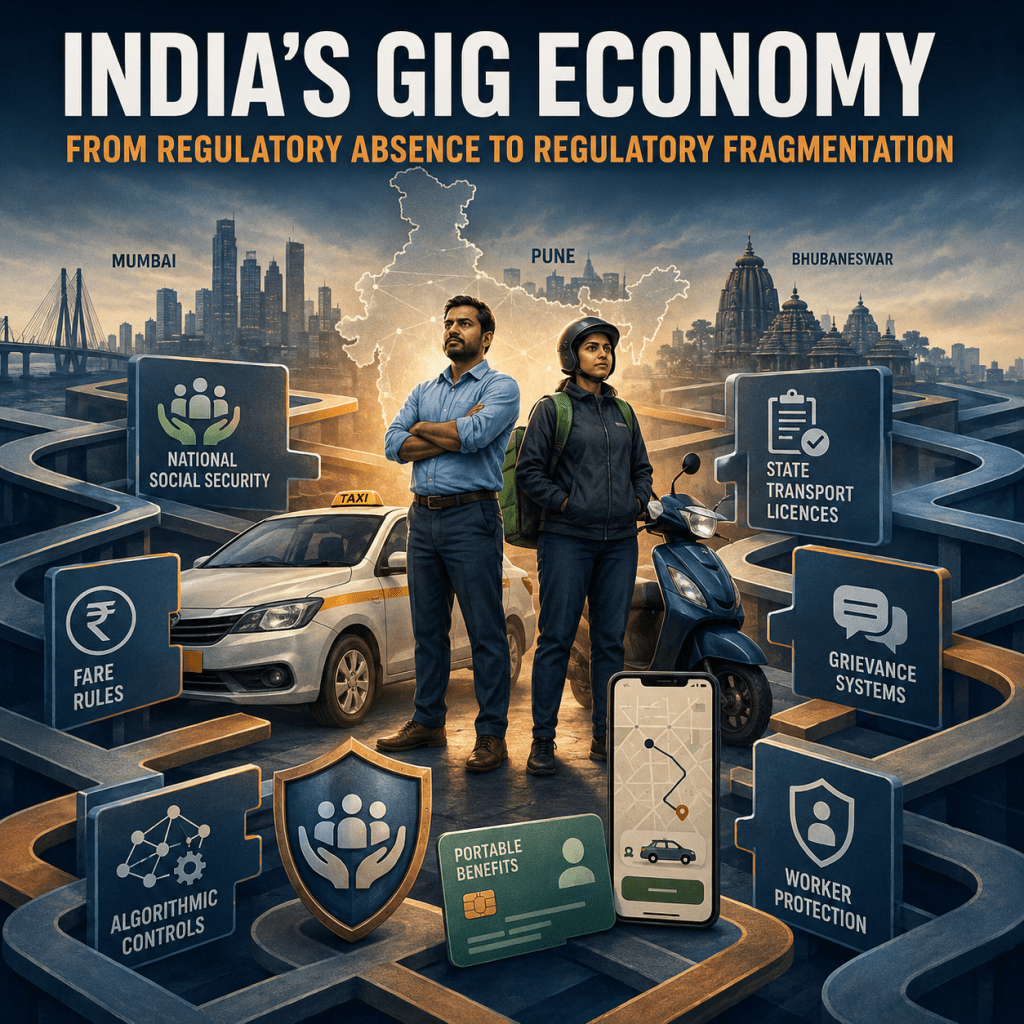
India’s gig economy is no longer operating in a legal vacuum. It is entering something more complicated: a period in which national labour law, state welfare legislation, transport regulation, court challenges, platform algorithms and worker mobilisation are all beginning to govern the same economic relationship from different directions. This is progress, but it is also producing a fragmented compliance environment in which a platform may satisfy a national social-security requirement and still face separate rules on fares, driver eligibility, grievance handling, language, licensing and app design in each state.
From Invisible Labour to Regulated Infrastructure
The first phase of India’s platform economy was built on regulatory absence. Drivers, delivery workers and other service providers were described as independent partners, while platforms presented themselves as digital intermediaries rather than employers or transport operators. This model allowed rapid expansion because the economic relationship remained contractually flexible and institutionally light.
That phase is ending. The Code on Social Security, 2020 formally recognised gig workers, platform workers and aggregators. Its implementation has created a framework for worker registration, social-security financing and portable benefits. Aggregators are expected to contribute between one and two per cent of annual turnover, subject to a ceiling of five per cent of payments made to gig and platform workers. Registration through e-Shram is gradually creating a national database that can connect workers across companies, states and welfare schemes.
Yet recognition is not the same as protection. A worker may possess an e-Shram identity but still face unpredictable earnings, arbitrary deactivation, uncompensated waiting time, unsafe delivery pressure or the absence of a locally accessible grievance office. India is discovering that platform-worker regulation cannot be reduced to a welfare contribution. It must also address how work is allocated, priced, measured and terminated.
The App Interface Has Become a Regulatory Space
The Union Government’s August 2026 direction requiring motor-vehicle aggregators to remove tipping prompts displayed before trip acceptance or completion is significant for a reason larger than tipping itself. It demonstrates that app design is no longer treated as a neutral business decision.
A prompt, notification, countdown, incentive banner or acceptance-rate warning can influence the behaviour of passengers and workers. Digital architecture can therefore function like a workplace rule, pricing instrument or psychological pressure mechanism. Regulation is consequently moving inside the app.
Platforms must now recognise product design as a compliance function. Every change in fare presentation, tipping, cancellation, ratings, incentives or deactivation should be examined not only by technology and marketing teams but also by legal, labour and consumer-protection specialists. The future regulatory audit will not stop at company contracts and financial records. It will examine what the worker and customer actually see on the screen.
Odisha Shows the Cost of Delayed Dialogue
The August mobilisation of app-based drivers in Odisha exposed the widening distance between formal welfare policy and the daily economics of platform work. Driver organisations demanded regulated fares, compensation for cancellations and waiting, protection against arbitrary account blocking, limits on uncontrolled vehicle onboarding and locally accessible grievance mechanisms.
These demands are economically connected. If a platform continuously adds vehicles without corresponding demand, the earnings of existing drivers decline even if the nominal fare remains unchanged. If cancellation charges are retained by the platform, the driver bears the cost of fuel and time without compensation. If deactivation is automated and appeals are remote, an algorithm effectively exercises disciplinary power without a visible institution accepting responsibility.
The escalation of the protest into violence, arrests, vehicle seizures and possible permit proceedings shows what happens when dialogue begins only after the economic conflict reaches the street. Legitimate policy concerns then become mixed with public-order enforcement. Government attention shifts from fare transparency and grievance systems to driver conduct and punitive action.
This is a warning for both platforms and worker organisations. Platforms cannot treat grievance handling as a customer-service function located somewhere inside an application. Workers cannot allow violence to weaken the legitimacy of their economic demands. Governments must create permanent tripartite forums before disputes become transport crises.
Maharashtra Reveals the Risks of Rule-Making by Accumulation
Maharashtra’s 2026 aggregator rules represent one of India’s most extensive attempts to regulate app-based passenger transport. They cover licences, fare limits, cancellation compensation, driver contracts, working-hour restrictions, passenger safety, vehicle standards, grievance procedures and penalties that may reach ₹1 crore.
The rules also require drivers to satisfy several eligibility conditions and place limits on the number of vehicles that a single owner may onboard on one platform. In Pune, authorities warned that aggregators without permanent licences could be prevented from operating after 1 September. This creates substantial risks for platforms, approximately 64,000 registered cabs, drivers and commuters dependent on app-based mobility.
The difficult issue is not whether transport aggregators should be licensed. They should be. The concern is whether compliance transitions are legally clear and operationally possible. The rules provide a temporary continuation for earlier licences, while public statements have indicated a separate enforcement deadline. When regulatory text, administrative interpretation and political announcements do not align precisely, compliance becomes uncertain even for firms willing to obey the law.
The Marathi-language requirement created another layer of uncertainty. Maharashtra initially moved towards action against commercial passenger-vehicle drivers lacking working knowledge of Marathi. App-based drivers challenged the rule in the Bombay High Court, arguing that it threatened livelihoods and exceeded the state’s legal authority. On 27 August, the Chief Minister granted drivers one year to learn functional Marathi and announced that no punitive action would be taken during this period.
The extension reduces the immediate danger of driver suspension and platform disruption. But the underlying rule has not disappeared. It has moved from immediate enforcement to deferred compliance. Platforms should use the period to support accessible language training, while the government should issue a formal written clarification applicable uniformly across RTO jurisdictions. Public assurance cannot permanently substitute for a legally clear administrative order.
The International Middle Path
Australia’s first enforceable minimum-standards order for employee-like independent contractors in app-based food and grocery delivery offers an important precedent. It provides minimum rates, insurance protection, record-keeping, dispute resolution, consultation and a platform-feedback mechanism without automatically converting every worker into a conventional employee.
This approach is relevant to India because the debate is often trapped between two extremes: leaving workers as independent contractors with minimal protection or classifying all of them as employees under the complete structure of traditional labour law.
The emerging international middle path is based on functional responsibility. Platforms may not be conventional employers, but they still control crucial elements of the economic relationship through pricing systems, ratings, work allocation, data and deactivation. Regulation can impose corresponding obligations without destroying every form of flexibility.
India should study this model carefully while implementing the Social Security Code and state-level gig-worker laws. Portable benefits, transparent earnings statements, accident insurance, fair deactivation, human review of algorithmic decisions and sector-level dialogue can be legally guaranteed without forcing every platform and occupation into an identical employment structure.
The Coming Compliance Crisis
India is moving towards a layered system in which an aggregator may face national social-security contributions, state welfare fees, transport licences, local fare controls, driver-eligibility conditions, safety requirements and multiple grievance systems. Larger platforms may absorb this complexity. Smaller platforms and local innovators may not.
This creates the danger of regulatory concentration. Rules designed to control dominant platforms could unintentionally strengthen them by raising compliance costs beyond the capacity of smaller competitors. A fragmented regulatory system could therefore protect workers in principle while reducing competition in practice.
The solution is not weaker protection. It is interoperable regulation. Worker registration should be portable across platforms and states. Compliance reporting should use common digital standards. Welfare contributions should be transparently coordinated to prevent unexplained duplication. Deactivation appeals should follow minimum national principles. State transport rules should reflect local realities without creating entirely incompatible systems.
Collective Engagement Is Becoming Essential
Individual platforms negotiating separately with each government will produce inconsistent concessions and greater fragmentation. Worker organisations acting only during strikes will remain reactive. Industry associations must therefore evolve from traditional advocacy bodies into institutions capable of structured social dialogue.
A national platform-economy forum should include aggregators, worker representatives, transport authorities, labour ministries, consumer organisations and technology experts. It should develop model standards for contracts, earnings transparency, grievance resolution, accident protection, data sharing and algorithmic accountability.
The gig economy cannot be governed only through welfare boards after workers are injured, transport departments after services are disrupted, or courts after livelihoods are threatened. Regulation must move upstream—to the design of platforms, the structure of incentives and the institutions through which conflicts are resolved.
The Future Is Not Deregulation or Traditional Employment
The decisive question is no longer whether gig work should be regulated. It already is. The real question is whether India will build a coherent regulatory architecture or allow hundreds of disconnected obligations to emerge through local crises.
The next generation of platform regulation must recognise that flexibility and protection are not natural enemies. Flexibility without bargaining power becomes insecurity. Protection without operational realism can eliminate opportunities. The challenge is to create a system in which workers can move between platforms without losing benefits, companies can innovate without escaping responsibility, and governments can regulate without producing a maze of contradictory rules.
India’s gig economy began as a technological disruption. It is now becoming an institutional test. Its future will depend less on how quickly an app can connect a customer with a worker and more on whether the country can build trust, accountability and collective dialogue around that connection.
#GigEconomy #PlatformWorkers #SocialSecurity #FutureOfWork #LabourReforms #DigitalEconomy #India


Leave a Reply