The licence on the wall is no longer enough
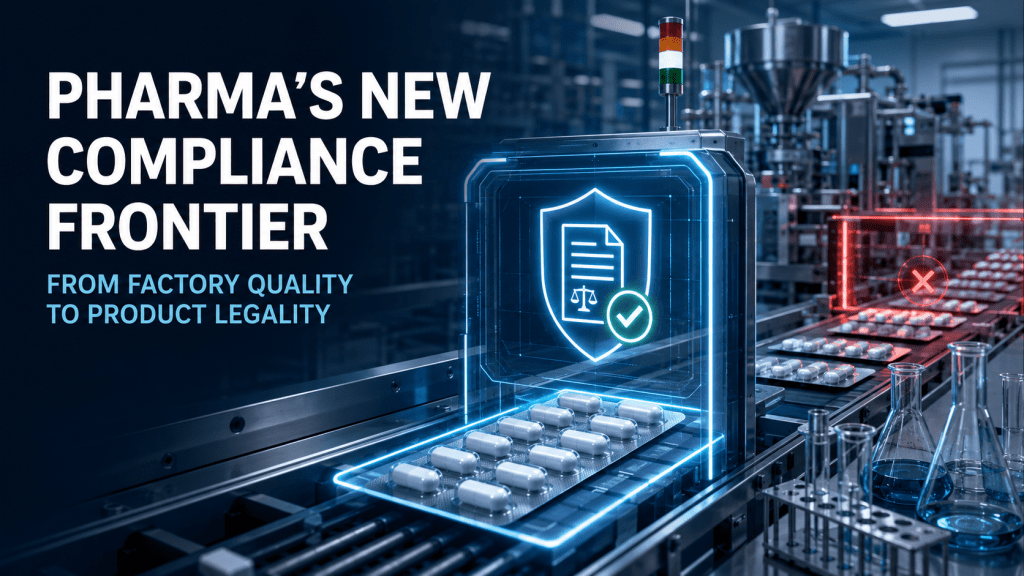
For decades, pharmaceutical compliance in India was largely understood through the factory. Was the manufacturing unit licensed? Did it follow Good Manufacturing Practices? Were its laboratories, equipment, records and quality-control systems adequate? These questions remain essential, but they no longer define the complete compliance frontier. A company may operate an apparently compliant factory and still manufacture a product that cannot legally be sold.
This distinction has been brought into sharp focus by the Central Drugs Standard Control Organisation’s action concerning Enclomiphene. CDSCO directed drug regulators in the states and Union Territories to identify and act against manufacturers, marketers, distributors and retailers dealing in Enclomiphene products and combinations without the approval required from the Central Licensing Authority. The regulator stated that these products fall within the definition of a new drug and have not been approved for manufacture and marketing in India. Its directions extend beyond manufacturers to the wider commercial chain and contemplate suspension or cancellation of permissions where applicable. “CDSCO public notice” (https://cdsco.gov.in/opencms/opencms/en/Notifications/Public-Notices/), “Express Pharma report” (https://www.expresspharma.in/cdsco-directs-action-against-unapproved-enclomiphene-drug-products/)
The message is larger than one drug. The next phase of pharmaceutical enforcement will increasingly examine not only how a medicine was manufactured, but whether that particular molecule, dosage, formulation, combination, indication and brand entered the market through the correct legal route.
From manufacturing quality to product legality
India’s pharmaceutical regulation developed historically around a serious public-health need: preventing adulterated, substandard and unsafe medicines. The Drugs and Cosmetics Act of 1940 created the foundational legal structure, while successive rules added requirements covering licensing, testing, clinical research, new drugs and manufacturing practices. As the industry expanded, compliance systems naturally became factory-centred. Inspectors examined premises, records, equipment, personnel and production conditions.
But modern pharmaceutical production has become far more fragmented. One enterprise may own the brand, another may hold the manufacturing licence, a third may undertake contract production, a digital platform may promote the product, and several distributors may move it across state boundaries. In such a system, a factory inspection can establish that a tablet was produced consistently. It cannot, by itself, establish that the tablet was legally authorised to exist in the market.
This is the crucial difference between product quality and product legality. Quality asks whether the medicine was made properly. Legality asks whether it was permitted to be made and sold at all. A product can satisfy manufacturing specifications and still lack the necessary central approval. Conversely, a legally approved product can become unsafe if it is manufactured badly. India must enforce both dimensions simultaneously.
The Enclomiphene case illustrates why commercial presence cannot be treated as evidence of regulatory approval. A product may appear on online platforms, be prescribed in certain channels, be marketed by several companies or be available through distributors. None of these conditions automatically makes it lawful. Repetition in the market can create the illusion of legitimacy, but regulatory legality does not arise through popularity.
The most exposed firms may not be the largest factories
This changing enforcement environment is especially important for small pharmaceutical manufacturers, loan-license operators, contract manufacturers, marketing companies, online pharmacies and wellness businesses entering medicine-adjacent markets.
Large companies normally maintain regulatory-affairs departments capable of examining approval history, legal classification, clinical requirements, labelling conditions and post-marketing responsibilities. Many smaller firms rely on consultants, brand owners, distributors or informal market intelligence. A contract manufacturer may assume that the marketing company has secured approval. The marketing company may assume that the manufacturer’s licence covers the product. A digital seller may believe that the existence of invoices and a drug licence is sufficient. Responsibility then circulates through the supply chain while accountability remains unclear.
This creates a dangerous business model: regulatory outsourcing without regulatory verification. Under stronger enforcement, a clause in a commercial agreement may not protect a company from suspension, product seizure, recall, reputational damage or legal action. Every participant will increasingly need verifiable evidence that the product, and not merely the production facility, is properly authorised.
Artificial intelligence will make this transition faster. Regulators will be able to compare product listings, composition claims, manufacturing licences, approval records, GST data and online advertisements at a scale impossible through physical inspection alone. An unapproved formulation advertised across multiple platforms can eventually be detected before an inspector visits the factory. In the coming regulatory system, the digital footprint of a medicine may become as important as the physical production record.
India is opening capital channels while tightening product boundaries
At first sight, stronger drug enforcement appears to sit uneasily beside India’s cautious liberalisation of foreign investment. Under the revised framework introduced in May 2026, certain entities with non-controlling ownership of up to 10 per cent from countries sharing a land border with India can use the automatic route, subject to sectoral caps and other conditions. By 20 August, 29 investments worth ₹4,895.65 crore had reportedly been recorded across pharmaceuticals, manufacturing, information technology, artificial intelligence, data centres and other activities. “Reuters” (https://www.reuters.com/world/india/india-gets-5115-million-fdi-under-new-policy-neighbouring-countries-2026-08-21/)
There is no real contradiction. India is gradually making it easier for legitimate capital to enter while making it more difficult for unauthorised products to remain in the market. This is likely to become the defining regulatory bargain of the next decade: easier investment, faster digital approvals and more global collaboration, combined with deeper traceability, stricter product-level accountability and quicker enforcement.
Pharmaceutical clusters should understand this shift early. New investment will not automatically raise the competitiveness of a cluster if local firms remain weak in regulatory intelligence. Capital can finance laboratories, machinery and production capacity, but it cannot compensate for uncertainty about whether a formulation has the necessary approval. In pharmaceuticals, regulatory knowledge is not an administrative overhead. It is productive infrastructure.
Pharma clusters need regulatory intelligence as a common facility
India’s major pharmaceutical clusters have traditionally built shared strengths around bulk drugs, formulation capacity, packaging, testing laboratories, logistics, specialised labour and supplier networks. Their next common facility may need to be less visible but equally important: a shared regulatory-intelligence system.
Such a system should continuously track approved drugs and fixed-dose combinations, conditions attached to approvals, changes in classification, licensing requirements, labelling rules, pharmacovigilance duties, safety alerts, recalls and enforcement orders. It should help a member enterprise answer a basic question before production begins: Is this exact product legally permitted, under what conditions, and which entity carries which responsibility?
Industry associations can establish regulatory help desks, shared databases and rapid-alert services. Common legal and scientific teams can review proposed products before commercial agreements are signed. Contract-manufacturing clusters can adopt a standard product-legality certificate requiring the brand owner to disclose the relevant approval, licence and pharmacovigilance arrangements. E-commerce platforms can require machine-verifiable approval information before listing higher-risk products.
Enforcement without accessible information can become retrospective punishment
This would convert compliance from an individual burden into a cluster capability. It would also reduce the disadvantage faced by smaller enterprises that cannot maintain large regulatory teams. Common testing laboratories helped clusters address the physical science of quality. The next generation of common infrastructure must address the institutional science of legality.
The regulatory state also carries a responsibility. Firms must not manufacture unapproved drugs, but compliance becomes unnecessarily difficult when approval information is fragmented, poorly indexed or difficult to interpret. A digital enforcement system cannot be fair or preventive if the underlying regulatory information remains scattered across notices, committee records, approval letters and state-level databases.
CDSCO should therefore create an authoritative, easily searchable and machine-readable national database covering approved new drugs, fixed-dose combinations, active pharmaceutical ingredients, formulations, approved manufacturers, indications, conditions, safety requirements and current regulatory status. Historical approvals, withdrawals, suspensions and modifications should also be visible. Every entry should carry a unique identification number that manufacturers, marketers, hospitals, pharmacies and online platforms can verify.
Such transparency would not weaken enforcement. It would make enforcement more credible. Regulators could distinguish deliberate violation from genuine ambiguity, while responsible businesses could check a product before investing in tooling, packaging, promotion and distribution. Banks and investors could also include regulatory-status verification in their due diligence.
Without this public infrastructure, digital enforcement may identify smaller firms only after they have committed violations. That produces punishment but not necessarily prevention. A mature regulatory system should make lawful conduct easier to identify before making unlawful conduct easier to prosecute.
The future pharmaceutical company will need a legal digital twin
The factory of the future will have a digital twin containing data on machinery, processes, output and maintenance. The pharmaceutical product will require something similar—a continuously updated legal and regulatory identity.
This legal digital twin would connect the product’s composition, approval, manufacturer, batch, licence, label, indication, distribution chain, adverse-event history and current regulatory status. A change in any critical condition could generate alerts across the supply chain. Pharmacies and consumers could verify authenticity and approval through a common identifier. Regulators could detect unauthorised combinations without waiting for a physical complaint.
This is where biotechnology, artificial intelligence and regulation will converge. As personalised medicines, biosimilars, cell therapies, digital therapeutics and AI-assisted drug development grow, the difference between a product, a process and a medical service will become less obvious. Regulation organised mainly around the traditional factory licence will struggle to govern this complexity.
India’s advantage will not come merely from producing medicines at lower cost. It will come from producing regulatory trust at scale. Countries and companies that can establish the legal identity, scientific validity, manufacturing history and post-market behaviour of every product will control the higher-value parts of future pharmaceutical supply chains.
The coming divide will be between informed and uninformed manufacturers
The next pharmaceutical divide may not simply separate large firms from small firms or compliant factories from non-compliant ones. It may separate enterprises that possess real-time regulatory intelligence from those operating through market assumptions.
A manufacturer that learns about a restriction after receiving an enforcement notice is already too late. A marketing company that treats widespread availability as proof of approval is confusing commercial evidence with legal evidence. A cluster that offers land, laboratories and subsidies but no regulatory-navigation infrastructure is preparing firms for the pharmaceutical industry of the past.
The Enclomiphene action should therefore be read as an early warning. Factory quality remains indispensable, but it is no longer sufficient. Every medicine must carry two forms of assurance: evidence that it was made correctly and evidence that it was legally allowed to enter the market.
The future of Indian pharma will depend on joining these two assurances into a single system of trust. The factory gate can no longer be the final boundary of compliance. The new boundary follows the product—from scientific development and central approval to contract manufacturing, digital promotion, distribution, patient use and post-market surveillance. India’s pharmaceutical clusters must follow it there.
Pharmaceuticals #Biotechnology #MSME #PharmaClusters #DrugRegulation #CDSCO #Compliance #Healthcare


Leave a Reply