The age of the self-contained sector is ending
For much of the twentieth century, industrial policy was organised into separate boxes. Agriculture belonged to one ministry, automobiles to another, electronics to a third and energy to a fourth. Each sector received its own incentives, institutions, research facilities, regulations and export-promotion machinery. This structure reflected an industrial world in which a car was mainly a mechanical product, food processing was largely about preservation, healthcare centred on medicines and hospitals, and electricity was generated by large, centralised plants.
That world is rapidly disappearing.
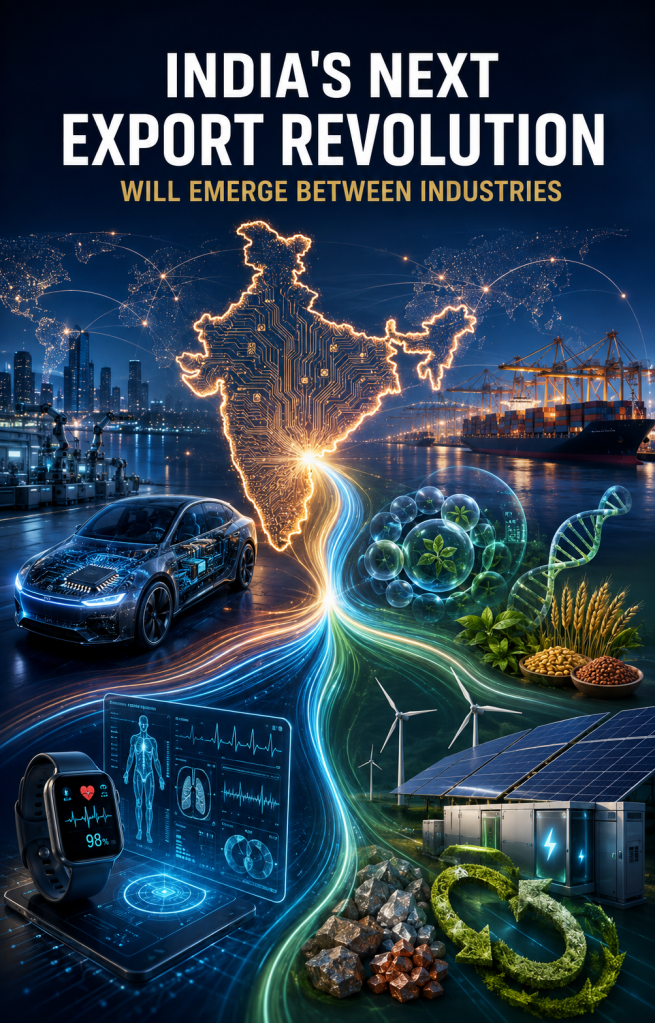
A modern electric vehicle is simultaneously an automobile, a computer, a battery system, a software platform, a communications device and a repository of valuable recyclable materials. A packet of exported food may involve biotechnology, satellite-based farm intelligence, sensor-controlled cold chains, digital traceability and sustainable packaging. Healthcare increasingly combines pharmaceuticals, medical electronics, artificial intelligence, cloud infrastructure and genomic science. Renewable energy is no longer only about generating electricity; it now connects mineral security, advanced materials, power electronics, mobility, storage and recycling.
The future, therefore, cannot be organised through isolated sectoral policies. Industrial growth will increasingly emerge at the intersections. Nations that understand these intersections will capture the high-value stages of global production. Those that continue to govern through administrative silos may manufacture more, but they will remain dependent on imported technologies, components, standards and intellectual property.
From exporting products to exporting integrated capabilities
India has already crossed important export milestones. Total exports of goods and services reached a record US$825.3 billion in FY2024–25, including merchandise exports of US$437.7 billion. Estimated exports rose further to approximately US$860.1 billion in FY2025–26. Electronics, pharmaceuticals, electrical machinery and automobiles have emerged as significant drivers of non-petroleum export growth. During April–September 2025 alone, electronic-goods exports grew by nearly 42 per cent over the corresponding period. These figures demonstrate progress, but they also reveal the next challenge: India must move from increasing export volume to increasing the domestic knowledge, technology and value embodied in every export. Department of Commerce export assessment FY2025–26 export estimate
The distinction is critical. Exporting a smartphone assembled with imported semiconductors, display systems, camera modules and manufacturing equipment is not economically equivalent to exporting a device built around domestically designed chips, embedded software, locally produced components and Indian intellectual property. Similarly, exporting a generic pharmaceutical formulation is different from exporting a biological therapy, diagnostic platform or digitally monitored treatment system.
India’s next export milestone should therefore not be measured only by whether exports cross US$1 trillion. It should be measured by whether the country becomes capable of exporting complete industrial solutions: an electric-mobility system rather than merely an automobile; an intelligent food-supply chain rather than only an agricultural commodity; a healthcare platform rather than only tablets and capsules; and a circular renewable-energy ecosystem rather than only solar modules.
Electronics and automobiles: the vehicle is becoming a digital export
The convergence of electronics and automobiles is perhaps the clearest example of the new industrial economy. Conventional vehicles were built around engines, transmissions and mechanical components. Electric and connected vehicles depend increasingly on batteries, semiconductors, sensors, power electronics, navigation systems, embedded software, cybersecurity and data analytics.
This shift creates a historic export opening for India. The country is already one of the world’s major vehicle producers, but its share in globally traded automobile components remains only around 3 per cent. The national industry’s Vision 2030 roadmap seeks auto-component exports of about US$60 billion. Yet that ambition cannot be achieved by improving mechanical engineering alone. The future export basket must include battery-management systems, charging equipment, automotive semiconductors, electric drivetrains, telematics, lightweight materials, vehicle software and recycling technologies. India and automotive global value chains
India has established important milestones through automotive and advanced-chemistry-cell incentive programmes, electric-mobility schemes and expanding electronics manufacturing. The next task is to connect them. At present, an automobile cluster, an electronics cluster, a battery project, a software hub and a recycling facility may operate under different policy frameworks even when they are parts of the same value chain.
Export competitiveness will require convergence at the cluster level. Chennai, Pune, Bengaluru, Hyderabad, the National Capital Region and Gujarat should be developed not merely as automobile or electronics locations but as integrated mobility-technology ecosystems. Common facilities should provide semiconductor validation, electromagnetic-compatibility testing, battery safety certification, automotive cybersecurity assessment, prototyping and material-recovery services. MSMEs producing conventional components must be helped to enter electric and electronic systems before their existing product markets begin to contract.
The danger is that India could become a large assembler of electric vehicles while remaining dependent on imported cells, magnets, chips, controllers and critical minerals. That would replace petroleum dependence with technology and mineral dependence. The objective must be to export not just electric vehicles, but the intelligence inside them.
Biotechnology and food: exporting nutrition, resilience and trust
India’s agricultural exports have traditionally depended on rice, spices, marine products, tea, coffee, sugar and other commodities. These sectors remain important, but future value will increasingly come from the convergence of food processing and biotechnology.
Fermentation technologies, microbial inputs, bio-preservation, plant proteins, precision nutrition, disease-resistant crops, functional foods, biodegradable packaging and waste-to-value processes are transforming the food economy. Biotechnology can extend shelf life, improve nutritional quality, reduce chemical intensity and convert agricultural residues into enzymes, biofuels, biomaterials and industrial ingredients.
India’s bioeconomy reportedly expanded from approximately US$10 billion in 2014 to US$165.7 billion in 2024, with an official ambition of reaching US$300 billion by 2030. More recent official reporting placed it at US$195.3 billion in 2025. This growth is a major milestone, but the real export opportunity lies in connecting the bioeconomy to India’s enormous agricultural and food-processing base. India’s bioeconomy trajectory
The next generation of Indian food exports could include clinically validated nutraceuticals, personalised nutrition products, plant-based proteins, natural food ingredients, probiotic formulations and low-carbon biomaterials. Rural regions could become biomanufacturing locations rather than merely sources of raw material.
However, bio-food exports operate in a demanding world of sanitary standards, traceability, scientific claims, biodiversity rules and intellectual-property protection. A nutraceutical cannot be exported successfully merely because it is traditional or natural. Its ingredients, safety, efficacy, contamination risks and health claims must be scientifically validated.
This presents a major challenge for small enterprises. India possesses traditional knowledge and biological diversity, but laboratory infrastructure, regulatory expertise, clinical validation and international certification remain concentrated. Without shared facilities and credible institutions, large companies may commercialise this knowledge while farmers, traditional producers and microenterprises remain low-value suppliers.
Biotechnology policy, food-processing policy, agricultural research, export promotion and biodiversity governance must therefore be brought into one operational framework. Otherwise, India may export raw botanical material and later import the same biological value in the form of branded, patented and expensive products.
Digital technology and healthcare: beyond the pharmacy of the world
India’s pharmaceutical-export story is one of its most important industrial achievements. Pharmaceutical exports rose from about US$1.9 billion in 2000–01 to US$30.5 billion in 2024–25, reaching 191 countries. Approximately half went to highly regulated markets such as the United States and Europe. Medical-device exports also increased from roughly US$2.5 billion in FY2020–21 to US$4.1 billion in FY2024–25. India’s pharmaceutical export performance
But future global healthcare will not be divided neatly between medicines, devices and information technology. Treatment will increasingly combine diagnostics, drugs, remote monitoring, artificial intelligence, wearable devices and personalised data. The exportable product may not be a single medicine; it may be an integrated system that identifies risk, recommends treatment, monitors adherence and alerts medical professionals.
India has a rare combination of pharmaceutical manufacturing, medical talent, digital capability and a vast, diverse population. This could support globally competitive digital-health platforms, affordable diagnostics, AI-assisted imaging, remote-care systems and disease-management solutions suited to emerging markets.
Yet this opportunity carries difficult questions. Who owns health data? How will algorithms be clinically validated? Can Indian products comply simultaneously with multiple privacy, cybersecurity and medical-device regimes? Will digital-health companies be treated as software providers, medical-device producers or healthcare institutions?
Fragmented regulation could prevent promising technologies from reaching international markets. India needs common regulatory pathways connecting drugs, devices, software and clinical services. Export-readiness facilities should help companies undertake clinical validation, cybersecurity testing, data-governance assessment and certification for major markets.
The strategic ambition should be to move beyond being the pharmacy of the world and become a provider of affordable, trusted and digitally enabled healthcare systems.
Renewable energy, materials and recycling: the circular export frontier
The clean-energy transition is often described as a shift from fossil fuels to renewable power. In industrial terms, it is equally a shift towards minerals, advanced materials, batteries, electronics and recycling.
Solar modules require polysilicon, specialised glass, aluminium, silver and power electronics. Wind turbines depend on steel, composites and, in some designs, rare-earth magnets. Batteries require lithium, nickel, cobalt, graphite, copper and complex chemical processing. When these products reach the end of their lives, they become potential sources of secondary minerals.
This means that renewable-energy policy cannot remain separated from mining, materials science, manufacturing and waste management. A country may install enormous renewable capacity while importing most of the equipment and minerals. Such a transition may improve energy security without building adequate industrial strength.
India’s establishment of the National Critical Mineral Mission in 2025 was an important milestone. The mission provides for expanded exploration, research centres, patents and recycling capacity, including a ₹1,500 crore incentive programme for critical-mineral recycling. The deeper export opportunity, however, lies in turning recycling into an advanced manufacturing industry. National Critical Mineral Mission
India should aim to export battery-recovery technologies, recycled materials, energy-storage systems, power electronics, green industrial equipment and circular-economy services. Industrial clusters could establish shared systems for collecting used batteries, solar modules, electronic waste and industrial scrap. Digital product passports could record material origin, carbon intensity, repair history and recyclability.
This will become increasingly important as international markets impose carbon, traceability and circularity requirements. In the future, an exporter may have to prove not only what a product contains, but where its materials came from, how much carbon was emitted and how the product will be recovered after use.
The hidden weakness: institutions still follow yesterday’s classifications
The largest barrier to industrial convergence may not be technological. It may be administrative.
Government departments are organised by sector. Banks classify borrowers by conventional industry codes. Industrial estates are often designed around static product categories. Universities separate engineering, biology, medicine and business into institutional compartments. Export-promotion bodies frequently represent individual industries, while modern products cross several of them.
A company developing an AI-enabled diagnostic device may need to navigate electronics regulation, medical-device approval, software certification, clinical validation, data-protection rules and export compliance. A battery-recycling enterprise may interact with mining, chemicals, environment, transport, energy and automobile authorities. The more innovative a product becomes, the more regulatory borders it crosses.
This creates an innovation paradox: policies encourage technological convergence, but institutions penalise enterprises for not fitting into an established category.
India needs mission-based industrial governance built around emerging value chains rather than inherited departmental boundaries. Possible missions could cover intelligent mobility, bio-based food systems, digital health, circular energy technologies and climate-resilient materials. Each mission should bring together research, standards, finance, skills, infrastructure, procurement and export promotion.
Milestones India must now pursue
The first milestone is to move from production-linked incentives towards value-chain-linked capability development. Incentives should reward domestic design, component depth, patents, testing capacity, supplier development and export diversification, not only final production.
The second is to develop convergence clusters. Existing clusters should be mapped according to technological relationships. An automobile cluster must connect with electronics, software, batteries and recycling. A food-processing cluster must connect with biotechnology, packaging, logistics and testing. A pharmaceutical cluster must connect with devices, digital health and clinical research.
The third is to create shared export infrastructure for MSMEs. Advanced laboratories, pilot plants, clean rooms, design centres, certification facilities, data platforms and technology-demonstration centres are too expensive for most small enterprises to establish individually. Cluster-level ownership can convert these fixed costs into shared competitiveness.
The fourth is to build an Indian standards-to-market system. International standards should not be treated as paperwork completed at the end of production. Standards intelligence must enter product design, material selection and supplier development from the beginning.
The fifth is to make services part of the manufacturing export strategy. Engineering design, embedded software, remote maintenance, product analytics, clinical support and digital monitoring can raise the lifetime value of physical exports. India’s strength in services should be integrated with, rather than kept separate from, manufacturing.
The sixth is to measure domestic value and knowledge intensity. Export statistics should distinguish between assembly-driven exports and exports based on locally developed components, processes, designs and intellectual property.
The challenges cannot be underestimated
Industrial convergence also produces new vulnerabilities. India remains dependent on imported semiconductors, specialised machinery, critical minerals, active pharmaceutical ingredients and advanced materials. High logistics and financing costs affect MSMEs disproportionately. Research institutions and industry frequently operate at different speeds. Skills programmes are still organised around occupations that may be transformed by automation within a few years.
Global markets are also becoming more political. Tariffs, subsidies, carbon-border measures, local-content rules, data restrictions and strategic technology controls are reshaping trade. Export success can no longer depend only on lower production costs. It requires geopolitical awareness, regulatory diplomacy, diversified markets and resilient supply chains.
There is also a danger that convergence will strengthen only a few large corporations. Without supplier-development programmes, technology extension services and shared facilities, MSMEs may be excluded from advanced value chains. The objective should not be to place small firms at the weakest end of a sophisticated chain, but to help them acquire specialised capabilities that give them bargaining power.
The export map of the future
India’s next export revolution will not be built inside the traditional boundaries of electronics, automobiles, food, biotechnology, healthcare or renewable energy. It will emerge between them.
The most valuable export may be an electric commercial vehicle with Indian software, battery management and recycled materials. It may be a bio-based food ingredient supported by farm traceability and scientific validation. It may be an affordable diagnostic device connected to a secure digital-health platform. It may be an energy-storage system designed for tropical conditions and supported by a closed-loop recycling network.
The central policy question must therefore change. Instead of asking how to increase the exports of each sector separately, India must ask what combinations of capabilities the world will need—and where Indian enterprises, clusters and institutions can build them together.
The country that organises industrial policy around yesterday’s sectors will export yesterday’s products. The country that builds institutions around technological intersections will shape tomorrow’s markets. India has already demonstrated that it can scale production and exports. Its next test is more demanding: whether it can connect its capabilities deeply enough to become not merely a manufacturing location, but a designer and exporter of integrated solutions for a rapidly changing world.
#IndianExports #IndustrialPolicy #Manufacturing #MSME #IndustrialClusters #GlobalValueChains #Electronics #AutomobileIndustry #Biotechnology #DigitalHealth #RenewableEnergy #CircularEconomy #ExportStrategy #MakeInIndia


Leave a Reply