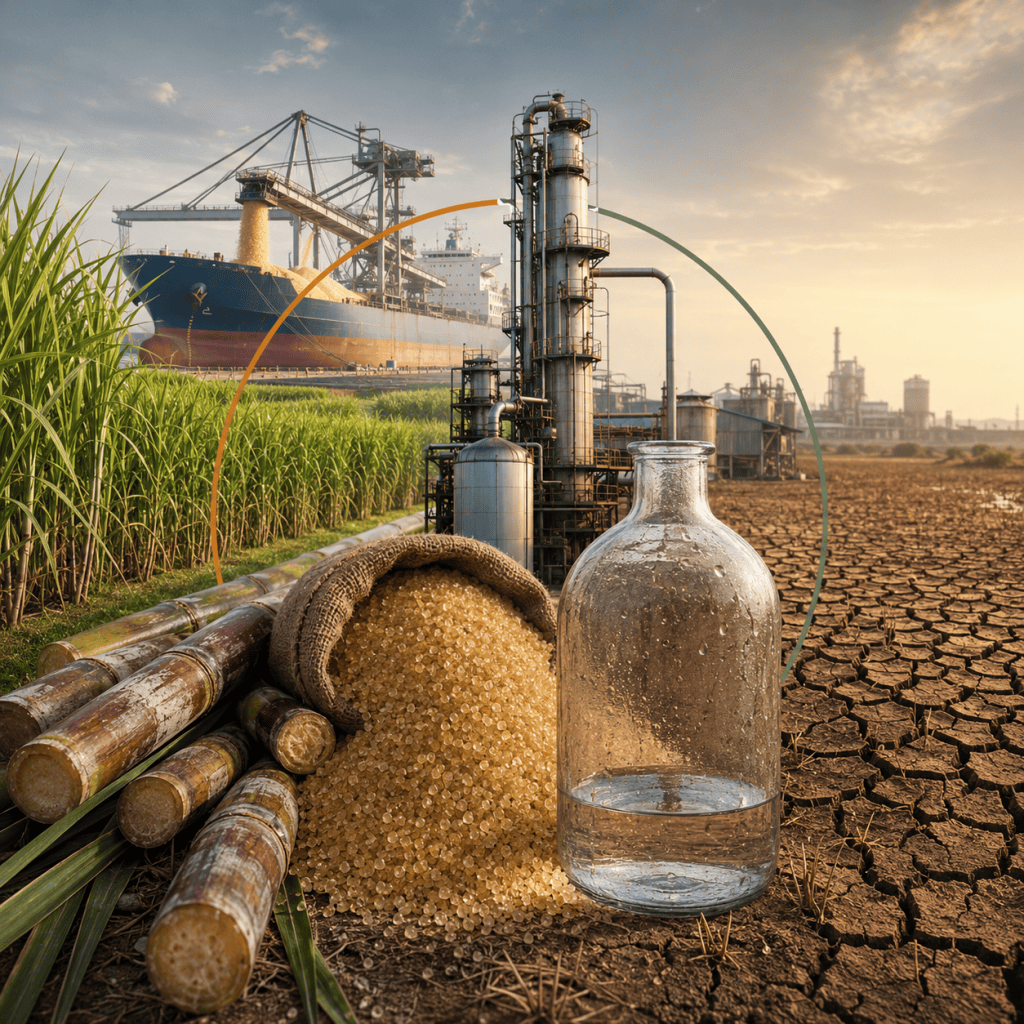
From Surplus Power to Supply Anxiety
For years, India’s sugar economy was built around abundance. Sugarcane was not merely an agricultural crop; it became a political contract linking farmers, cooperative mills, private industry, rural employment and state power. Governments fixed cane prices, banks financed mills, industries invested in distilleries, and policymakers treated surplus sugar as a resource that could be exported or converted into ethanol. The system appeared to have solved an old problem: too much sugar, too little liquidity and long delays in payments to farmers.
That confidence has now been shaken.
On 20 August 2026, India permitted the duty-free import of one million tonnes of raw sugar under a limited quota, valid until 31 October. The normal import duty is 100%. It is the country’s first major opening for sugar imports in nearly a decade. The decision followed an increase of almost 40% in domestic sugar prices over two months as weaker production tightened supplies. The government expects imports and the release of stocks held by port-based refiners to soften prices before the festival season. “Reuters reported” (https://www.reuters.com/world/india/india-allows-duty-free-imports-sugar-2026-08-20/) that roughly 300,000 tonnes could enter the domestic market relatively quickly through such refiners, although larger shipments from Brazil may arrive only closer to October.
This is more than a temporary trade adjustment. It is a warning that India’s sugar economy is moving from predictable surplus to climate-sensitive uncertainty.
The Historical Cycle Has Turned Again
India’s sugar policy has always moved between two fears: the fear of surplus and the fear of shortage. When production rises, prices weaken, mills accumulate stocks and cane payments are delayed. The government then supports exports, encourages ethanol diversion or provides financial relief. When production falls, exports are restricted, stock limits are imposed and imports become politically unavoidable.
The ethanol programme was partly designed to escape this cycle. Instead of treating excess sugar as a burden, mills could convert sugarcane juice, syrup and molasses into fuel. This strengthened mill liquidity, supported farmer payments and reduced petroleum dependence. In 2022, the government estimated sugar production at about 35 million tonnes after diverting 3.5 million tonnes for ethanol, against domestic consumption of approximately 27.8 million tonnes. It was then planning to raise annual diversion to 5–6 million tonnes. “The official policy narrative” (https://www.pib.gov.in/PressReleaseIframePage.aspx?PRID=1818130) was therefore built around managing excess production.
The import decision reveals how quickly the underlying equation can change. A crop assumed to be abundant has become vulnerable to erratic rainfall, heat, disease, falling recovery rates and regional water stress. A policy architecture created for surplus management must now operate under shortage risk.
Ethanol Is Not the Villain—but Feedstock Certainty Is an Illusion
It would be simplistic to blame the present price increase entirely on ethanol. The government states that the share of sugar diverted for ethanol declined from around 12% in 2022–23 to approximately 9% in 2025–26. It also says that nearly three-fourths of Indian ethanol is now produced from grains, particularly maize. “These figures” (https://www.pib.gov.in/PressReleasePage.aspx?PRID=2302018&lang=1®=48) weaken the argument that ethanol diversion alone created the present shortage.
But this defence does not remove the deeper policy problem. Ethanol capacity, sugar availability, food demand and water use are connected even when their immediate statistical relationship changes from one season to another. Distilleries and sugar mills make investments over 10 or 15 years, while feedstock allocations can be changed within months. A distillery financed on the assumption of regular cane-based supply becomes vulnerable when the government must suddenly prioritise household sugar availability. Lenders, machinery manufacturers and ancillary MSMEs inherit the same uncertainty.
The real issue is therefore not sugar versus ethanol. It is fixed industrial capacity competing for a climate-sensitive agricultural resource under an unpredictable allocation system.
India has diversified ethanol towards grains, but that does not eliminate the food-and-resource question; it merely moves part of it from cane to maize and other crops. The country cannot build energy security by transferring water, land and price pressure from one commodity chain to another. Future ethanol policy must be feedstock-flexible, region-specific and based on measurable resource availability.
The Missing Commodity Is Water
Sugar policy is usually discussed in tonnes, prices and blending percentages. Its most important unit, however, may be the cubic metre of water.
Sugarcane is concentrated in Maharashtra, Karnataka and Uttar Pradesh, but the water economics of these regions differ sharply. In several drought-prone districts of Maharashtra and Karnataka, cane competes with drinking water, other crops and groundwater recovery. Yet mills and distilleries create local economic dependence: once capacity is installed, farmers are encouraged to continue supplying cane even where the agro-climatic logic is weak.
This produces a dangerous contradiction. The factory requires cane every year, but the landscape cannot guarantee it every year. Climate change will widen that gap. Rainfall may remain adequate at the national level while its timing, intensity and geographical distribution become increasingly unsuitable for cane. A single production estimate cannot capture these regional risks.
India’s next sugar shortage may therefore begin not at the mill gate but in an aquifer, a delayed monsoon, a heat-affected crop or a decline in sugar recovery. Import policy can replace missing sugar temporarily. It cannot import water security for domestic cane-growing regions.
One Million Tonnes Can Calm Prices, Not Repair the System
Duty-free imports are defensible as an emergency measure. Consumers, sweet manufacturers, bakeries, beverage firms and food-processing MSMEs cannot be expected to absorb a 40% price shock without passing it through to retail prices. Festival-season demand adds urgency, and a temporary import window may reduce panic buying and speculative stocking.
But timing matters. Raw sugar must be contracted, transported, refined and distributed. If substantial volumes arrive only near October, the measure may influence market expectations before it materially increases physical supply. Traders may lower prices in anticipation, but structural scarcity cannot be solved through sentiment alone.
The distribution of benefits will also be uneven. Port-based refineries with logistics infrastructure, import experience and access to working capital are best positioned to use the quota. Inland mills may face lower sugar prices without receiving cheaper cane or more reliable feedstock. Smaller food processors may obtain some price relief, yet they remain exposed to volatility in transport, finance and wholesale distribution.
Imports may therefore stabilise the national average price while producing very different outcomes across regions and enterprises.
Sugar Clusters Must Stop Planning Through the Rear-View Mirror
The immediate lesson for Maharashtra, Karnataka and Uttar Pradesh is uncomfortable: past cane availability is no longer a sufficient basis for future capacity.
Sugar clusters should not continue expanding single-feedstock ethanol plants merely because earlier seasons produced surpluses. Every new investment should undergo a combined climate, water and feedstock stress test. This must examine rainfall variability, groundwater conditions, crop disease, recovery rates, competing food demand and the probability of government restrictions on diversion.
Distilleries should be designed for greater feedstock flexibility where technically, environmentally and commercially feasible. Bagasse-based energy, compressed biogas, crop-residue processing, biochemicals and circular use of press mud can diversify cluster income. But diversification should not become an excuse to build additional resource-intensive capacity without assessing local carrying limits.
Common infrastructure will also become more important. Cluster-level wastewater treatment, water accounting, drip-irrigation support, drought-resilient cane varieties, crop forecasting and shared biomass logistics can reduce costs that individual mills or MSMEs cannot manage alone. The future sugar cluster will have to operate as a resource-management system, not merely as a collection of crushing and distillation units.
The MSME Shock Will Travel Beyond Sugar Mills
Sugar volatility affects a much wider industrial network than is usually recognised. Small engineering firms manufacture boilers, evaporators, centrifuges, storage tanks, pumps, valves and distillery components. Transport operators move cane and finished sugar. Packaging firms, repair workshops, laboratories, jaggery units, bakeries, confectionery manufacturers and beverage companies depend directly or indirectly on stable supply.
When policy changes suddenly, these enterprises experience the shock without possessing the financial reserves of large companies. Equipment suppliers may see ethanol orders postponed. Small food manufacturers face working-capital stress. Inland refiners lose competitiveness against port-based facilities. Contractors and seasonal workers face shorter operating periods when cane availability declines.
A sugar import decision is therefore also an MSME policy decision, an industrial-cluster decision and a rural-employment decision. Yet these consequences are rarely included in trade and stock-management announcements.
India Needs a Sugar–Fuel–Water Allocation Framework
The present system relies too heavily on discretionary corrections after the market has already tightened. India needs a transparent framework that connects four numbers: expected sugar production, minimum domestic stocks, realistic ethanol-feedstock requirements and permissible exports or imports.
The framework should be published before each season and updated at predetermined intervals using rainfall, reservoir, acreage, yield and recovery data. It should contain clear trigger points. If production falls below a defined range, export permissions and ethanol allocations should adjust automatically. If stocks rise above the required buffer, additional diversion or exports could be allowed. Import decisions should follow publicly understood thresholds rather than arrive as emergency surprises.
Such a system would not remove climate risk, but it would reduce policy risk. Mills could plan production. Distilleries could assess feedstock exposure. Banks could price loans more accurately. Equipment manufacturers could judge future demand. Farmers would receive clearer crop signals. Importers and exporters would be less exposed to sudden reversals.
Transparency is not a technical luxury. It is productive infrastructure.
The Future Is Not More Sugar or Less Sugar—It Is Smarter Allocation
India’s return to sugar imports does not mean that the ethanol programme has failed, nor does it mean that the country has permanently lost its sugar surplus. Agricultural production will continue to fluctuate. Some years may again produce enough sugar for domestic consumption, ethanol and exports.
The deeper warning is that future abundance cannot be assumed from historical production. Climate instability is turning seasonal variation into investment risk. India has built factories, distilleries and blending targets around biological supply chains that are becoming less predictable. The policy system must now become more adaptive than the climate system is disruptive.
The country should gradually move from single-crop energy planning towards a diversified bioeconomy based on regionally appropriate feedstocks, agricultural residues, waste and more advanced ethanol pathways. At the same time, cane-growing regions must place water productivity—not simply tonnes of cane per hectare—at the centre of agricultural incentives.
The import opening of August 2026 may succeed in cooling prices. But if it is treated only as a festival-season intervention, its larger message will be lost. India is no longer managing a simple sugar surplus. It is managing a three-way contest among food security, fuel ambition and ecological limits.
The future of the sugar industry will not be decided by how much cane India can crush in a good year. It will be decided by whether the country can allocate scarce land, water and feedstock intelligently in a difficult one.
SugarIndustry #Agriculture #FoodSecurity #Ethanol #WaterSecurity #ClimateRisk #MSME #IndustrialClusters #Biofuels #AgriculturalPolicy #IndiaEconomy


Leave a Reply