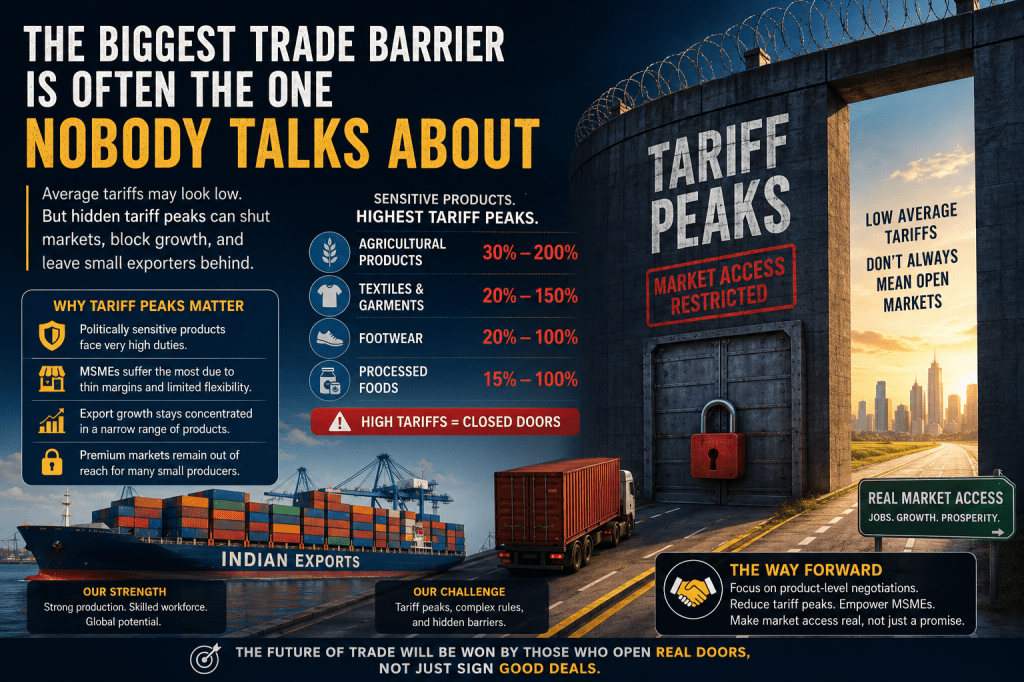
Before we celebrate falling average tariffs, one uncomfortable question deserves attention. Average for whom? Trade policy often speaks in averages because averages sound reassuring. Yet global trade does not operate on averages. It operates product by product, shipment by shipment, and industry by industry. Hidden behind impressive national tariff statistics are tariff peaks, extremely high duties imposed on products that governments consider politically, socially, or economically sensitive. These are the invisible walls of modern trade. Markets may appear open on paper, while in reality many doors remain firmly locked.
The Invisible Walls Behind Open Markets
History shows that countries have always protected sectors that influence employment, rural livelihoods, food security, or domestic politics. Agriculture has traditionally enjoyed high protection across developed and developing economies. As manufacturing evolved, textiles, garments, footwear, dairy products, sugar, processed food, and selected consumer goods also entered the list of sensitive sectors. While trade agreements reduced average tariffs over several decades, these politically important products often remained protected through exceptionally high duties. The result is a global trading system where openness exists alongside carefully designed barriers.
For India, this distinction is far more important than headline tariff numbers suggest. India has developed strong capabilities in agriculture, processed food, textiles, garments, leather products, footwear, handicrafts, and several labour-intensive industries. Ironically, many of these are precisely the sectors where importing countries maintain some of their highest tariffs. An exporter may hear that a country has an average tariff of only a few percentage points, only to discover that the specific product they manufacture attracts duties many times higher. Market access then becomes more of an illusion than an opportunity.
When MSMEs Carry the Heaviest Burden
Large multinational corporations have options when faced with high tariffs. They can shift production across countries, establish overseas factories, negotiate bulk contracts, or absorb temporary losses. India’s MSMEs rarely enjoy such flexibility. A small exporter from Tiruppur, Kanpur, Moradabad, Jaipur, Ludhiana, or Panipat depends on narrow profit margins where even a modest increase in import duty can erase competitiveness. High tariffs often become a silent tax on entrepreneurship rather than merely a tax on products.
The challenge extends beyond pricing. Buyers in international markets naturally seek suppliers with stable costs and predictable access. If tariff peaks make Indian products expensive compared with competing suppliers, long-term contracts may move elsewhere. Once these relationships are lost, rebuilding trust can take years. The hidden cost is therefore not only today’s export but tomorrow’s market presence.
Looking Beyond National Averages
Trade negotiations frequently celebrate reductions in average tariff levels. While politically attractive, averages conceal commercial realities. What matters to an exporter is not the national average but the exact tariff applicable to the product they manufacture. A country may proudly advertise liberal trade policies while maintaining exceptionally high duties on precisely those goods where foreign competitors hold comparative advantages.
Future trade diplomacy must therefore become far more product-specific. Negotiators should identify sectors with genuine export potential and target reductions in tariff peaks rather than seeking broad statistical improvements. A single reduction on a high-value export product can create more commercial opportunity than dozens of reductions on products with little trade potential.
The Risk of Narrow Export Growth
If tariff peaks continue to dominate sensitive sectors, India’s export basket may become increasingly concentrated. Growth could remain confined to products facing relatively lower trade barriers, while labour-intensive industries struggle to expand. Such concentration creates vulnerability. A few successful sectors cannot generate employment at the scale required by a rapidly growing economy.
This challenge becomes particularly significant because labour-intensive exports remain one of the fastest ways to create jobs, increase rural incomes, and strengthen manufacturing ecosystems. Restricting these sectors through tariff peaks does not merely distort trade; it also slows inclusive economic development.
The Future May Reward Strategy More Than Production
Global trade is gradually shifting from a world where producing efficiently is enough to one where navigating policy barriers becomes equally important. Export competitiveness will increasingly depend on understanding tariff schedules, free trade agreements, rules of origin, sustainability standards, and geopolitical priorities. Market intelligence may become as valuable as manufacturing capability itself.
For India, this means strengthening institutional support for MSMEs. Product-level tariff databases, early warning systems, specialised trade advisory services, and better negotiation strategies can help smaller firms compete more effectively. Trade policy must evolve from simply promoting exports to actively removing the hidden barriers that prevent exports from growing.
The Real Test of Trade Liberalisation
The future of global trade will not be judged by average tariff rates displayed in international reports. It will be judged by whether a farmer, a weaver, a footwear manufacturer, a food processor, or a small entrepreneur can actually sell products in global markets without facing prohibitive barriers. Tariff peaks remind us that protectionism has not disappeared; it has simply become more selective and sophisticated.
The next generation of trade agreements must move beyond attractive averages and confront these hidden barriers directly. Otherwise, countries may continue to sign ambitious agreements, publish optimistic trade statistics, and celebrate expanding partnerships while millions of small producers remain locked outside the very markets they were promised. In the coming decade, the true measure of successful trade policy will not be how open economies appear, but how accessible global markets become for those who need them the most.
GlobalTrade #India #MSMEs #Exports #TradePolicy #Tariffs #Manufacturing #EconomicDevelopment #MarketAccess #FutureEconomy


Leave a Reply