When One Border Tax Begins a Chain Reaction
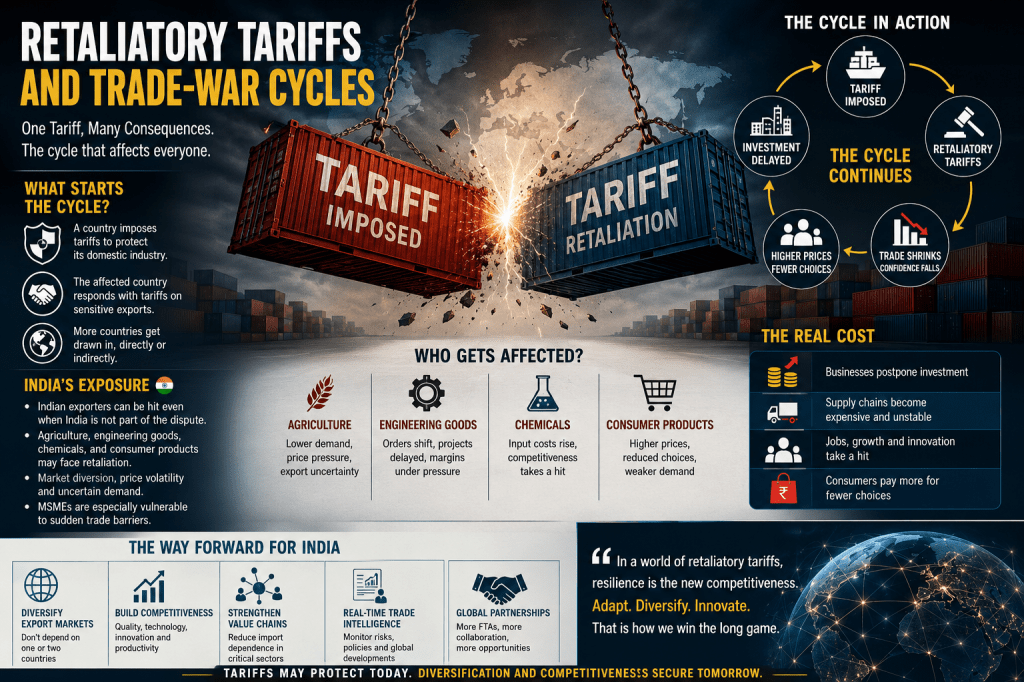
Trade wars rarely begin with a declaration. They often begin quietly with a tariff placed on steel, machinery, agricultural products, technology, chemicals, or consumer goods. The decision may initially appear limited to one product or one country. However, tariffs rarely remain isolated for long. The affected country may respond by imposing duties on products that create economic pressure, political discomfort, or public attention. One tariff creates another, retaliation invites counter-retaliation, and trade slowly moves from cooperation towards confrontation.
History Shows That Tariffs Can Travel Far Beyond Their Original Purpose
The history of international trade repeatedly shows that protection can produce consequences much larger than expected. During periods of economic uncertainty, governments have often used tariffs to protect domestic industries, preserve employment, or respond to unfair trade practices. Some protection has helped industries gain time to modernise. However, when many countries adopt the same approach, global trade can contract, business confidence can weaken, and economic recovery can become more difficult.
The deeper problem is that retaliatory tariffs are not always imposed on the industry involved in the original dispute. A disagreement over metals may affect agricultural exports. A conflict involving technology may reach food products, chemicals, automobiles, textiles, or consumer goods. Governments often select products where tariffs can create maximum economic and political pressure. As a result, farmers, workers, exporters, small businesses, and consumers may pay for disputes they did not create.
Trade wars therefore behave less like a controlled policy instrument and more like a chain reaction. The first tariff may have a clear objective, but every response creates new interests, new pressures, and new demands for further protection.
India May Be Affected Without Being at the Centre of the Conflict
India occupies a complex position in this changing trade environment. It is a major exporter, a large consumer market, an emerging manufacturing economy, and an important participant in global supply chains. This creates opportunities, but it also increases exposure to trade conflicts.
Indian exporters may face difficulties even when India is not directly involved in the original dispute. A tariff conflict between two large economies can redirect goods towards other markets. Products that become expensive in one country may enter India or compete with Indian exports in third countries. Global prices may fall in some sectors while imported inputs become more expensive in others. The impact can move across borders faster than traditional trade policy can respond.
Agriculture may become particularly vulnerable because agricultural products are economically important and politically sensitive. Farmers may suddenly face lower export demand or greater price uncertainty. Engineering goods can become targets because they are connected with manufacturing competitiveness and industrial employment. Chemicals may be affected because they serve multiple industries and global value chains. Consumer products can also become part of retaliation because higher prices are quickly noticed by businesses and households.
The most serious risk is uncertainty. An exporter can plan for a known tariff, but it is difficult to plan for a tariff that may appear suddenly after a political disagreement. Orders may be delayed, contracts may be reconsidered, and buyers may search for suppliers in countries facing lower trade barriers.
The Unexpected Winners May Also Face Hidden Risks
Trade conflicts can create short-term opportunities. If one country imposes high tariffs on products from another country, Indian exporters may gain access to the resulting market gap. New orders may emerge in engineering goods, chemicals, textiles, processed food, pharmaceuticals, electronics, or industrial products.
However, temporary trade diversion should not be confused with permanent competitiveness. A market opportunity created by political conflict may disappear when relations improve, tariffs are reduced, or competitors establish production in other locations. Businesses that invest heavily only because of a temporary tariff advantage may face difficulties when trade conditions change.
India should therefore use trade diversion as an entry opportunity rather than a long-term business model. New market access must be supported by quality improvement, reliable delivery, competitive pricing, technology, branding, compliance, and stronger relationships with international buyers. A tariff may open a door, but competitiveness determines whether the door remains open.
Export Diversification Is Becoming Economic Insurance
For many years, export diversification was treated mainly as a growth strategy. In the emerging global economy, it is becoming a form of risk protection.
Dependence on one major market may increase sales during stable periods, but it can become dangerous when tariffs change suddenly. Indian businesses need a wider portfolio of markets across Europe, North America, Africa, Southeast Asia, West Asia, Latin America, and other emerging regions. Diversification should also extend beyond geography. Exporters need a broader range of products, customers, supply sources, logistics routes, and payment arrangements.
For MSMEs, diversification is more difficult because entering a new market requires information, certification, finance, local partnerships, and sustained marketing. Smaller exporters may not have the resources to manage several markets independently. Export promotion institutions, industry associations, clusters, digital platforms, and trade-support organisations must therefore help businesses develop shared market intelligence and collective export strategies.
Future competitiveness may depend less on finding one large buyer and more on building a network of stable buyers across different economic regions.
Trade Uncertainty Can Become More Expensive Than the Tariff
The visible cost of a trade war is the tariff. The invisible cost is delayed investment.
Businesses invest when they can estimate future demand, production costs, market access, and expected returns. Repeated tariff changes weaken these assumptions. A company planning a new factory may postpone investment because export conditions are uncertain. A manufacturer may delay purchasing machinery because imported components could become more expensive. An international company may reconsider the location of its next production facility.
When many businesses delay decisions at the same time, economic growth can weaken even before trade volumes decline. Employment generation may slow, technology investment may be postponed, and supply-chain development may lose momentum.
The future trade risk is therefore not limited to higher duties. It is the possibility that uncertainty becomes a permanent feature of international business.
Consumers May Become the Silent Participants in Trade Wars
Tariffs are generally discussed as disputes between governments, but consumers often carry part of the economic burden. Imported products may become more expensive. Domestic producers may face higher costs for imported machinery, components, chemicals, metals, or raw materials. These additional costs may gradually enter the prices of food, vehicles, electronics, household goods, industrial products, and services.
Consumers may also face fewer choices if businesses reduce imports or withdraw products from markets affected by high tariffs. Domestic production may expand over time, but building competitive capacity requires investment, skills, technology, infrastructure, and scale. Tariffs alone cannot guarantee affordable or high-quality alternatives.
Protection may sometimes be necessary, particularly for strategic industries. However, protection without clear performance expectations can reduce competitive pressure. Industries receiving support should be encouraged to improve productivity, technology, quality, investment, and global competitiveness. Otherwise, temporary protection may become a permanent cost for consumers and downstream industries.
The Future May Bring Continuous Trade Friction Rather Than One Large Trade War
The next phase of global trade may not be defined by a single worldwide trade war. It may involve many smaller and overlapping conflicts. Tariffs may be linked with national security, technology leadership, climate policy, industrial subsidies, critical minerals, energy security, digital trade, and supply-chain resilience.
Countries may impose tariffs not only to protect industries but also to influence investment decisions and reduce dependence on strategic competitors. Trade policy may become closely connected with foreign policy. Businesses may increasingly need to study political relationships alongside market demand.
Artificial intelligence and advanced trade intelligence may help companies identify risks earlier. Exporters may use real-time data to track tariff changes, shipping costs, regulatory measures, political developments, and changes in global demand. Scenario planning may become a regular business activity rather than an emergency response.
The successful exporter of the future may not necessarily be the company with the lowest production cost. It may be the company that can shift markets, redesign products, change suppliers, adjust logistics, and respond quickly to policy changes.
India Needs Resilience Without Isolation
India should avoid choosing between complete dependence on global trade and excessive economic isolation. The stronger path lies in building competitive domestic capacity while remaining connected with diversified international markets.
Strategic sectors may require carefully designed support, but protection should be linked with measurable improvements in productivity, innovation, technology, quality, investment, and exports. Trade agreements should expand market access, while domestic reforms should help businesses use those opportunities. Export promotion should move beyond trade fairs and incentives towards continuous market intelligence, supply-chain analysis, standards support, technology upgrading, and risk management.
India also needs stronger systems to assess how a tariff imposed in one part of the world may affect Indian industries indirectly. Trade policy can no longer focus only on bilateral imports and exports. It must examine complete global value chains because a disruption involving one country can affect production, prices, investment, and employment across many economies.
The Final Question Is Not Who Wins the First Round
A country may impose a tariff and gain temporary protection. Another country may retaliate and create political pressure. Some industries may benefit, while others may lose markets. Yet the long-term outcome is rarely simple.
When tariffs repeatedly produce retaliation, trade becomes less predictable, businesses become cautious, investment slows, and consumers face higher costs. The world may continue trading, but it may trade through more expensive, fragmented, and politically influenced networks.
The future challenge is not to eliminate every tariff. Countries will continue protecting strategic interests and responding to unfair trade practices. The challenge is to prevent protection from becoming an endless cycle in which every economic problem produces another barrier.
For India, resilience will come from competitive manufacturing, diversified exports, stronger domestic value chains, better trade intelligence, flexible businesses, and wider international partnerships. In the coming decade, economic strength may not be measured only by how strongly a country can retaliate. It may be measured by how effectively it can remain competitive without becoming trapped in the cycle of retaliation.#TradeWar #RetaliatoryTariffs #IndiaTrade #IndianExporters #GlobalTrade #ExportGrowth #Manufacturing #MSME #EconomicResilience #FutureOfTrade


Leave a Reply