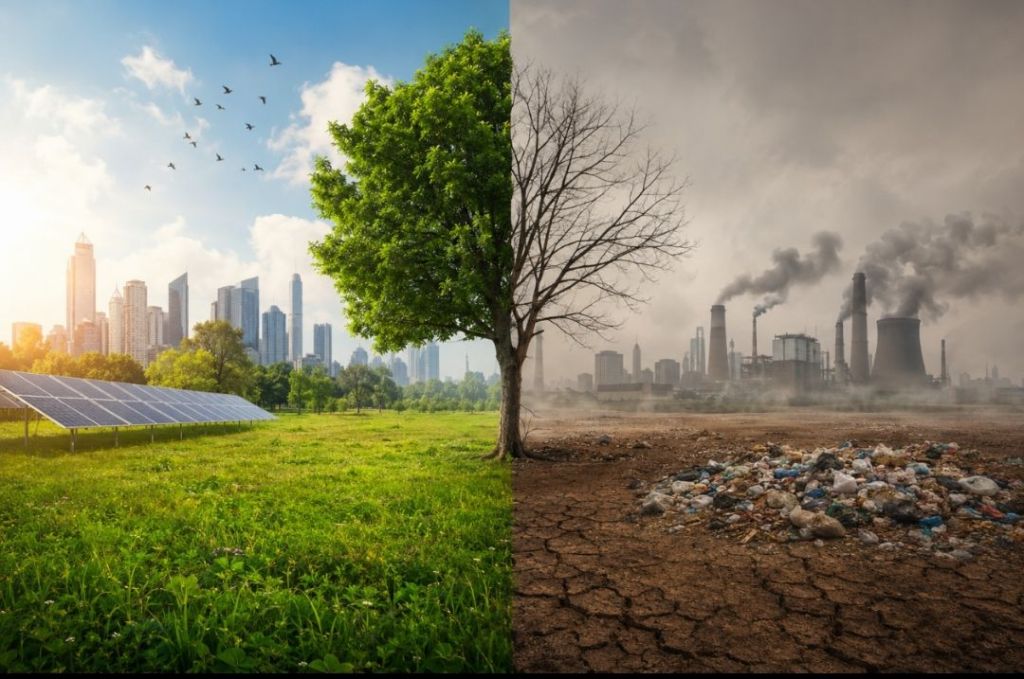
A Day of Reflection Beyond Symbolism
Every year, World Environment Day reminds us of our relationship with nature. Yet for India, this day is no longer merely a symbolic occasion marked by plantation drives, awareness campaigns, and public pledges. It has become a moment of serious reflection on whether the country can sustain its economic ambitions while protecting the natural systems that support nearly one-fifth of humanity.
India has achieved remarkable progress in economic growth, infrastructure development, industrialization, and poverty reduction over the last three decades. However, this growth has also generated significant environmental pressures. The challenge before India is not simply environmental protection. It is about ensuring that development itself remains sustainable and does not undermine future prosperity.
Air Pollution: The Invisible National Emergency
Air pollution remains perhaps the most visible environmental paradox of modern India. Despite advances in technology and environmental regulations, many Indian cities continue to experience air quality levels far beyond safe limits. Major urban centers frequently record particulate matter concentrations several times higher than globally recommended standards.
The causes are complex and interconnected. Rapid urbanization has increased vehicle ownership. Industrial growth has expanded emissions from manufacturing clusters. Crop residue burning continues to contribute seasonal spikes in pollution across northern India. Construction activities, diesel generators, and waste burning further add to the burden.
The economic cost is enormous. Lost productivity, rising healthcare expenses, reduced worker efficiency, and increasing respiratory illnesses collectively create a hidden tax on national development. For millions of families, polluted air is no longer an environmental issue but a daily health challenge affecting children, the elderly, and working adults alike.
Looking ahead, artificial intelligence, smart mobility systems, electric vehicles, and real-time environmental monitoring may offer solutions. However, technology alone cannot solve a problem deeply rooted in governance, urban planning, and behavioral patterns.
Climate Change and the Era of Permanent Heat
India has always experienced climatic diversity, but recent years indicate a shift from occasional extreme weather to a new normal of climate uncertainty. Heatwaves are arriving earlier, lasting longer, and affecting larger populations. Temperatures crossing 45 degrees Celsius are becoming increasingly common across several states.
Historically, Indian communities adapted to seasonal cycles through traditional water systems, climate-responsive architecture, and localized agricultural practices. Modern development has often weakened these adaptive mechanisms. Expanding concrete surfaces, shrinking green spaces, and groundwater depletion have intensified urban heat island effects.
Climate change is not merely an environmental issue. It directly affects food security, public health, labor productivity, energy demand, and migration patterns. Farmers face unpredictable rainfall. Urban populations face increasing heat stress. Coastal communities confront rising risks from cyclones and sea-level changes.
The next decade may witness a fundamental redesign of cities, agriculture, and infrastructure to accommodate climate realities. Nations that adapt early will gain resilience. Those that delay may face escalating economic and social costs.
Water: India’s Most Strategic Resource
For centuries, rivers shaped India’s civilization, culture, and economy. Today many of these water systems are under immense pressure. Pollution, over-extraction, encroachment, and changing rainfall patterns are threatening both water quality and availability.
India’s water challenge is unique because it combines scarcity and contamination simultaneously. In some regions groundwater levels are declining rapidly, while in others rivers and lakes struggle with untreated sewage, industrial discharge, and solid waste accumulation.
Water security may become one of the defining policy issues of the coming decades. Future conflicts may not revolve around oil or minerals but around access to clean and reliable water. Urban expansion, industrial growth, and agricultural demand will continue increasing pressure on already stressed resources.
The solution requires moving beyond large infrastructure projects toward integrated watershed management, wastewater recycling, rainwater harvesting, groundwater recharge, and community participation. Traditional Indian water conservation systems may once again become valuable sources of inspiration.
Plastic Pollution and the Culture of Convenience
Plastic has transformed modern life through affordability, durability, and convenience. Yet these same characteristics have created one of the most persistent environmental challenges of our time.
Plastic waste now reaches rivers, oceans, agricultural fields, and even the food chain. Microplastics have been detected in water, soil, and human bodies across the world. India generates enormous quantities of plastic waste every year, reflecting both economic growth and changing consumption patterns.
The issue extends beyond waste management. It raises fundamental questions about production systems, consumer behavior, packaging design, and corporate responsibility. Recycling alone cannot solve the problem if plastic generation continues to grow rapidly.
Future solutions may involve biodegradable materials, circular economy models, extended producer responsibility, and innovations in packaging technologies. However, success will depend equally on changing consumption habits at the household level.
Governance, Enforcement, and the Development Debate
One of the most critical environmental discussions in India concerns governance itself. Environmental regulations often exist, but implementation remains uneven. Institutional capacity, transparency, monitoring mechanisms, and enforcement continue to vary significantly across regions.
The traditional debate that pits economic growth against environmental protection is increasingly outdated. Environmental degradation itself is becoming a barrier to growth. Polluted cities struggle to attract talent. Water shortages affect industrial productivity. Climate disasters strain public finances. Health impacts reduce workforce efficiency.
The countries that succeed in the twenty-first century may not be those that grow the fastest in the short term, but those that balance growth with ecological resilience over the long term.
From Environmental Protection to Ecological Competitiveness
The future environmental conversation will likely move beyond conservation toward competitiveness. Clean energy, green manufacturing, sustainable agriculture, water-efficient technologies, carbon management systems, and circular economy practices could become major drivers of economic opportunity.
India possesses several advantages. It has a young population, a growing technology ecosystem, expanding renewable energy capacity, and a long tradition of community-based environmental stewardship. If these strengths are effectively integrated, India can transform environmental challenges into development opportunities.
World Environment Day should therefore not be viewed only as a reminder of environmental problems. It should be seen as an opportunity to rethink the development model itself. The real question is not whether India can afford environmental action. The more important question is whether India can afford to delay it.
The choices made today regarding air, water, climate, waste, and governance will shape not only the quality of the environment but also the quality of life, economic prosperity, and social stability for future generations. In many ways, the future of India’s development story will be determined by how successfully it manages its environmental journey.Suggested hashtags:
#WorldEnvironmentDay #ClimateChange #AirPollution #WaterSecurity #PlasticPollution #SustainableDevelopment #GreenEconomy #EnvironmentalGovernance #ClimateResilience #FutureOfIndia
 "Connecting communities, empowering nations: Unifying the Regional and Global Economy ."
Leave a comment