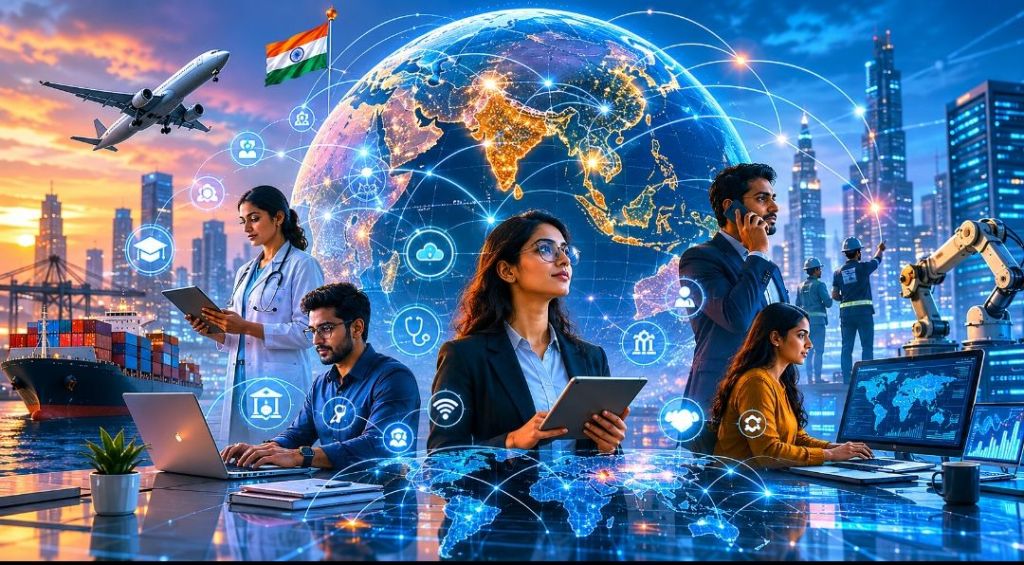
For decades, international trade was largely measured through ships carrying containers filled with manufactured products, commodities, and consumer goods. Nations competed to build factories, ports, and industrial infrastructure to capture a larger share of global merchandise trade. However, beneath the visible movement of goods, a quieter but far more transformative shift has been taking place. Services are emerging as one of the fastest-growing components of global trade, gradually reshaping economic competitiveness, employment patterns, and geopolitical influence. In many ways, the twenty-first century may ultimately be remembered not as the century of manufacturing dominance but as the century of knowledge, skills, and digitally delivered services.
From Industrial Trade to Knowledge Trade
Historically, economic power was associated with control over natural resources, manufacturing capacity, and physical infrastructure. The Industrial Revolution enabled nations such as Britain, Germany, and later the United States to dominate world commerce through large-scale production. The rise of globalization in the late twentieth century further strengthened manufacturing-led trade networks, with countries such as China becoming global production hubs.
Today, however, the nature of trade is evolving. Advances in telecommunications, cloud computing, digital platforms, and high-speed internet have enabled services to cross borders as easily as goods. A software engineer in Bengaluru can serve clients in New York, a financial analyst in Mumbai can support firms in London, and a medical specialist in Chennai can provide consultations to patients thousands of kilometers away. The result is the gradual emergence of a global marketplace where knowledge, expertise, and intellectual capabilities are becoming as valuable as physical products.
India’s Strategic Advantage in the Services Economy
India occupies a unique position in this transformation. Unlike many developing economies that relied primarily on manufacturing-led growth, India developed a strong services ecosystem relatively early. The country’s success in information technology, business process management, consulting, engineering design, financial services, and digital solutions has created a globally recognized service export industry.
Today, services exports contribute significantly to India’s foreign exchange earnings and help offset trade deficits in merchandise trade. Software services, IT-enabled services, global capability centers, financial technology, legal support services, healthcare services, education, and engineering design have collectively positioned India as one of the world’s leading service-exporting economies.
The importance of this sector extends beyond export earnings. Services generate high-value employment, encourage innovation, support urban development, and create demand for advanced skills. Unlike traditional industries that often require heavy investments in land and machinery, service industries are increasingly driven by human capital, making them more scalable and adaptable.
Yet India cannot afford complacency. The first generation of outsourcing success was built largely on cost competitiveness. The next phase will require innovation, intellectual property creation, advanced research capabilities, and specialization in emerging technologies such as artificial intelligence, cybersecurity, quantum computing, biotechnology, digital finance, and advanced engineering.
Mobility of Professionals: The New Trade Negotiation Frontier
One of the most critical yet underappreciated challenges facing service exports is the movement of skilled professionals across borders. While goods can move through ports with relative ease, human talent remains constrained by immigration policies, licensing requirements, visa regulations, and recognition of professional qualifications.
Indian engineers, doctors, accountants, architects, teachers, and consultants often encounter complex regulatory barriers despite possessing globally competitive skills. Recognition of educational qualifications and professional certifications has therefore become a major issue in international economic negotiations.
Future trade agreements may increasingly focus not only on tariff reductions but also on talent mobility frameworks. Countries capable of securing mutual recognition agreements, streamlined visa systems, and digital credential verification mechanisms may gain substantial advantages in global services trade.
The battle for market access is gradually shifting from customs checkpoints to regulatory systems governing human capital.
Artificial Intelligence: Opportunity and Disruption
Perhaps no development is likely to reshape service trade more profoundly than artificial intelligence. For decades, routine service exports relied heavily on large pools of educated workers performing repetitive knowledge-based tasks. AI is beginning to automate many of these functions at unprecedented speed.
Basic coding, customer support, document processing, financial analysis, content generation, and routine consulting activities are increasingly becoming susceptible to automation. This presents a significant challenge for countries whose service export models depend primarily on labor arbitrage.
However, history suggests that technological revolutions rarely eliminate economic opportunities entirely. Instead, they transform them. Just as computers created new industries even while automating older tasks, AI is likely to generate demand for new skills, new professions, and entirely new service categories.
The real risk for India is not AI itself but failing to move up the value chain. Countries that continue to compete mainly on labor costs may face increasing pressure, while those investing in innovation, creativity, problem-solving, research, and specialized expertise may emerge stronger.
The future service economy will reward intelligence augmentation rather than simple labor substitution.
Digital Delivery and the Borderless Marketplace
Digital delivery models are expanding market access in ways unimaginable just two decades ago. Online education, telemedicine, digital consulting, software-as-a-service platforms, remote engineering services, legal advisory solutions, and virtual business support are creating a borderless marketplace.
Small firms and individual professionals can now access global clients without establishing physical offices overseas. This democratization of international trade has the potential to benefit not only large corporations but also startups, freelancers, educational institutions, healthcare providers, and specialized consultants.
For India, this trend is particularly significant because it aligns with the country’s strengths in technology adoption, entrepreneurship, and skilled human resources. Digital platforms may enable professionals from smaller cities and emerging economic regions to participate directly in global markets.
However, digital trade also introduces new challenges related to data governance, cybersecurity, digital taxation, privacy regulations, and cross-border regulatory compliance. Future competitiveness will increasingly depend on the ability to navigate these complex digital frameworks.
The Emerging Geopolitics of Services
A less discussed but increasingly important trend is the growing geopolitical dimension of services trade. Nations are becoming more protective of data, digital infrastructure, financial networks, and technological capabilities. Data localization requirements, restrictions on digital platforms, cybersecurity concerns, and national security considerations are beginning to influence service flows.
In the coming decade, digital sovereignty may become as strategically important as energy security. Countries may seek greater control over cloud infrastructure, digital payments, artificial intelligence systems, and critical data assets. This could lead to fragmentation of global digital markets and create new barriers to cross-border service delivery.
For India, balancing openness with strategic autonomy will be a complex policy challenge. Excessive restrictions may limit competitiveness, while excessive dependence on foreign digital ecosystems could create vulnerabilities.
Looking Ahead: The Rise of Human Capital Nations
The future of international trade may be less about what countries manufacture and more about what their people know. Nations rich in human capital, innovation capacity, digital infrastructure, and educational excellence are likely to enjoy significant advantages in the emerging global economy.
India possesses many of the ingredients necessary to become a leading services superpower: a large skilled workforce, strong digital infrastructure, entrepreneurial energy, and a globally recognized technology ecosystem. Yet demographic size alone will not guarantee success. Continuous investment in education quality, research, innovation, professional standards, and global competitiveness will be essential.
The most critical question is whether India can transition from being the world’s back office to becoming one of the world’s leading creators of knowledge, technology, and specialized expertise.
The next phase of globalization may not be driven by containers crossing oceans. It may be driven by ideas crossing networks, skills crossing borders, and expertise delivered instantly across continents. In that world, services will no longer be the invisible side of trade. They may become the defining engine of economic power, national competitiveness, and global influence in the decades ahead.
#InternationalTrade #ServicesExports #DigitalEconomy #ArtificialIntelligence #IndiaGrowth #GlobalServices #KnowledgeEconomy #TalentMobility #FutureOfWork #EconomicTransformation


Leave a Reply