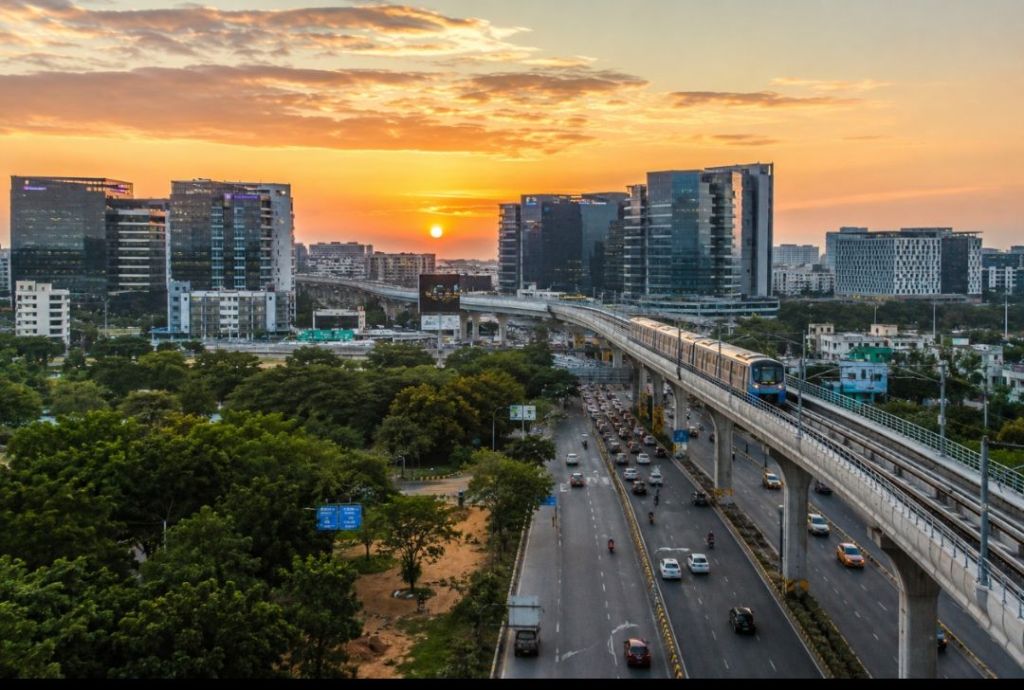
India is gradually witnessing the emergence of a new economic geography where growth is increasingly concentrating in a few high-productivity regions. Among these, the southern states of Telangana, Karnataka, Tamil Nadu, and Kerala are becoming central pillars of India’s economic transformation. Together, these states currently contribute nearly one-fourth of India’s GDP, but the larger debate is whether they could eventually contribute half of the Indian economy. At first glance, such a possibility appears distant, yet the deeper trends shaping India’s future suggest that the question itself reflects a major structural shift already underway.
Historically, India’s economic strength was distributed differently. In the decades after independence, industrial concentration revolved around port cities such as Mumbai, Kolkata, Chennai, and Ahmedabad. Over time, western India emerged as a manufacturing and financial powerhouse while northern India remained politically dominant because of population size and agricultural importance. Southern India, although socially progressive and educationally advanced, was not initially perceived as the core engine of national growth. The transformation began after economic liberalisation in the 1990s when technology, services, exports, healthcare, higher education, and global outsourcing became major growth drivers. This shift fundamentally favoured states that had stronger human development indicators, urban governance systems, and educational ecosystems.
Today, Bengaluru in Karnataka has become one of the world’s most important technology hubs. Hyderabad in Telangana is emerging as a global centre for pharmaceuticals, digital services, and data infrastructure. Tamil Nadu has built one of India’s strongest industrial ecosystems in automobiles, electronics, textiles, renewable energy equipment, and increasingly semiconductors. Kerala, despite limitations in industrialisation, has developed a strong service economy supported by tourism, remittances, healthcare, education, and high social development indicators. These states are no longer merely regional contributors; they are increasingly shaping India’s global economic identity.
The critical point, however, is that economic contribution is not determined only by growth rates. It depends on relative growth compared with the rest of the country. At present, the combined contribution of these four states is around 26 percent of India’s GDP. If current trends continue, this may rise to nearly 30 percent by 2030 and perhaps 35 to 40 percent by 2040 or 2050. Reaching 50 percent would require southern India to consistently outperform all other regions for several decades. That appears difficult because other major economic regions such as Maharashtra, Gujarat, Delhi NCR, Uttar Pradesh, and Haryana are also growing rapidly and attracting investment.
Yet the more important reality may not be whether southern India reaches 50 percent of GDP, but whether it begins dominating the most productive sectors of the economy. This distinction is crucial. Future economic power may increasingly depend less on population size and more on productivity, innovation, technology intensity, energy efficiency, institutional quality, and skilled human capital. In many of these areas, southern India already enjoys a structural advantage.
One of the strongest indicators is per capita income. Southern states generally have much higher income levels, better health outcomes, stronger educational attainment, and higher female workforce participation than many parts of northern India. They are also more urbanised and better integrated into global value chains. This creates a self-reinforcing cycle where talent attracts investment and investment attracts more talent. Global corporations increasingly prefer regions with predictable governance, skilled labour, digital infrastructure, and social stability. Southern India is positioning itself strongly within this framework.
Another major factor is demographic transition. Several southern states have achieved lower fertility rates and slower population growth. While this creates future ageing challenges, it also allows higher investments in education, health, and productivity per citizen. In contrast, some northern states will continue adding large populations but may struggle to create sufficient high-quality employment. This divergence could widen economic inequality between regions over the next two decades.
The political economy implications of this transformation could become highly sensitive. Southern states already contribute disproportionately to direct taxes, exports, services, and formal economic activity. At the same time, debates around fiscal transfers, parliamentary representation, welfare allocation, and federalism are intensifying. As economic weight shifts southward while population-driven political influence remains concentrated elsewhere, tensions over resource distribution may become sharper. India may increasingly face the challenge of balancing demographic democracy with economic productivity.
Climate change may further accelerate this transition. Regions with better urban planning, healthcare systems, renewable energy adoption, and water management may attract more long-term investments. Southern states, despite facing climate vulnerabilities themselves, may still be relatively better prepared institutionally than many other regions. Global investors are increasingly evaluating resilience, sustainability, and governance quality alongside labour costs.
The future Indian economy may therefore not be divided simply between rich and poor states, but between high-productivity and low-productivity regions. In that future, southern India may not necessarily account for 50 percent of total GDP, but it could dominate technology exports, innovation ecosystems, advanced manufacturing, digital infrastructure, healthcare services, and formal sector tax generation. Such dominance may be economically transformative even without numerical majority in GDP share.
India’s next developmental challenge may thus revolve around reducing the widening gap between regions while preserving national cohesion. The success of southern India should ideally become a model for broader institutional strengthening across the country rather than a source of regional imbalance. The real question is not whether southern India will become half of India’s economy, but whether India can ensure that the rest of the country rises with equal productivity, capability, and opportunity in the decades ahead.
#SouthIndia #IndianEconomy #GDPGrowth #FederalEconomics #TamilNadu #Karnataka #Telangana #Kerala #EconomicTransformation #RegionalDevelopment


Leave a comment