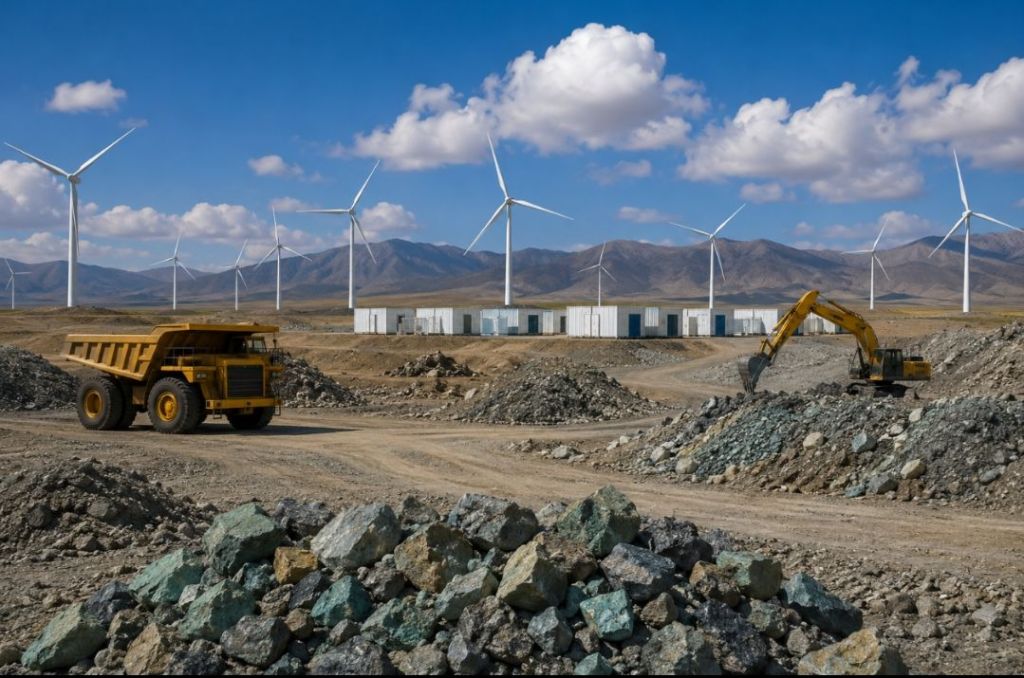
The global economy is quietly entering a new geopolitical era where control over critical minerals is becoming as strategically important as control over oil was during the twentieth century. The future of electric vehicles, semiconductors, renewable energy systems, aerospace technologies, advanced defence equipment, and artificial intelligence hardware increasingly depends not only on technological innovation but also on access to lithium, cobalt, nickel, graphite, copper, and rare earth elements. What oil represented to industrial growth and military power in the last century, critical minerals are beginning to represent for the digital and green economy of the future. The difference, however, is that this new mineral geopolitics is likely to be even more complex, fragmented, and unstable.
From Oil Wells to Mineral Corridors
Historically, global power shifted around regions that controlled oil reserves. The Middle East became strategically central after the Second World War because industrial economies depended heavily on petroleum for transportation, manufacturing, and military operations. Today, the same logic is being replicated through mineral corridors stretching from Africa and Latin America to Australia and Central Asia. The competition is no longer just about energy supply. It is about technological sovereignty, industrial resilience, and national security.
An electric vehicle requires nearly six times more mineral inputs than a conventional vehicle. Wind turbines, solar panels, battery storage systems, data centres, and missile guidance systems all require specialized metals. Copper has become the nervous system of electrification. Rare earths are now embedded in advanced electronics and defence applications. Lithium and cobalt are central to battery technologies. This transition is creating a silent but intense race among nations to secure supply chains before shortages become structural.
China’s Dominance and the Strategic Imbalance
One of the most critical realities shaping the global mineral economy is China’s overwhelming dominance in refining and processing capabilities. While mineral reserves are geographically distributed across several countries, processing capacity is highly concentrated. China processes a major share of the world’s lithium, cobalt, graphite, and rare earth materials. This creates a strategic asymmetry where even countries rich in mineral reserves remain dependent on Chinese industrial infrastructure.
The situation resembles a hidden monopoly. Many Western countries focused for decades on low-cost imports and outsourced refining due to environmental costs and labour economics. China invested patiently in mining rights, processing infrastructure, logistics, and downstream manufacturing. Today, this strategy gives Beijing enormous leverage over global clean energy and electronics supply chains.
This dependence is increasingly worrying for the United States, Europe, Japan, and India. Any geopolitical conflict, export restriction, or supply disruption could destabilize industries ranging from electric vehicles to defence manufacturing. The semiconductor crisis during the pandemic already demonstrated how fragile global supply chains can become when concentration risk is ignored.
India’s Strategic Awakening
India has slowly begun recognizing that critical minerals are not merely industrial commodities but strategic assets. The country’s policy push toward domestic exploration and overseas acquisitions reflects this changing mindset. Indian public and private entities are actively exploring opportunities in Australia, Africa, and Latin America to secure access to lithium, cobalt, and copper reserves. This is not simply an economic strategy. It is a long-term national security requirement.
India’s rapid push toward renewable energy, electric mobility, electronics manufacturing, and semiconductor ambitions cannot succeed without mineral security. The country is attempting to create an integrated battery ecosystem through incentives for cell manufacturing, refining, recycling, and component production. However, India still remains heavily dependent on imports, especially in rare earth processing and advanced material technologies.
This dependence exposes a deeper structural issue. India has traditionally been stronger in software, services, and market scale than in resource diplomacy and processing infrastructure. Mineral security requires a very different strategic capability involving geology, mining technology, overseas diplomacy, logistics, refining chemistry, environmental management, and long-term industrial financing. These ecosystems take decades to build.
Resource Nationalism and the Fragmentation of Globalisation
The world is also witnessing the rise of resource nationalism. Countries rich in minerals are increasingly restricting exports, imposing local processing conditions, or renegotiating mining contracts to capture greater value domestically. Indonesia restricted nickel exports to encourage domestic processing. Several African nations are reconsidering mining agreements signed during earlier decades. Latin American countries are debating state control over lithium reserves.
This trend reflects a broader collapse of blind globalization. Developing countries no longer want to remain suppliers of raw materials while developed economies capture high-value manufacturing and technology profits. They are demanding greater industrial participation in the value chain. While economically understandable, such policies may also create supply uncertainty and price instability globally.
The green transition itself may therefore become more inflationary and politically contested than originally expected. The assumption that renewable technologies would automatically become cheaper and universally accessible is now being questioned because mineral concentration risks are emerging as the new bottleneck.
The Hidden Environmental Contradiction
There is also a profound contradiction hidden inside the clean energy narrative. The transition to green technologies requires massive mining expansion. Lithium extraction affects water systems. Cobalt mining in some regions raises labour and human rights concerns. Rare earth processing creates toxic waste challenges. Copper mining requires enormous land and energy resources.
The world is therefore entering a paradoxical situation where the pursuit of environmental sustainability may generate new ecological and social pressures elsewhere. Advanced economies often want clean technologies but resist environmentally sensitive mining within their own borders. This shifts environmental burdens toward developing countries with weaker regulations and vulnerable communities.
The politics of climate transition may therefore increasingly collide with the politics of mining justice, indigenous rights, water security, and local livelihoods. The future conflict may not simply be oil versus renewables. It may become a struggle over who bears the environmental cost of the green economy.
Price Volatility and the Economics of Transition
Another major challenge is price volatility. Critical mineral prices have shown extreme fluctuations over the last few years due to speculative demand, geopolitical tensions, and supply bottlenecks. Sudden spikes in lithium and cobalt prices directly impact electric vehicle affordability and renewable energy economics.
This creates uncertainty for industries making long-term investments. High mineral prices can slow adoption of green technologies, while sudden price collapses can discourage mining investments. The world may therefore face cycles of overinvestment and shortages similar to historical oil markets.
For countries like India, this volatility creates dual pressure. On one side, there is a strategic need to accelerate energy transition and manufacturing growth. On the other side, import dependence exposes the economy to inflationary risks and trade imbalances.
The Future Battlefield of Economic Power
The future global order may increasingly be shaped not by armies alone but by supply chain control. Nations that dominate mineral refining, battery technologies, semiconductor ecosystems, and advanced manufacturing may hold disproportionate economic and geopolitical influence. Critical minerals are gradually becoming instruments of diplomacy, economic coercion, and strategic bargaining.
India’s challenge is therefore much larger than securing mining assets. The real challenge lies in building an entire industrial ecosystem around processing, recycling, material science, logistics, and technological innovation. Without this ecosystem, India risks remaining a large consumer market dependent on external supply chains.
At the same time, the world may also move toward alternative technologies that reduce dependence on scarce minerals through recycling, sodium-ion batteries, material substitution, and circular economy systems. The countries that innovate fastest may eventually reduce strategic vulnerability.
The Green Future May Not Be Peaceful
The transition from fossil fuels to clean technologies is often presented as a smooth technological evolution. In reality, it may become one of the most geopolitically contested transitions in modern history. Critical minerals are turning into strategic instruments of economic warfare, industrial policy, and global influence.
The world is moving from oil geopolitics to mineral geopolitics, but the coming era may be even more unstable because the supply chains are more concentrated, technologies are evolving rapidly, and climate urgency is compressing timelines. The green economy may reduce carbon emissions, but it may not reduce competition, inequality, or geopolitical conflict.
For India, the opportunity is historic but the risks are equally large. If managed strategically, critical minerals can support industrial transformation, manufacturing expansion, and energy security. If neglected, dependence on imported mineral ecosystems may become the next structural vulnerability of the Indian economy.
#CriticalMinerals #Lithium #RareEarths #EnergyTransition #Geopolitics #IndiaManufacturing #SupplyChain #ElectricVehicles #ResourceNationalism #GreenEconomy
 "Connecting communities, empowering nations: Unifying the Regional and Global Economy ."
Leave a comment