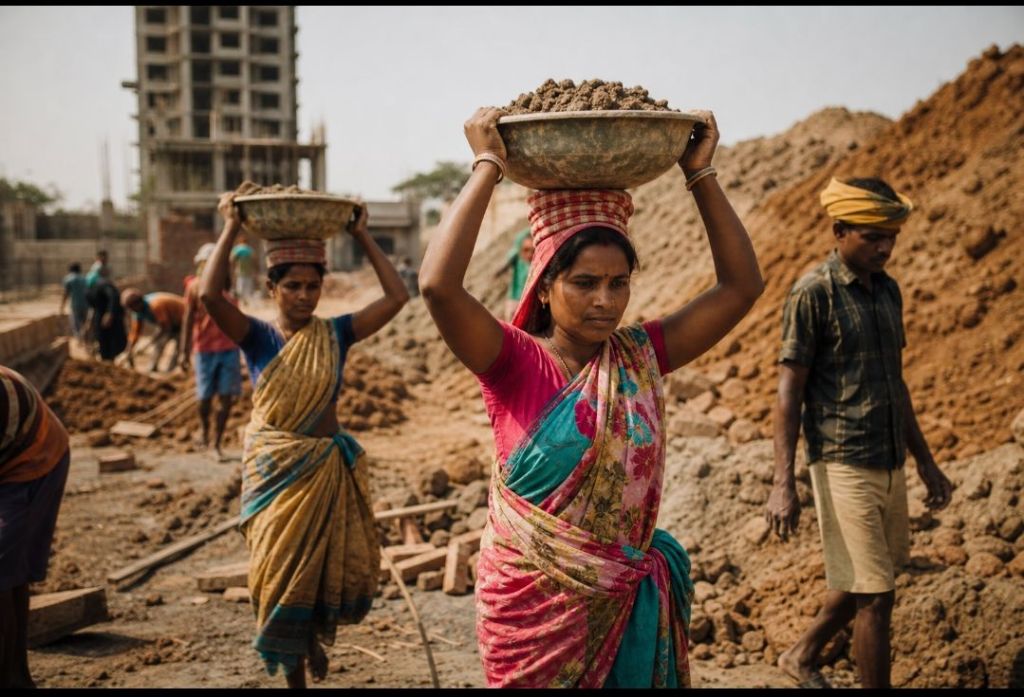
From Visible Labour to Invisible Effort
Labour Day was born out of struggle, sacrifice, and the demand for dignity in work. It emerged in the late 19th century when factory workers fought for basic rights like an eight-hour workday, fair wages, and humane conditions. That era had a visible enemy—industrial exploitation in factories. Today, the irony is sharper. Labour has not disappeared, but it has become invisible. The worker is no longer always in a factory; he is delivering food in 10 minutes, driving a cab without social security, coding through the night on contract, or selling goods on a pavement without protection. The form has changed, but the vulnerability remains deeply rooted.
The Illusion of Progress and the Reality of Precarity
India proudly celebrates its demographic dividend and digital economy, yet a large share of its workforce remains informal. Nearly 80 to 90 percent of workers operate without formal contracts, insurance, or pension. Labour Day speeches celebrate productivity and growth, but rarely confront the uncomfortable truth that growth in India has often been job-light and security-poor. The gig economy, often projected as flexibility, is in reality a silent transfer of risk from companies to workers. A delivery worker bears fuel costs, health risks, and income uncertainty, while platforms scale rapidly with minimal liability. This is not empowerment; it is structured informality in a digital form.
The Shrinking Value of Human Labour
Historically, labour was central to production. Today, technology is steadily displacing its value. Automation, artificial intelligence, and robotics are not just replacing repetitive jobs but also encroaching into skilled domains. The concern is not job loss alone, but the weakening bargaining power of workers. When labour becomes easily replaceable, dignity becomes negotiable. The system quietly shifts from valuing workers to optimizing costs. Labour Day, therefore, is no longer just about rights; it is about relevance in an economy where machines increasingly define productivity.
Informal Sector: The Silent Backbone with No Voice
Walk through any Indian city or rural market, and the real economy reveals itself. Street vendors, small shopkeepers, repair workers, agricultural labourers—they sustain consumption, supply chains, and livelihoods. Yet, policy attention often treats them as residual or transitional. The informal sector is not shrinking; it is adapting, often integrating with digital platforms in fragmented ways. But adaptation without protection leads to exploitation. A vegetable vendor using digital payments still has no insurance. A small artisan selling online still faces price pressure without bargaining power. Labour Day rarely acknowledges this silent backbone.
Policy Intent vs Ground Reality
Governments have introduced labour codes, social security schemes, and digital identification systems. On paper, the architecture appears progressive. But implementation remains weak, fragmented, and often inaccessible to the most vulnerable. Registration hurdles, lack of awareness, and administrative inefficiencies dilute impact. More critically, policy thinking still assumes a transition from informal to formal, whereas the economy is increasingly hybrid. Without recognizing this structural reality, interventions remain cosmetic.
Globalisation and the Race to the Bottom
Labour is also trapped in a global competition. Countries compete for investment by lowering labour costs, relaxing regulations, and offering flexibility to firms. While this may attract capital in the short term, it erodes long-term labour standards. The worker becomes a variable cost in a global spreadsheet. Labour Day, in such a context, exposes a contradiction—while the world celebrates workers, it simultaneously designs systems that weaken their negotiating power.
The Psychological Cost of Modern Labour
Beyond wages and contracts lies a deeper crisis—the mental and emotional strain of insecure work. Uncertain incomes, long working hours, algorithmic control, and lack of social protection create a constant state of anxiety. A gig worker waiting for the next order, a contract employee uncertain about renewal, a migrant labourer away from family—these are not just economic conditions; they are human realities. Labour Day conversations rarely touch this dimension, yet it defines the lived experience of millions.
Rethinking Labour in a Hybrid Economy
The future of labour will not be defined by traditional employer-employee relationships alone. It will be a mix of formal jobs, gig work, self-employment, and micro-entrepreneurship. This demands a shift in thinking—from job security to income security, from employer-based benefits to universal social protection, from rigid labour laws to adaptable frameworks that still protect dignity. Without this shift, Labour Day risks becoming symbolic rather than transformative.
A Day of Reflection, Not Celebration
Labour Day should not be reduced to ceremonial recognition. It must provoke uncomfortable questions. Why does economic growth not translate into secure livelihoods? Why does technology amplify profits more than it improves worker welfare? Why are those who build the economy the least protected within it?
The real tribute to workers is not in slogans but in structural change. Until labour is given not just a role in production but a rightful share in prosperity, Labour Day will remain a reminder of promises yet to be fulfilled.
#LabourDay #InformalEconomy #GigWorkers #WorkerDignity #EconomicInequality #FutureOfWork #SocialSecurity #DigitalEconomy #EmploymentCrisis #InclusiveGrowth
 "Connecting communities, empowering nations: Unifying the Regional and Global Economy ."
Leave a comment