A New Industrial Frontier: Historical Perspective and Policy Shift
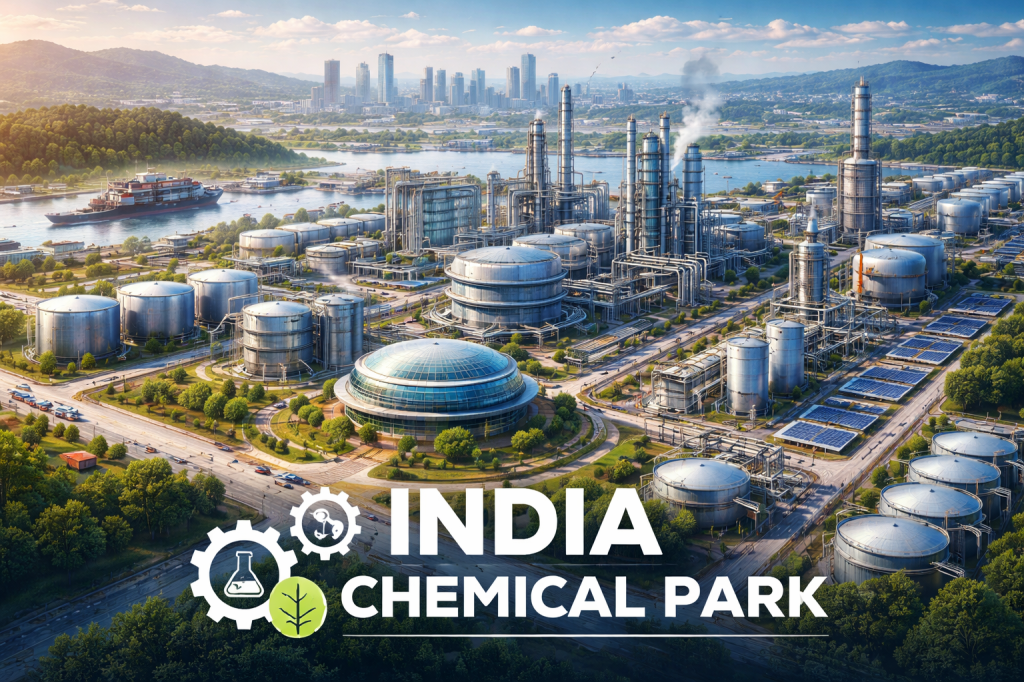
India’s newly proposed chemical parks scheme marks a decisive shift in the country’s industrial policy—one that blends lessons from past attempts with a clearer understanding of global competitiveness. Historically, large industrial parks such as the PPI RCC initiative aimed for scale but struggled to achieve momentum due to fragmented governance, insufficient infrastructure coordination, and misaligned state–centre cooperation. In a world where supply chains are being reorganised by geopolitical tensions, climate-linked compliance pressures, and rising tariff walls, India’s renewed push signals an attempt to carve out a competitive space in the global chemicals and petrochemicals map. The difference this time is the strategic use of public investment, moderate-scale design, and policy discipline, making the scheme more aligned with the demands of a volatile global economy.
Government Financial Commitment: Strategic Spending for Capability Building
The government’s commitment of ₹3,000 crores for three parks—with ₹1,000 crores already earmarked for Prague and ₹600 crores expected for infrastructure within this financial year—demonstrates a shift away from cosmetic incentives toward structural capability building. The focus on “outside battery limits” (OSP) infrastructure acknowledges a long-standing cost burden that has restricted global-scale competitiveness for Indian chemical manufacturers. By targeting utilities, logistics connective tissue, and waste-handling systems instead of subsidizing individual firms, the scheme adopts a systems-thinking approach, mirroring best practices in East Asian and European chemical clusters.
Design Philosophy: Moderate Size, High Efficiency, Deep Integration
Unlike previous “mega-park” ambitions that suffered from overextension, the current scheme’s moderate scale of roughly 2,000 acres indicates a deliberate move toward efficiency, better governance, and faster implementation cycles. The proposal that up to 70% of common infrastructure costs—primarily utilities and BTL activities—be supported from central funds creates a fiscal structure that incentivizes both states and anchor firms. States are encouraged to add institutional layers such as accreditation labs and quality benchmarking facilities, ensuring tenants are not isolated units but components of integrated value chains. This reflects a maturing policy mindset: build ecosystems, not estates.
Operational Flexibility: SPVs and the Rise of Anchor-Led Governance
By granting states the ability to choose operational models—including SPVs and PPP structures—the scheme acknowledges that uniformity has previously been a bottleneck. The emerging preference for anchor-led SPVs mirrors successful global cases where large firms drive ecosystem development by synchronizing supply chains, overseeing technical standards, and de-risking investment for smaller players. This flexibility is crucial in the chemical industry, where heterogeneous processes, environmental liabilities, and specialized supply chains require responsive governance.
Proposal Evaluation: Infrastructure Quality as Industrial Destiny
The proposed criteria for evaluating chemical park proposals signal a deep understanding of industrial competitiveness. Utility depth—power, steam, water, waste disposal, pipeline networks, environmental labs—is positioned as the most critical determinant. This aligns with global evidence: chemical parks thrive when utilities are reliable, centralized, and cost-efficient. The emphasis on location and connectivity—rail access, port linkages, inland waterways, feedstock availability—reflects the impact of logistics costs on overall plant viability. State incentives, including land packages and single-window clearances, and environmental suitability, acknowledging differentiated risk levels across chemical categories, round out a multidimensional evaluation architecture. Collectively, these criteria represent a more scientific, less bureaucratic approach to industrial policy.
Strategic Goals: Reducing Import Dependence and Building Future Value Chains
India currently imports over $20 billion worth of chemicals annually, a vulnerability that has grown sharper as global supply chains fragment. By integrating downstream sectors—semiconductors, battery materials, specialty chemicals—the parks aim not only to localize manufacturing but to transform India into a critical node in future industries. Discussions on fund disbursement models such as 30-30-10 point to the importance of transparency and performance-linked financial flows. Complementing this is the increasing recognition that skill ecosystems, in-lab testing capacities, and shared environmental compliance systems are central to long-term viability.
A Forward-Looking View: Chemical Parks as Platforms for Technological Sovereignty
The most futuristic aspect of the scheme is its potential alignment with global shifts toward green chemistry, circular manufacturing, and carbon-neutral industrial estates. As climate-linked regulations harden across Europe, North America, and East Asia, India must build parks that are compliant with future standards, not past norms. This includes embedding renewable energy integration, emissions monitoring, effluent recycling, and digitalized operations from the outset. If implemented with discipline, these parks could serve as sovereign industrial platforms—bridging India’s need for technological self-reliance with global supply chain participation.
A Rare Window of Opportunity
The new chemical parks scheme offers India a rare opportunity to reset its industrial foundations at a time when global realignments favour countries with scale, policy coherence, and resilient infrastructure. Its success will depend not on the size of the investment but on the quality of execution—particularly in utilities, governance structures, environmental safeguards, and integration with downstream sectors. If these priorities remain intact, the scheme could shape the next era of India’s chemical manufacturing capability, balancing competitiveness, sustainability, and strategic autonomy in a world defined by continuous uncertainty.
#ChemicalParks
#IndustrialInfrastructure
#SupplyChainResilience
#BTLUtilities
#ImportSubstitution
#StateIncentives
#EnvironmentalCompliance
#AnchorTenants
#ValueChainIntegration
#ManufacturingCompetitiveness


Leave a comment