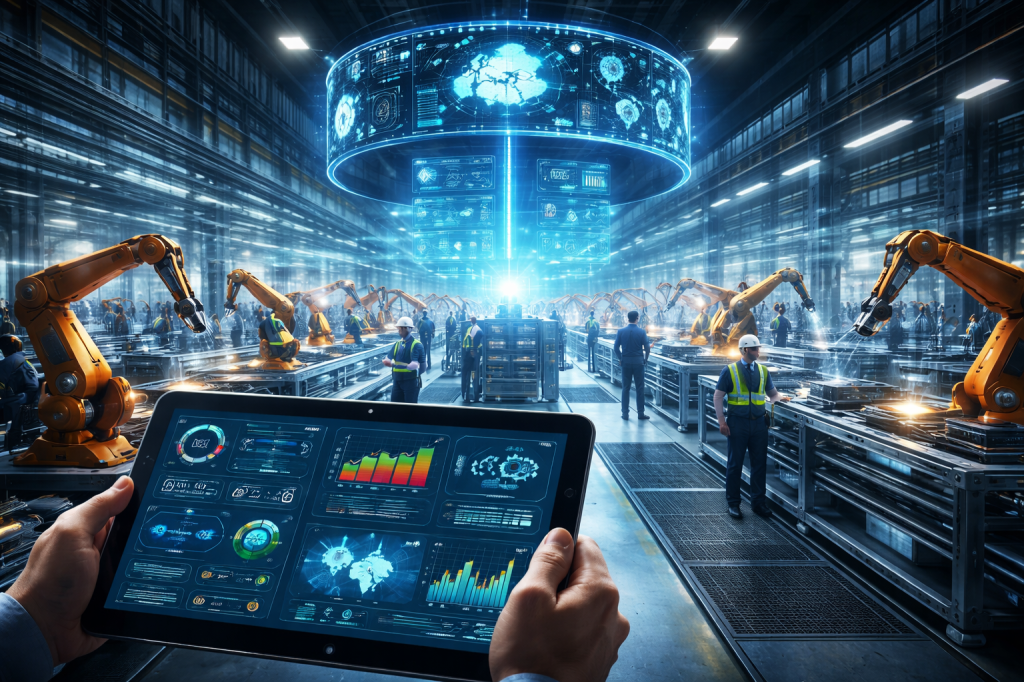
The global manufacturing landscape is entering a period where volatility is not a temporary shock but a structural feature. The last four decades—from the liberalisation-led booms of the 1980s and 1990s to the GVC-driven efficiencies of the 2000s—were built on the assumption that planners could rely on reasonably stable policy environments, predictable interest-rate cycles, and linear supply chains. That world has disappeared. By 2026, operational agility is no longer a premium capability; it has matured into a survival requirement. Shifting tariffs, sudden tax-incentive reversals, fluctuating interest rates, and recurring disruptions across semiconductor, shipping and energy supply chains mean manufacturers cannot rely on long horizons. They must instead operate in a mode of real-time adjustment, balancing speed with precision. The idea of “plan-execute-review” has given way to “sense-decide-act,” powered by continuous digital intelligence.
Economic Volatility and Policy Shifts Reshaping Competitiveness
Manufacturers today are confronted with a thick fog of uncertainty, where the strategic anchoring points of the past no longer hold. Tariff changes occur within days, not years; monetary tightening cycles stretch longer than anticipated; and supply chain interruptions—from Red Sea tensions to container shortages—can alter cost structures overnight. Surveys in the U.S., Europe, and Asia show that more than two-thirds of manufacturers identify economic unpredictability as their top risk driver. India’s own MSME clusters feel this pressure: the PMI remains expansionary, but unpredictable export demand, fluctuating commodity prices, and tightening global liquidity push firms to move away from static planning. Operational agility, therefore, becomes the absorber of uncertainty—transforming unpredictable shocks into manageable, data-driven decisions.
AI, Automation, and Predictive Intelligence Become Core Infrastructure
What electricity was to the Second Industrial Revolution, AI becomes to the manufacturing ecosystems of 2026. Adoption is no longer motivated by cost-cutting alone; it is a stabilising mechanism. Predictive modelling and scenario-simulation tools allow companies to map supply chain fragilities, anticipate stock-outs, and dynamically adjust production schedules. Real-time analytics turn unpredictable procurement cycles into quantifiable probabilities. Manufacturers increasingly deploy autonomous agents to orchestrate supplier options, simulate macro-policy changes, and translate market shifts into operational responses. Globally, a major share of manufacturers are dedicating more than 20 percent of their digital budgets toward such “agility infrastructure.” For MSMEs—especially in distributed clusters like Coimbatore, Rajkot, Ludhiana, and Faridabad—cloud-based AI offers plug-and-play adoption, enabling 15–20 percent productivity gains without full-scale integration costs.
Shop Floor Agility Becomes the Heart of Competitive Strategy
The battle for survival will be won or lost on the shop floor. Operational agility here means compressing the reaction time between supply-side disruption and production-side adjustment. The ability to pivot schedules, reroute workflows, or modify batch sequences becomes essential. New tools such as flexible CNC systems, automated metal cutting, and on-demand 3D production allow manufacturers to shift from precut inventory to dynamic fabrication—reducing wastage, lowering working capital, and enabling rapid customization. The companies that excel are those that maintain delivery reliability while reshaping throughput in real time. Speed without accuracy is chaos; precision without speed is stagnation. Agility in 2026 requires both, reinforced by digital systems that help orchestrate change without destabilizing operational rhythms.
Supply Chain Intelligence: From Linear Pipelines to Dynamic Ecosystems
The era of linear supply chains is over; 2026 marks the arrival of dynamic, intelligence-driven supply ecosystems. Companies are building “control tower” architectures that provide visibility across Tier-2 and Tier-3 suppliers—areas where most disruptions originate. Predictive tools flag bottlenecks weeks in advance. Automated alerts recalibrate procurement strategy, allowing firms to choose between cost, delivery reliability, carbon constraints, and geopolitical risk. In India, MSME clusters can structurally benefit from this shift. With fragmented supply chains and informal linkages, clusters often rely on local information rather than structured intelligence. AI-enabled platforms, including emerging domestic digital public infrastructure for supply chains, can empower clusters to move from reactive firefighting to proactive optimization. This is especially critical as India navigates trade volatility from shifting tariff regimes in the U.S., EU, and Asia.
Turning Uncertainty Into Economic Opportunity
For India, operational agility provides a strategic economic dividend. Clusters historically grew through factor-market advantages—cheap labour, embedded skills, and dense supplier networks. But the next era belongs to those who build “digital depth” around these networks. MSMEs can use AI-driven demand forecasting, automated compliance reporting, predictive maintenance, and energy-optimized operations to offset global unpredictability. Government initiatives in AI skilling, cluster modernization, and the IndiaAI Mission further reduce adoption barriers. Tech-driven agility allows MSMEs to shorten planning cycles, stabilize margins, and improve export readiness despite external shocks. If implemented strategically, operational agility can become India’s signature manufacturing advantage—transforming volatility into momentum and enabling clusters to escalate from local to global competitiveness.
Agility as a Structural Condition, Not a Temporary Trend
In 2026 , operational agility will not remain a reaction to instability; it will become the fundamental design principle of industrial ecosystems. Manufacturers will transition from rigid production architectures to fluid, continuously reconfigurable systems. Supply chains will evolve into sensing networks. Shop floors will imitate living systems—responding, learning, and adapting. In this new world, agility replaces certainty as the true backbone of competitiveness. The countries and clusters that embed agility at the heart of their industrial strategy—India included—will not merely survive global turbulence; they will convert it into a long-term structural advantage.
#OperationalAgility
#PredictiveAnalytics
#AIinManufacturing
#SupplyChainResilience
#RealTimeVisibility
#ShopFloorAutomation
#DigitalEcosystems
#MSMECompetitiveness
#ScenarioModelling
#AgileProductionSystems
 "Connecting communities, empowering nations: Unifying the Regional and Global Economy ."
Leave a comment