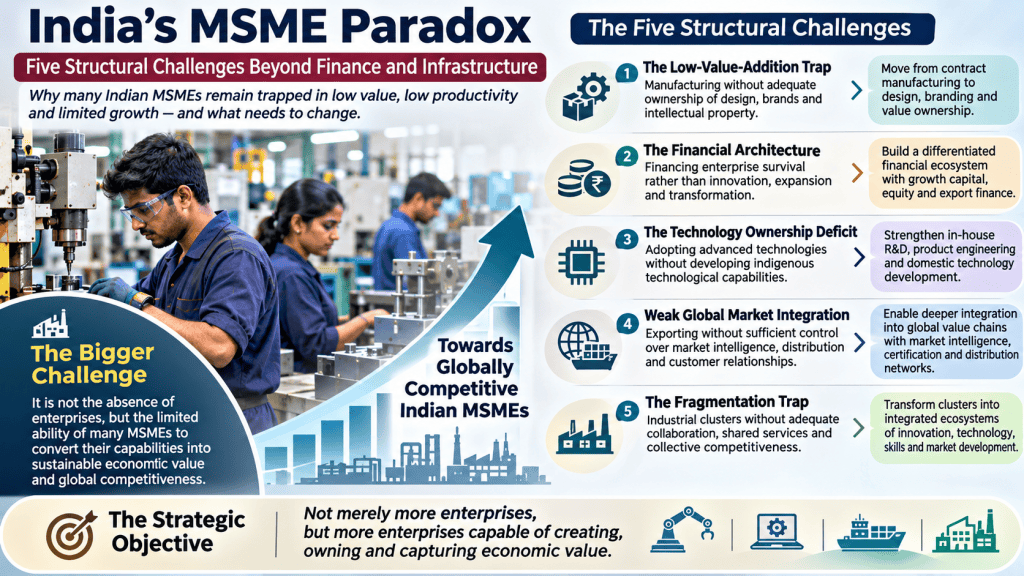
Beyond finance, infrastructure and manpower, India must address the deeper challenges of value creation, technology ownership and global market integration.
25 November 2026
India’s micro, small and medium enterprises (MSMEs) have historically been the backbone of employment generation, industrialisation, entrepreneurship and regional economic development. Yet, despite decades of institutional support, financial assistance, technology upgrading programmes and cluster development initiatives, a significant proportion of Indian MSMEs remain trapped in low-productivity and low-value-added economic activities.
The fundamental challenge is no longer merely the survival of small enterprises but their ability to grow, innovate, compete internationally and capture a greater share of economic value.
Drawing upon recent discussions on MSME finance, global value chains, export competitiveness, technology ownership and industrial clusters, five interconnected structural challenges emerge.
1. The Low-Value-Addition Trap: Manufacturing Without Value Ownership
India has developed considerable manufacturing capabilities, but many MSMEs continue to operate at the lower end of domestic and global value chains. They manufacture components, undertake job work, assemble products and supply intermediate goods without controlling product design, intellectual property, technology, branding or distribution networks.
An engineering enterprise may manufacture a sophisticated component but remain dependent on foreign technology and customer specifications. Similarly, a garment manufacturer may undertake labour-intensive production while international brands capture a substantial proportion of the final commercial value.
The problem is not simply inadequate manufacturing capacity but inadequate ownership of the sources of profitability.
As automation and artificial intelligence transform manufacturing, enterprises dependent exclusively on low-cost labour and conventional production capabilities may experience further pressure on margins.
India must move from manufacturing for others towards designing, developing and owning products. Future industrial competitiveness will increasingly depend on intellectual capital rather than physical production capacity alone.
2. The Financial Architecture: Financing Survival Rather Than Growth
The conventional discussion on MSME finance revolves around inadequate credit availability. However, an equally important issue is whether the existing financial architecture supports enterprise transformation.
Much of MSME financing remains oriented towards working capital, collateral-backed lending and short-term operational requirements. Enterprises seeking to develop new products, acquire advanced technologies, establish international distribution networks or undertake research and development face a different set of financial requirements.
The IFC’s recent assessment of MSME finance estimated that the formal MSME credit gap across emerging and developing economies increased from $3.6 trillion in 2019 to $4 trillion in 2023. It also identified an estimated equity financing gap of $1.4 trillion.
These estimates highlight the need to look beyond conventional bank lending.
An enterprise requiring working capital cannot be treated in the same manner as one attempting technological innovation or international expansion. India needs a differentiated financial ecosystem combining cash-flow-based lending, patient capital, equity financing, export finance and risk-sharing mechanisms.
The objective of MSME financing should not merely be to prevent enterprise failure but to enable enterprise transformation.
3. The Technology Ownership Deficit: Adoption Without Innovation
India’s MSME sector is gradually adopting digital technologies, automation, advanced machinery and artificial intelligence. However, technology adoption should not be confused with technological capability or ownership.
An enterprise purchasing imported machinery may improve its productivity without developing the capacity to design, modify or manufacture that machinery. Similarly, adopting digital platforms does not necessarily enable an enterprise to develop proprietary software, control customer data or create independent technological capabilities.
This distinction is particularly important in capital goods, electronics, pharmaceuticals, renewable energy and precision engineering.
Unless domestic enterprises develop stronger capabilities in product engineering, industrial software, advanced materials, sensors, precision components and applied research, industrial expansion could simultaneously increase technological dependence.
India’s industrial clusters need to evolve into innovation ecosystems connecting enterprises with universities, research institutions, engineering centres and technology developers.
The future technological divide will not simply be between enterprises that use technology and those that do not. It will increasingly be between enterprises that own and develop technology and those that remain dependent on it.
4. Weak Global Market Integration: Exporting Without Market Intelligence
India’s export strategy has traditionally emphasised production capacity, export incentives, trade fairs and market promotion. These interventions remain important, but international competitiveness increasingly depends on capabilities beyond the factory gate.
Global buyers are demanding traceability, environmental compliance, consistent quality, shorter delivery cycles, product customisation and supply-chain reliability. Emerging carbon regulations, technical standards and geopolitical uncertainties are further transforming international trade.
For smaller enterprises, the fixed costs of certification, market intelligence, buyer identification, logistics and regulatory compliance can become significant barriers to internationalisation.
Free trade agreements may provide preferential market access, but preferential tariffs alone cannot create competitive enterprises.
India needs cluster-based export intelligence systems, shared certification facilities, professional export intermediaries, international distribution partnerships and collective market-development mechanisms.
The strategic objective must shift from occasional export transactions towards durable integration into international production and distribution networks.
Access to global markets is increasingly an organisational and knowledge challenge rather than merely a production challenge.
5. The Fragmentation Trap: Industrial Clusters Without Collective Competitiveness
India has numerous industrial clusters with decades of accumulated manufacturing experience. However, geographical concentration does not automatically generate collective competitiveness.
Many enterprises operating within the same cluster continue to purchase inputs independently, compete primarily on price, duplicate infrastructure and undertake limited collaborative innovation or market development.
Historically, industrial clusters in countries such as Italy, Germany and China have demonstrated how specialised suppliers, research institutions, logistics networks, industry associations and shared services can strengthen enterprise-level competitiveness.
India’s cluster development approach must therefore move beyond common facility centres and physical infrastructure towards deeper institutional and economic integration.
Future clusters should facilitate joint research, collective procurement, shared technology platforms, product development, export intelligence, professional management and specialised workforce development.
Without such mechanisms, thousands of individually small enterprises may remain economically fragmented despite being geographically concentrated.
The challenge is not necessarily to make every small enterprise large but to enable small enterprises to collectively achieve the capabilities of large industrial organisations.
The Five Structural Challenges at a Glance
Structural challenge Existing limitation Future strategic direction Low value addition Production without value ownership Design, branding and intellectual property Financial architecture Financing survival Financing innovation and growth Technology dependence Technology adoption without ownership Indigenous technological capabilities Weak market integration Transaction-based exports Global value-chain integration Enterprise fragmentation Individual competitiveness Collective cluster competitiveness
Rethinking India’s MSME Development Strategy Towards 2047
India’s MSME development strategy has historically been influenced by employment generation, protection of small enterprises, regional industrialisation and financial inclusion. These objectives remain relevant, particularly in a labour-abundant economy.
However, the emerging global economic environment demands a fundamental expansion of this approach.
Success should increasingly be measured through labour productivity, domestic value addition, enterprise profitability, technology ownership, export sophistication, wage growth and the transition of micro enterprises into sustainable small and medium enterprises.
Formalisation, enterprise registration, credit disbursement and machinery installations are important intermediate indicators, but they cannot substitute for actual economic transformation.
India must also recognise that livelihood-oriented micro enterprises, established manufacturing firms and technology-driven growth enterprises require fundamentally different development strategies. A uniform MSME policy framework cannot adequately address their diverse needs.
Conclusion: India Needs Competitive Enterprises, Not Merely More Enterprises
India’s MSME challenge is not simply a shortage of entrepreneurs, finance, machinery or industrial infrastructure. It is the limited ability of many enterprises to convert these resources into sustainable economic value.
The next generation of MSME development must facilitate five fundamental transitions: from production to value creation, from credit to growth capital, from technology adoption to technology ownership, from exporting to market integration, and from fragmented enterprises to collective industrial competitiveness.
India cannot become a global manufacturing powerhouse merely by expanding the number of enterprises engaged in manufacturing. It must develop enterprises capable of influencing what is produced, how it is produced, where it is sold and who captures the resulting economic value.
The future of India’s MSME sector will depend not on how many small enterprises the country creates, but on how many it enables to become productive, innovative, profitable and globally competitive.
Analytical basis: This article synthesises themes from recent discussions on MSME finance, global value chains, technology ownership, export competitiveness and industrial cluster development. The five challenges constitute a strategic analytical framework rather than an empirically ranked assessment. The IFC figures are drawn from the previously discussed November 2026 research brief and have not been independently reverified for this article.


Leave a Reply