GLOBAL ECONOMY | CLIMATE POLICY | INTERNATIONAL TRADE
Why the real challenge for developing economies is not simply the carbon price, but the uncertainty surrounding how carbon is measured, verified and taxed.
21 November 2026 | Research-based economic analysis
Introduction: A New Challenge for International Trade
International trade is entering a new phase in which the carbon content of production may become almost as important as the price and quality of the product itself.
For decades, exporters competed primarily on production costs, technology, productivity, reliability and market access. Today, environmental performance is becoming another determinant of international competitiveness.
Border Carbon Adjustment Mechanisms (BCAMs), including the European Union’s Carbon Border Adjustment Mechanism (CBAM), seek to address a fundamental problem: industries facing domestic carbon costs may lose competitiveness against foreign producers operating under less stringent climate policies.
But an important economic question remains:
Can border carbon adjustments reduce global emissions without creating new inequalities between developed and developing economies?
A recent World Bank research paper provides valuable insights into this increasingly important issue.
1. What Does the New World Bank Research Tell Us?
The paper Border Carbon Adjustments Revisited, by Christoph Böhringer, Isha Dube, Carolyn Fischer and Thomas F. Rutherford, dated 13 November 2026, examines the economic, environmental and trade consequences of alternative border carbon adjustment designs.
Rather than relying on a single prediction, the researchers use a large-scale computable general-equilibrium model to examine how outcomes change under different assumptions.
Their analysis considers variations in carbon measurement, sectoral coverage, country participation, export rebates and the ability of firms and consumers to substitute between products and inputs.
The central conclusion is particularly important:
The consequences of carbon border adjustments are not determined by carbon pricing alone. They depend heavily on policy design and the underlying structure of production and international trade.
A measure that appears environmentally effective under one set of assumptions may produce substantially different trade and competitiveness outcomes under another.
This challenges the tendency to discuss carbon border adjustments as though their economic effects were already known with certainty.
2. The Economic Contradiction: Climate Protection Versus Trade Competitiveness
Carbon pricing is intended to make producers account for the environmental costs of their activities.
However, when carbon pricing differs across countries, it can generate a competitiveness problem.
Consider two steel producers:
- A European manufacturer pays for carbon emissions under a domestic carbon pricing system.
- An Indian manufacturer may face different energy prices, production technologies and carbon regulations.
Without border adjustments, the European producer may face higher carbon-related costs, potentially encouraging production to shift toward countries with lower carbon costs.
This phenomenon is known as carbon leakage.
Border adjustments attempt to reduce that risk by imposing a carbon-related charge on eligible imports.
Yet this introduces another challenge.
Countries differ considerably in access to clean energy, production technology, emissions measurement systems and affordable finance.
Consequently, an identical carbon-related import charge can have very different economic consequences for different producers.
A large multinational enterprise may possess sophisticated emissions accounting systems and access to low-carbon technologies. A small enterprise in an industrial cluster may lack both.
The result is a potential contradiction: a policy designed to equalise carbon costs may still impose unequal adjustment burdens on enterprises.
3. Why Policy Design Matters More Than a Single Carbon Tariff Estimate
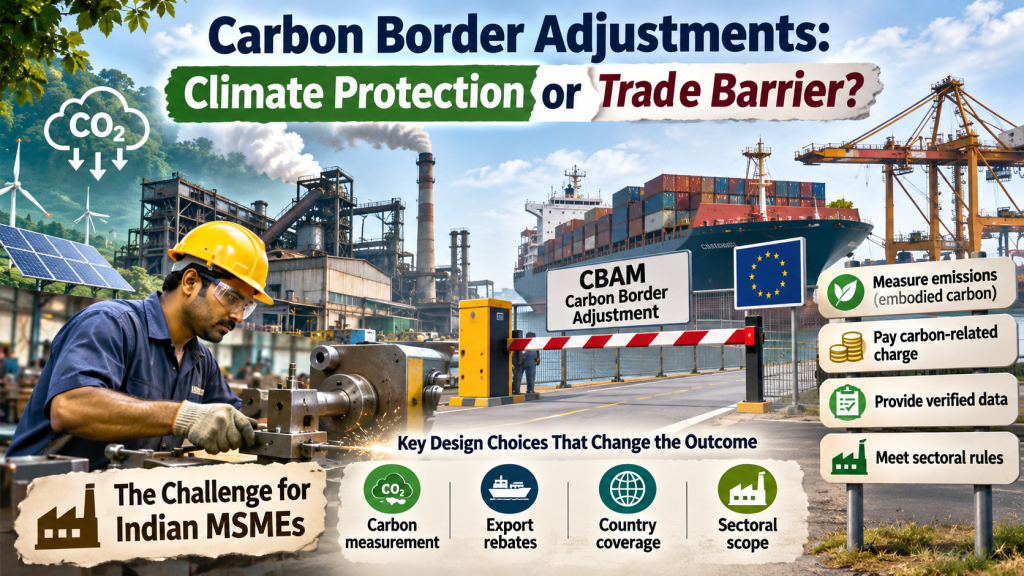
Four design choices that can change the economic outcome
Carbon measurement
Actual verified emissions versus default emissions values
Export rebates
Whether domestic exporters receive relief from carbon costs
Country coverage
Which trading partners face adjustment requirements
Sectoral coverage
Which products and industrial value chains are included
These choices can influence production costs, trade diversion, carbon leakage, global emissions and industrial competitiveness.
For example, using country-level default emissions values instead of verified factory-level emissions may disadvantage relatively efficient producers located in otherwise carbon-intensive economies.
Similarly, expanding coverage from basic materials to downstream products can change the distribution of costs across industrial value chains.
The important lesson is that carbon border adjustments should be evaluated as complex trade and environmental policy instruments, not simply as additional import duties.
4. The Hidden Challenge for Developing Economies
Much of the international discussion focuses on the direct financial burden of carbon adjustments.
However, for developing economies, another set of costs may be equally important: the institutional and technological costs of demonstrating environmental compliance.
These include emissions monitoring, independent verification, traceability, cleaner production technologies and access to reliable energy data.
For smaller enterprises, such costs may be disproportionately high because they are spread across relatively limited production volumes.
This creates the possibility of a new form of non-tariff barrier.
An enterprise may be internationally competitive in price and quality but still struggle to access a market because it cannot provide sufficiently reliable product-level carbon information.
Importantly, these enterprise-level compliance challenges are not fully captured by the aggregate structural modelling in the World Bank paper. They represent an additional practical concern for industrial development policy.
5. India’s Industrial Clusters: A Particular Vulnerability
India’s steel, aluminium, chemicals, fertilisers and engineering value chains face differing degrees of direct and indirect exposure to carbon-related trade requirements.
The challenge extends beyond major exporters.
Many MSMEs operate as suppliers to larger manufacturers, providing castings, forgings, fabricated components, chemicals and intermediate inputs.
Even when these enterprises are not directly covered by a particular border adjustment, their customers may increasingly require information about embodied emissions.
Consider an engineering cluster supplying components to a European manufacturer.
The immediate concern may not be a direct carbon levy on every component. Instead, the European buyer may seek information about the carbon content of purchased inputs, electricity consumption and production processes.
An enterprise unable to supply reliable data could face additional buyer scrutiny or lose opportunities to competitors with better documentation.
This is where climate regulation begins to influence the organisation of global value chains.
Carbon competitiveness is gradually becoming a supply-chain capability, not merely an environmental compliance requirement.
6. What Should Indian Industrial Clusters Do?
A cluster-based response can reduce the costs that individual MSMEs would otherwise struggle to bear. Priority Practical cluster-level intervention Carbon baselines Develop product-level emissions inventories Measurement and reporting Establish shared emissions-data and reporting facilities Verification Facilitate access to accredited verification services Technology upgrading Promote energy efficiency and cleaner production Input substitution Assess alternative fuels, materials and electricity sources Policy uncertainty Test costs under multiple carbon-adjustment scenarios Market intelligence Track buyer requirements and changes in product coverage
Industrial associations, cluster development agencies, technology centres and financial institutions can collaborate to establish common services.
For example, a foundry cluster could develop a shared carbon-accounting platform, train enterprise personnel, identify energy-efficiency opportunities and support credible third-party verification.
Such collective arrangements could lower compliance costs while improving the quality and consistency of emissions information.
The objective should not be limited to avoiding carbon-related trade costs. It should be to improve productivity, resource efficiency and long-term competitiveness.
7. Why Sensitivity Analysis Should Become Part of Industrial Strategy
One of the most valuable contributions of the World Bank paper is its emphasis on uncertainty.
Industrial policy often relies on a single projected cost or expected policy outcome.
But carbon border adjustments involve several variables that can change simultaneously.
For an Indian exporter, the effective burden could depend on the applicable carbon price, emissions intensity, recognised carbon payments, verified data, default values and the final scope of regulation.
Rather than preparing one compliance estimate, enterprises and clusters should consider multiple scenarios.
For example, an exporter could examine the implications of continued dependence on carbon-intensive electricity, partial renewable electricity procurement and substantial improvements in production efficiency.
These scenarios should then be tested against alternative regulatory and market assumptions.
This approach would help firms distinguish investments that are economically worthwhile under several possible futures from those that depend on one narrow policy prediction.
8. The Broader Development Question: Will Green Trade Deepen Global Inequality?
Historically, developing countries have entered global markets by exploiting comparative advantages in labour, natural resources and production costs.
Climate-related trade requirements introduce another dimension of competitiveness: access to clean technology, low-carbon infrastructure and reliable environmental information.
Countries that industrialised earlier often possess stronger technological capabilities and more developed regulatory institutions.
Developing economies may therefore face the simultaneous challenge of industrialising, upgrading technology and decarbonising production.
This does not mean that carbon border adjustments are necessarily protectionist or environmentally ineffective.
Their effects depend on design, implementation and the responses of governments and enterprises.
Nevertheless, the distributional consequences deserve greater attention.
A climate policy that reduces emissions while imposing disproportionate adjustment costs on smaller producers could generate economic and political resistance.
International cooperation on technology transfer, climate finance, emissions accounting and verification capacity can help address this problem.
9. What the Research Establishes—and What It Does Not
The study’s methodological strength lies in its systematic testing of alternative designs and assumptions.
It helps identify which conclusions remain robust across different model specifications and which depend on particular structural assumptions.
However, computable general-equilibrium models simulate how economies may respond to hypothetical changes. They do not establish that the predicted outcomes have already occurred.
Moreover, broad industrial sectors cannot fully represent the differences between large integrated producers and small enterprises.
The effects of fixed compliance costs, verification constraints, buyer decisions and unequal access to technology require additional enterprise-level investigation.
For India, this suggests a complementary research agenda combining structural modelling with detailed studies of industrial clusters and export supply chains.
The Future of Trade Will Depend on Carbon Capabilities
Border carbon adjustments represent an important intersection of climate policy, international trade and industrial competitiveness.
The new World Bank research demonstrates that their consequences are sensitive to policy design and economic assumptions.
For India, the appropriate response is neither to assume that carbon border adjustments will destroy export competitiveness nor to dismiss them as a temporary trade obstacle.
The strategic priority is to develop credible emissions information, cleaner production systems, shared verification facilities and the institutional capabilities required to respond to changing market requirements.
Industrial clusters can play a critical role by transforming expensive enterprise-level compliance obligations into collective services.
The next phase of international competitiveness may not be determined simply by who can manufacture at the lowest cost, but by who can manufacture efficiently, demonstrate environmental performance credibly and adapt rapidly to changing trade rules.
The provocative question
Could carbon border adjustments reduce global emissions while unintentionally making it harder for developing-country MSMEs to participate in international value chains?
The answer will depend not only on how carbon adjustments are designed, but also on whether developing economies receive the technology, finance and institutional support needed to adapt.
Research reference: Christoph Böhringer, Isha Dube, Carolyn Fischer and Thomas F. Rutherford, Border Carbon Adjustments Revisited, World Bank Policy Research Working Paper 11500, 13 November 2026. This article is based on the research summary supplied; the full paper and reproducibility package have not been independently reviewed here.
International Trade · Climate Economics · Carbon Border Adjustment · Indian MSMEs · Industrial Clusters · Export Competitiveness


Leave a Reply