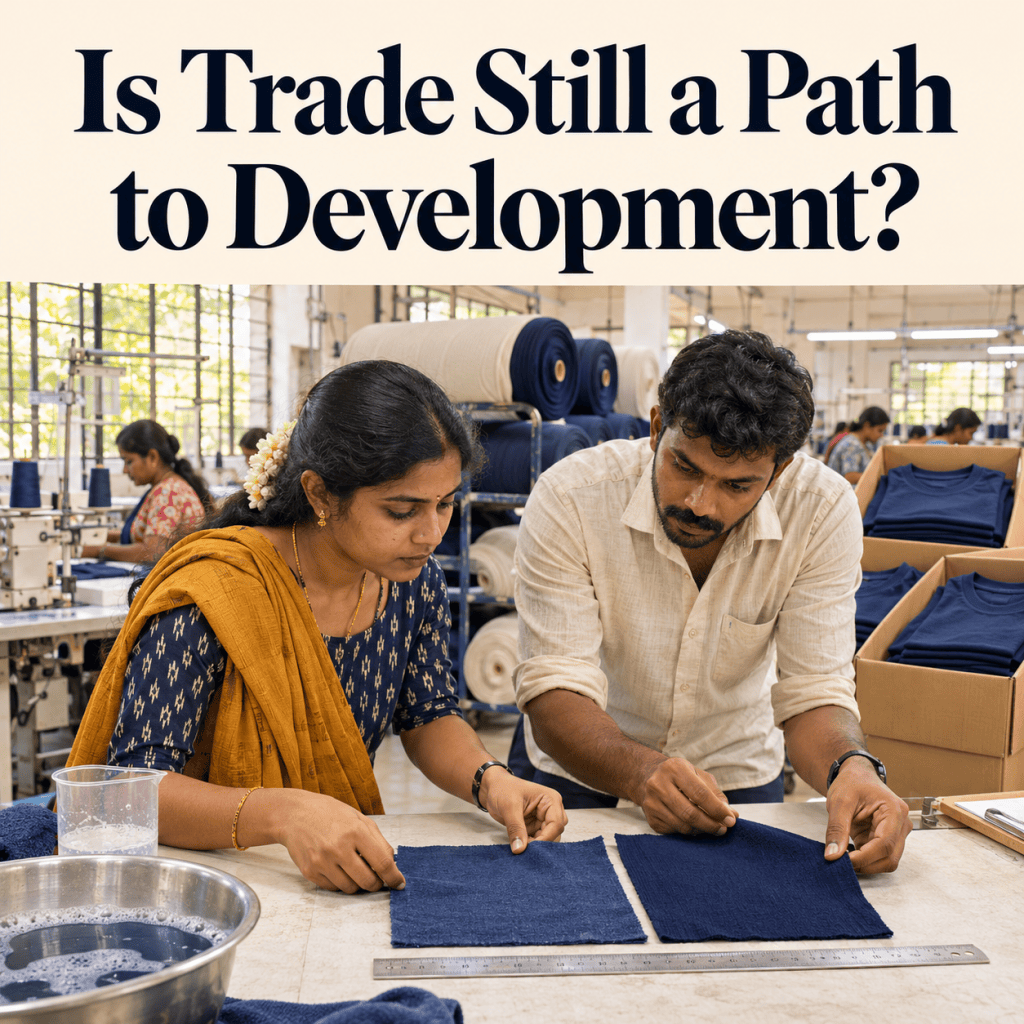
Imagine a knitwear exporter in Tiruppur that wins an overseas order, delivers on time and pays its workers. The buyer provides the design, chooses the fabric and sends a technician to resolve a shrinkage problem. Now imagine the same order a year later. This time, a local dyeing unit and a testing laboratory solve the problem before the fabric reaches the cutting table. The export invoice may be identical. Yet something economically important has changed. The cluster can now solve a problem for its next customer, and a technician in Tiruppur can earn a living doing it.
That difference goes to the heart of Shifting Sands: Is Trade Still a Path to Development?, a World Bank study by Alessandro Barattieri and Aaditya Mattoo released on 13 November 2026. Drawing particularly on East Asia and the Pacific, the authors conclude that trade remains a viable route to development. For India, their analysis raises a more demanding question. What can Indian firms and workers do after the hundredth export order that they could not do after the first?
What East Asia’s experience still teaches
For earlier East Asian industrialisers, an export factory could do two things at once. It could employ large numbers of people entering industrial work and expose domestic producers to demanding customers. A rejected consignment taught suppliers where quality had failed. A repeat order gave them a reason to invest in fixing it. Over time, managers, technicians and workers could take that knowledge to other firms. Selling abroad mattered partly because of what firms learned at home.
A developing economy entering world markets today faces a different calculation. A garment producer may offer lower wages than a Chinese competitor and still lose the order because the competitor can obtain fabric, alter a sample and deliver a replacement faster. A tariff change can make a buyer reluctant to commit to a new supplier. Climate requirements can make a dyehouse’s ability to document energy use commercially important. Meanwhile, ageing populations change the supply of factory labour and create demand for services that younger economies may be able to provide. Each shift changes which tasks a country can compete for and what it takes to perform them.
Automation makes the employment question especially interesting. The World Bank discusses evidence from developing East Asia that, in some manufacturing industries, lower costs helped firms win enough additional orders to expand employment even as machines took over individual tasks. The outcome depends partly on demand. A machine that doubles a workshop’s capacity has very different consequences when its order book is full than when its largest buyer is leaving. For a cluster considering a technology upgrade, that makes the sales forecast as important as the machinery specification.
The services inside the shipment
One of the report’s most consequential observations concerns where export value is created. Engineering, design, software and logistics contribute to the value of a manufactured product. Some of those services can also be sold independently across borders. A technician who helps commission an exported machine may later diagnose a fault remotely. That second transaction earns revenue without another machine crossing customs. The report finds that digitally delivered services exports have grown faster than goods exports, particularly in East Asia and the Pacific.
Consider what this means for an Indian pump manufacturer. An overseas customer facing repeated pump failures might pay for a replacement. It might pay more willingly for a supplier who can establish why the seal keeps failing and prevent the next shutdown. Winning that business requires a machinist who understands tolerances, an engineer who can interpret operating data and a service team the customer can reach. Their skills are complementary. A cluster policy that funds a new machining centre while overlooking diagnostics and after-sales support may finance only part of what the customer needs.
A different test for Indian cluster policy
A practical starting point is the last order a group of firms lost. Suppose several small exporters missed the same buyer’s deadline because every design revision required an outside specialist. The cluster association could arrange access to a design engineer and test the service on live orders. Did sample approval become faster? Did the buyer place a repeat order? Did local employees learn to handle the next revision themselves? Those answers would give the association a basis for deciding whether to expand the service. The World Bank’s cross-country synthesis gives a rationale for such an experiment. Its evidence cannot predict which intervention will work in a particular cluster.
National policy matters here too. Easier access to specialist services, including foreign expertise, can help a small manufacturer acquire skills that would take years to build alone. The opportunity is greatest when local staff work alongside the specialist and gain responsibility for the next assignment. That is where services reform, workforce training and industrial policy meet on the factory floor.
India should continue to count what its clusters export. It should also ask who gained steady work, whose wages rose, which supplier won a second customer and who can now solve a technical problem locally. Return to that Tiruppur order. The strongest sign of development may come months after the shipment, when another exporter encounters the same defect and knows whom to call in town.


Leave a Reply