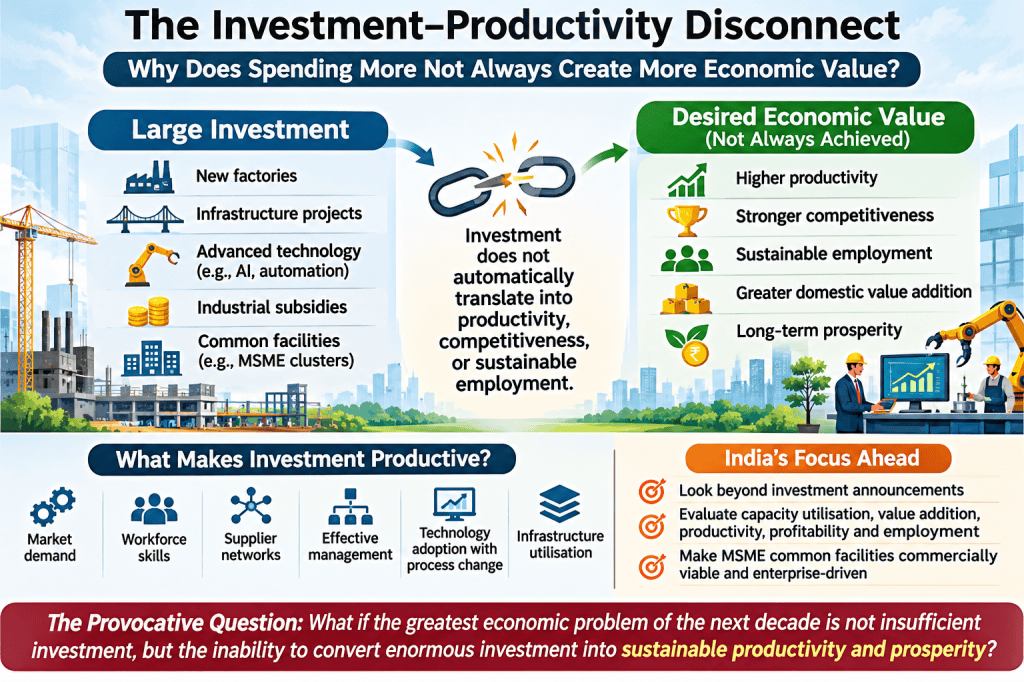
The emerging economic paradox: Countries are investing billions in infrastructure, factories, technology, and industrial expansion, but are they creating proportionately greater productivity, competitiveness, employment, and prosperity?
When Investment Becomes a Measure of Ambition Rather Than Economic Success
Modern economic development is increasingly judged by the scale of investment. Governments announce ambitious infrastructure programmes, corporations commit billions to manufacturing facilities, and policymakers celebrate rising capital expenditure as evidence of economic progress. Industrial corridors, semiconductor plants, renewable energy parks, logistics networks, and artificial intelligence infrastructure have become symbols of national economic strength.
Yet an uncomfortable question remains largely unanswered: Does spending more necessarily mean producing more economic value?
A factory can be constructed without sufficient demand for its products. A highway can be completed without generating the expected commercial activity. A sophisticated machine can be installed without improving production efficiency. An industrial park can attract substantial public investment while remaining underutilised.
The fundamental economic problem is that investment creates productive capacity, but productive capacity does not automatically create productivity.
Investment becomes economically meaningful only when it generates additional output, reduces costs, improves quality, strengthens technological capabilities, creates sustainable employment, or opens new markets.
This distinction may become one of the defining economic challenges of the coming decade.
Historical Perspective: The Long Journey from Capital Accumulation to Productivity
For much of the twentieth century, economic development strategies placed considerable emphasis on capital accumulation. Early development economists viewed savings, investment, and infrastructure as essential conditions for accelerating economic growth.
The Harrod–Domar growth framework highlighted the relationship between investment, capital requirements, and economic expansion. Countries with low savings and inadequate productive infrastructure were expected to face significant constraints on growth.
However, subsequent economic experience revealed an important limitation: countries investing similar proportions of national income could achieve dramatically different growth outcomes.
Robert Solow’s growth model demonstrated that capital accumulation alone could not explain sustained increases in income per worker. Technological progress and improvements in economic efficiency were central to long-term growth.
Later research emphasised human capital, innovation, institutions, organisational capabilities, and knowledge accumulation.
The experiences of East Asian economies further demonstrated that successful industrialisation required more than investment in factories. Export discipline, workforce development, supplier networks, technological learning, and continuous productivity improvement were equally important.
Conversely, experiences of inefficient public investment, underutilised industrial capacity, and debt-financed infrastructure expansion in different economies revealed that capital expenditure could increase without generating corresponding economic returns.
The historical lesson is significant: Capital accumulation creates the possibility of growth; productivity determines how effectively that possibility is realised.
The Hidden Economics of Investment Efficiency
The relationship between investment and economic growth is often examined through the Incremental Capital–Output Ratio (ICOR), which broadly measures how much additional capital is required to generate an additional unit of output.
A rising ICOR can indicate that an economy requires progressively greater investment to achieve a given increase in production, although the indicator is also affected by business cycles, investment gestation periods, and structural changes.
Consider two hypothetical economies investing an identical proportion of GDP.
Illustrative investment-efficiency comparison
Economy A
5%
Annual GDP growth
Investment: 30% of GDP
Illustrative ICOR: 6
Economy B
7.5%
Annual GDP growth
Investment: 30% of GDP
Illustrative ICOR: 4
Hypothetical steady-state illustration using growth ≈ investment rate ÷ ICOR. Not actual country observations.
Economy B generates considerably more growth from the same investment effort. The difference may reflect better project selection, technological capabilities, infrastructure utilisation, institutional efficiency, or stronger market demand.
This raises a fundamental policy question: Should governments concentrate primarily on increasing investment rates, or should they pay equal attention to reducing the amount of capital required to generate additional economic output?
The answer is not that investment should be reduced. Rather, investment must become more productive.
The Industrial Capacity Paradox: More Factories, but Not Necessarily More Competitiveness
Industrial policy increasingly relies on financial incentives, subsidised infrastructure, tax concessions, and production-linked support to attract manufacturing investment.
Such measures can address genuine market failures and accelerate industrial development. However, they can also create a dangerous illusion when investment announcements and installed capacity become substitutes for measuring actual industrial performance.
A manufacturing facility may achieve impressive production volumes while depending heavily on imported components, foreign technology, external designs, and international brands.
Its gross output may increase without generating comparable domestic value addition.
Similarly, industrial subsidies can encourage capacity expansion even when future demand is uncertain.
If several countries simultaneously subsidise similar industries, global production capacity may expand faster than demand, putting pressure on prices, profitability, and public finances.
The economic consequences can include idle factories, financially stressed enterprises, weak returns on public subsidies, and persistent dependence on government support.
The real test of industrial policy is not how much capacity it creates, but whether that capacity becomes internationally competitive without permanent financial protection.
The Artificial Intelligence Investment Paradox
Artificial intelligence introduces a particularly interesting dimension to the investment–productivity disconnect.
Governments and technology corporations are committing enormous resources to data centres, advanced computing infrastructure, semiconductor technologies, software platforms, and AI applications.
The expectation is that these investments will generate major productivity improvements across industries and services.
Yet technological investment and productivity improvement are not the same process.
A company may purchase advanced AI systems without changing its organisational structure. Employees may use sophisticated software while continuing inefficient work processes. Managers may automate existing procedures without questioning whether those procedures are economically necessary.
Historical experience with information technology suggests that productivity benefits often depend on complementary investments in skills, management, organisational redesign, and business processes.
AI could follow a similar pattern.
By 2035, a major distinction may emerge between economies that merely purchase advanced technologies and those that successfully integrate them into productive systems.
The greatest returns may come not from possessing the largest computing infrastructure, but from applying AI effectively to manufacturing quality, logistics, product design, energy efficiency, healthcare, education, and business decision-making.
For developing economies, this distinction is particularly important because expensive technological infrastructure can create substantial financial obligations before its economic benefits become visible.
India: From Investment-Led Growth to Productivity-Led Competitiveness
India’s development strategy has understandably placed considerable emphasis on infrastructure expansion, manufacturing investment, industrial corridors, logistics modernisation, and production-linked incentives.
These investments can address longstanding structural constraints and strengthen the foundations of economic growth.
However, their ultimate contribution cannot be established through expenditure figures or investment commitments alone.
A more demanding assessment is necessary.
Are new industrial facilities operating near economically efficient capacity levels? Are manufacturing enterprises generating higher domestic value addition? Are productivity improvements reducing unit production costs? Are Indian suppliers acquiring technological capabilities? Are firms becoming competitive in international markets without continuing protection? Are investments generating durable, productive employment?
These questions should become central to industrial policy evaluation.
India must also recognise that physical infrastructure and industrial capabilities are complementary rather than interchangeable.
A modern expressway cannot compensate for unreliable supplier quality. An industrial park cannot substitute for technical skills. A production subsidy cannot permanently overcome weak product design, inefficient management, or inadequate market intelligence.
Investment in machinery without corresponding investment in workforce capabilities, technology absorption, quality systems, and market development may generate disappointing economic returns.
India’s next stage of industrial transformation should therefore focus not simply on the volume of investment, but on the economic value created by every rupee invested.
The MSME Cluster Challenge: Common Facilities Without Common Competitiveness?
The investment–productivity disconnect is especially relevant to India’s MSME cluster development programmes.
Cluster development has traditionally emphasised common facility centres, testing laboratories, machinery, industrial infrastructure, training facilities, and shared production services.
These interventions can generate important economies of scale and overcome constraints that individual small enterprises cannot address independently.
However, establishing a common facility is only the beginning of cluster development.
A testing laboratory may remain underutilised if enterprises do not face sufficient market pressure to upgrade quality. A common production facility may struggle financially if its services do not match enterprise requirements. Expensive machinery may become obsolete without professional maintenance, skilled operators, and technological upgrading.
Most importantly, collective infrastructure does not automatically create collective competitiveness.
The success of cluster investment depends on whether enterprises actually use the facilities, improve their production processes, reduce costs, develop new products, and gain access to more demanding markets.
This requires a fundamental change in programme design.
Rather than beginning with machinery procurement, cluster development should begin with an assessment of market opportunities, value-chain bottlenecks, enterprise demand, technological gaps, and commercially viable services.
Professional management, transparent governance, enterprise participation, and sustainable revenue models should be integral components of common facilities.
The objective should be to transform cluster infrastructure from a publicly financed asset into a commercially relevant productivity-enhancing institution.
Measuring What Really Matters: A New Investment Scorecard
India’s industrial programmes and cluster interventions could benefit from a shift toward outcome-based investment evaluation. Traditional measure More meaningful economic measure Investment announced Investment realised and operational Factory capacity installed Capacity utilisation and unit costs Gross production value Domestic value addition Machinery purchased Productivity and quality improvement Industrial subsidies disbursed Additional competitive output generated Common facilities established Enterprise utilisation and financial sustainability Employment promised Sustainable jobs and real wages Technology expenditure Technology adoption and measurable efficiency gains
Such indicators should be evaluated over several years, recognising that infrastructure and technological investments often require substantial gestation periods.
The purpose is not to discourage long-term investment, but to distinguish economically productive capital formation from expenditure that merely increases the stock of physical assets.
Future Outlook: By 2035, Investment Productivity Could Become a Major Competitive Advantage
The coming decade may witness extraordinary investment in clean energy, digital infrastructure, semiconductor manufacturing, artificial intelligence, defence technologies, industrial automation, and supply-chain restructuring.
However, rising investment requirements will coincide with tighter fiscal constraints, technological uncertainty, geopolitical fragmentation, and growing pressure to create productive employment.
Countries that combine physical capital with skilled workers, capable institutions, efficient suppliers, strong management, and access to markets may generate significantly greater economic value from their investments.
Others may experience a more troubling outcome: rising capital expenditure accompanied by excess industrial capacity, growing public debt, disappointing productivity improvements, and limited employment creation.
The global economy could therefore witness a new form of divergence.
The most successful economies may not necessarily be those investing the largest amounts, but those achieving the greatest technological learning, domestic value addition, and productivity improvements from available capital.
For India, this suggests that the next generation of industrial policy must integrate investment promotion with enterprise upgrading, supplier development, technological capabilities, management improvement, and market competitiveness.
For MSME clusters, the future may lie less in creating additional physical facilities and more in developing institutions that continuously improve the productivity and adaptability of enterprises.
The Provocative Question: Are We Facing a Shortage of Capital or a Shortage of Economic Efficiency?
Economic policy frequently assumes that insufficient investment is the central obstacle to growth.
But what if the more serious problem is the inability to convert existing and new investments into sustainable economic value?
What if factories, infrastructure, technologies, and financial incentives continue expanding while productivity, profitability, and employment fail to keep pace?
The consequences would extend beyond inefficient capital allocation. Governments could face rising fiscal pressures, businesses could experience declining returns, and households might see limited improvements in living standards despite impressive investment statistics.
This possibility demands a fundamental reconsideration of how economic progress is measured.
The central economic question of the next decade may no longer be simply, “How much are we investing?”
It may increasingly become, “How much additional prosperity are we creating from every unit of capital invested?”
Because ultimately, nations do not become prosperous merely by accumulating factories, roads, machines, and technologies.
They become prosperous when those investments generate sustained productivity, competitive enterprises, better employment, and rising living standards.
The real challenge of economic development is not simply to invest more. It is to make investment work harder, smarter, and more productively for society.
#EconomicDevelopment #Productivity #InvestmentEfficiency #IndianEconomy #IndustrialPolicy #MSME #ClusterDevelopment #Manufacturing #ArtificialIntelligence #Competitiveness #EconomicGrowth


Leave a Reply