GLOBAL ECONOMIC PERSPECTIVES | 11 NOVEMBER 2026
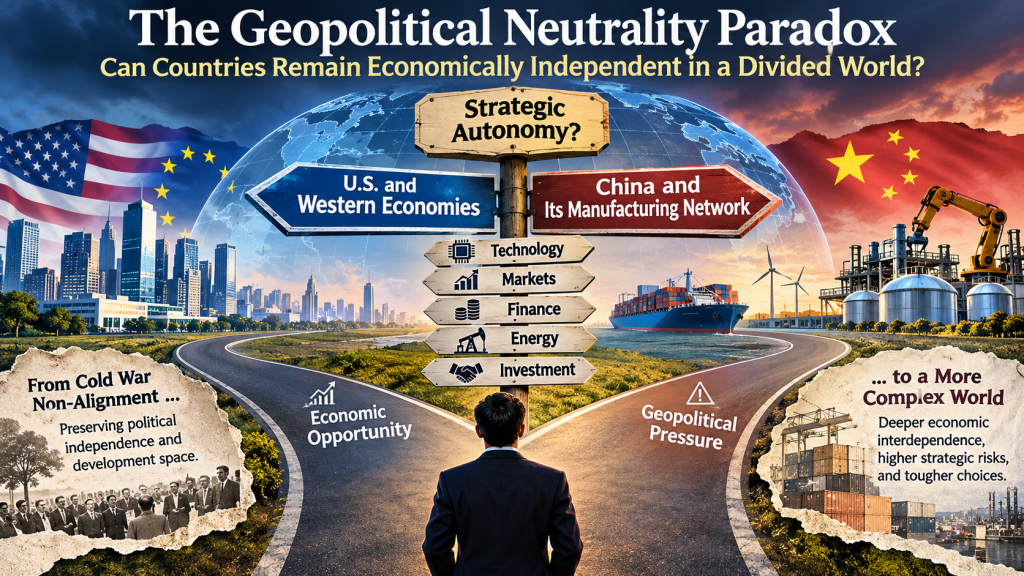
When global economic relationships become instruments of geopolitical power, can developing countries preserve their independence without sacrificing economic opportunities?
The New Dilemma: Economic Opportunity Without Political Dependence
For decades, developing countries have pursued a seemingly straightforward economic strategy: trade with everyone, attract investment from multiple sources, purchase technology wherever it is available, and maintain diplomatic flexibility. The underlying assumption was that economic cooperation could continue even when countries disagreed politically.
That assumption is becoming increasingly difficult to sustain.
The global economy is entering a period in which economic relationships are increasingly influenced by strategic competition. The United States and its allies remain central to advanced technology, international finance, and major consumer markets. China occupies an important position in manufacturing, industrial supply chains, critical minerals processing, and infrastructure development. Russia continues to influence international energy and commodity markets, while emerging regional powers are attempting to create alternative economic partnerships.
For countries such as India, Indonesia, Vietnam, Brazil, South Africa, and several Gulf economies, the challenge is not simply choosing between competing powers. It is preserving access to the economic advantages offered by different countries without becoming excessively dependent on any one of them.
This creates a fundamental paradox: the more countries attempt to diversify their international economic relationships, the more they may become exposed to geopolitical contradictions between those relationships.
From Cold War Non-Alignment to Economic Multi-Alignment
During the Cold War, several developing countries adopted non-alignment as a means of preserving political independence. India, Yugoslavia, Egypt, Indonesia, and other countries sought to avoid automatic identification with either the American or Soviet bloc.
However, political non-alignment did not necessarily produce economic independence. Many developing countries continued to depend on foreign aid, imported machinery, external finance, and access to international markets. Their ability to pursue independent development strategies was often constrained by limited domestic industrial and technological capabilities.
The end of the Cold War appeared to offer a different possibility. Globalisation expanded international production networks, reduced many trade barriers, and encouraged cross-border investment. Countries could increasingly purchase components from East Asia, obtain technology from Europe or the United States, attract investment from multiple sources, and sell finished products across global markets.
This system created opportunities for rapid industrialisation, particularly in economies capable of integrating themselves into global value chains.
Yet it also created a new form of dependence. Countries became increasingly connected to international networks of finance, technology, logistics, digital infrastructure, and specialised industrial inputs.
The economic integration that improved efficiency also made national economies more vulnerable to disruptions originating beyond their borders.
When Economic Interdependence Becomes a Geopolitical Weapon
The central weakness of contemporary globalisation is that economic interdependence is not always balanced.
A country may depend on another for advanced semiconductors, energy supplies, industrial machinery, pharmaceuticals, critical minerals, or access to international payment systems. Such dependence becomes particularly dangerous when the supplier controls a technology or resource that cannot easily be replaced.
Recent geopolitical developments have demonstrated how trade restrictions, financial sanctions, export controls, investment screening, and technological restrictions can be used to advance national security objectives.
These measures may be justified by governments as necessary for protecting strategic industries and national security. However, their economic consequences often extend far beyond the countries directly involved.
A developing economy may find itself purchasing industrial components from China, exporting finished products to the United States, using European technology, relying on international financial institutions, and importing energy from Russia or the Middle East.
Each relationship may be economically rational when considered independently. Together, however, they can create conflicting geopolitical pressures.
A country may remain politically neutral while its industries, banks, exporters, and technology companies become increasingly constrained by the strategic decisions of other countries.
This is the geopolitical neutrality paradox.
The Hidden Economic Cost of Strategic Independence
Economic independence is often presented as a matter of reducing foreign dependence. But complete self-sufficiency is neither realistic nor economically desirable for most countries.
Modern industrial production requires highly specialised technologies, materials, machinery, software, and research capabilities. Attempting to reproduce every component domestically would involve enormous financial costs and could weaken industrial competitiveness.
For example, a country seeking to reduce dependence on imported electronic components may invest heavily in domestic semiconductor manufacturing. Such investment could strengthen technological security, but it may also require substantial subsidies, advanced infrastructure, skilled workers, and access to foreign equipment.
Similarly, diversifying energy imports can improve supply security, but alternative sources may involve higher transportation costs or less favourable commercial terms.
The difficult question is therefore not whether countries should reduce dependence, but which dependencies are strategically dangerous, which are economically manageable, and which are essential for remaining internationally competitive.
Without this distinction, economic security policies could unintentionally produce inefficient industries protected by public subsidies but unable to compete internationally.
The Future: A World of Competing Economic Networks
The coming decade may witness a gradual restructuring of globalisation rather than its complete reversal.
Instead of one relatively integrated international production system, the world could develop overlapping networks shaped by technology standards, strategic partnerships, trade agreements, financial regulations, and national security considerations.
Companies may increasingly establish alternative suppliers and production locations to serve different geopolitical markets. Governments may encourage domestic production of selected strategic goods while continuing to depend on international trade for other products.
This restructuring could create opportunities for emerging economies seeking to attract investment diverted from existing production centres.
However, these opportunities will not be distributed equally.
Countries with reliable infrastructure, skilled labour, strong institutions, technological capabilities, and predictable trade policies will be better positioned to benefit. Economies relying primarily on low wages or temporary geopolitical advantages may struggle to retain investment.
An important distinction will emerge between countries that merely provide alternative manufacturing locations and those that develop genuine industrial and technological capabilities.
The former may experience temporary investment growth. The latter could achieve lasting improvements in productivity, domestic value addition, and economic bargaining power.
India’s Strategic Challenge: From Non-Alignment to Competitive Autonomy
India occupies a particularly interesting position in this changing economic environment.
Its relationships with the United States, European Union, Russia, China, Japan, the Gulf economies, and the wider Global South reflect different economic and strategic priorities.
Western markets are important for India’s merchandise and services exports. China remains a significant source of industrial inputs and machinery. Russia has been an important energy and defence partner. Japan and Europe contribute technology, investment, and industrial cooperation. Gulf economies are important for energy, investment, trade, and employment-related economic connections.
India cannot easily replace all these relationships without imposing substantial costs on its economy.
Consequently, India’s long-term economic strategy should not be based on choosing one geopolitical bloc over another. It should focus on strengthening the domestic capabilities that allow the country to negotiate with multiple partners from a position of greater economic strength.
This requires moving beyond the traditional emphasis on attracting foreign investment and expanding gross manufacturing output.
India needs to increase domestic value addition, develop competitive component suppliers, strengthen industrial research, improve technological absorption, and expand capabilities in advanced materials, electronics, precision engineering, industrial software, and critical manufacturing technologies.
Import substitution alone cannot achieve this objective. Domestic industries must become internationally competitive rather than merely domestically protected.
Strategic autonomy without industrial competitiveness can become an expensive political aspiration rather than a sustainable economic reality.
The Overlooked Vulnerability of Indian MSME Clusters
The geopolitical debate generally focuses on governments, multinational corporations, defence industries, and strategic technologies. Yet smaller enterprises may experience some of its most immediate economic consequences.
Indian MSME clusters in engineering, textiles, chemicals, pharmaceuticals, automotive components, and electronics are increasingly connected to international supply chains.
A small manufacturer may import machinery from one country, specialised chemicals from another, and electronic components from a third while exporting its finished products to several international markets.
Geopolitical disruptions can therefore affect these enterprises through rising input prices, restrictions on imported components, changing product standards, shipping disruptions, payment difficulties, and sudden shifts in export demand.
Unlike large multinational corporations, smaller enterprises generally lack the financial resources and organisational capabilities needed to maintain multiple international suppliers, strategic inventories, or sophisticated geopolitical risk-management systems.
This makes collective industrial action increasingly important.
MSME clusters could benefit from shared supplier intelligence, common testing facilities, technology development centres, alternative sourcing arrangements, export-market diversification, and collective compliance services.
Cluster development policy must consequently evolve beyond conventional infrastructure provision and entrepreneurship promotion.
It should increasingly address the resilience of entire industrial value chains.
A New Development Strategy: Independence Through Capability, Not Isolation
The most important lesson of the emerging geopolitical order is that economic independence cannot be achieved simply by reducing international engagement.
Countries that isolate themselves from global markets risk losing access to technology, investment, competition, and productivity improvements.
At the same time, countries that depend excessively on foreign technology, strategic inputs, or a limited number of export markets may discover that their economic choices are constrained by external political decisions.
The solution lies in building domestic capabilities while maintaining diversified international economic relationships.
For India, this means identifying strategically sensitive dependencies, strengthening domestic technological capabilities, supporting internationally competitive suppliers, diversifying export destinations, and ensuring that industrial policy produces measurable improvements in productivity and innovation.
It also means recognising that not every imported product represents a strategic vulnerability and not every domestic manufacturing investment represents genuine economic independence.
The quality of domestic capabilities matters more than the symbolic location of production.
The Provocative Question: Is Geopolitical Neutrality Becoming an Economic Luxury?
The emerging global order raises an uncomfortable possibility.
Countries with advanced technologies, deep financial markets, diversified industries, and strong institutions may have the greatest freedom to maintain independent foreign economic policies.
Countries lacking these capabilities may find that their political choices are increasingly influenced by their dependence on external markets, finance, energy, and technology.
In other words, geopolitical neutrality may become easier for economically powerful countries and progressively more difficult for weaker economies.
This reverses an important assumption underlying the traditional non-alignment movement. Political independence was once viewed as a means of creating space for economic development. In today’s world, strong economic capabilities may increasingly become a prerequisite for meaningful political independence.
The central question is no longer whether developing countries can remain neutral between competing geopolitical powers.
It is whether they can build sufficient economic and technological strength to make neutrality a genuine choice rather than a condition imposed by their vulnerabilities.
For India and other emerging economies, the future of strategic autonomy will ultimately depend less on diplomatic declarations and more on the competitiveness of their industries, the capabilities of their workers, the strength of their institutions, and their ability to participate in global markets without becoming excessively dependent on any single economic power.
The real measure of economic sovereignty is not how many international relationships a country can avoid, but how many independent economic choices it can afford to make.
Themes: International Political Economy | Geopolitical Fragmentation | Strategic Autonomy | Global Value Chains | Industrial Policy | Indian MSMEs


Leave a Reply