ECONOMIC PERSPECTIVES | 10 NOVEMBER 2026
Why the future of industrial competitiveness will depend less on how much a country manufactures and more on how much economic value it controls.
The uncomfortable contradiction in global manufacturing
A country can build enormous factories, employ millions of industrial workers, export billions of dollars worth of products, and still remain dependent on foreign companies for technology, product designs, intellectual property, brands, and access to international customers. This is one of the most important but insufficiently discussed contradictions of modern industrial development.
For decades, industrial success has largely been measured through manufacturing investment, production capacity, employment generation, and export performance. Governments celebrate new factories, industrial corridors, rising merchandise exports, and increasing participation in global supply chains. These achievements are important, but they do not necessarily reveal who captures the greatest economic benefits from industrial production.
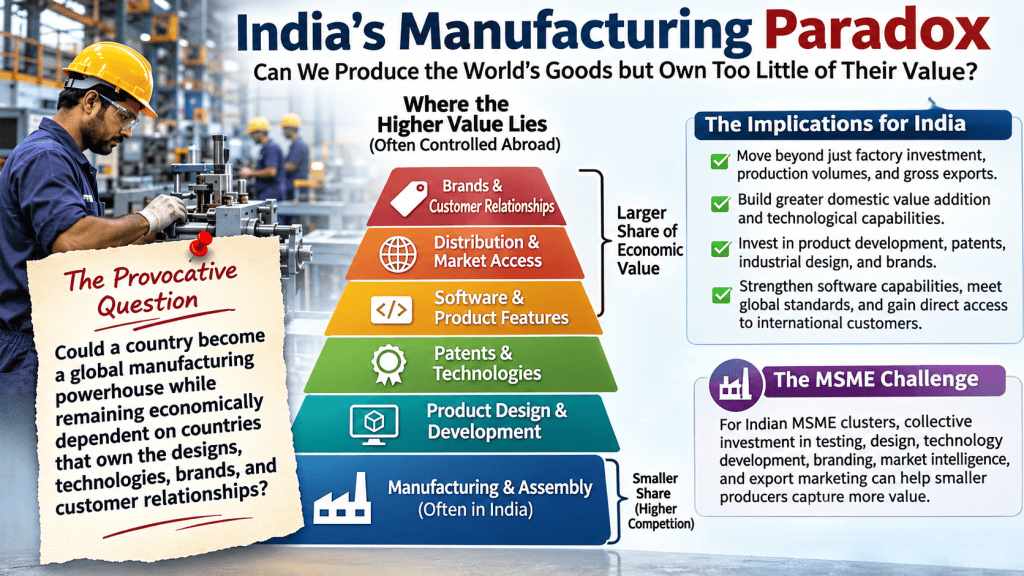
Consider a hypothetical electronic product manufactured in India and sold internationally for $1,000. The Indian manufacturer may receive only a relatively small share of the final selling price for assembly and production services, while other companies earn revenue from semiconductor technologies, operating systems, product design, branding, distribution, and customer relationships. The precise distribution varies substantially across products and industries, but the underlying economic question remains: Does manufacturing a product necessarily mean controlling the economic value it creates?
The answer increasingly determines the difference between industrial expansion and industrial leadership.
Historical perspective: From industrial production to control over value
During the Industrial Revolution, industrial power was closely associated with ownership of machinery, factories, energy resources, and manufacturing technologies. Britain initially benefited not simply because it produced industrial goods, but because it developed technological capabilities, financial institutions, commercial networks, and international market access.
During the twentieth century, industrial development became more complex. American, German, and Japanese manufacturers demonstrated that sustained competitiveness required engineering capabilities, technological innovation, organisational efficiency, product quality, and internationally recognised brands.
The rise of East Asian manufacturing introduced another transformation. Economies such as South Korea and Taiwan initially expanded through export-oriented production and participation in international supply chains. Over time, significant investments in research, engineering, technological learning, and enterprise development enabled domestic firms to move into more sophisticated activities.
However, this transition was neither automatic nor universal. Many developing economies expanded manufacturing exports without developing comparable ownership of technology, brands, or global distribution networks.
The emergence of global value chains further separated the physical location of production from the ownership of commercially valuable knowledge and market relationships.
A product might be designed in one country, use critical components from several others, be assembled in another economy, and finally be marketed internationally by a corporation controlling the brand and customer relationship.
Consequently, the geography of production and the geography of economic power increasingly became different.
The new industrial hierarchy: Who controls the profitable activities?
Modern manufacturing competition is no longer confined to factory productivity. It increasingly involves control over activities before, during, and after physical production.
Research and development determine technological possibilities. Product design influences functionality and differentiation. Patents and proprietary knowledge can protect commercially valuable innovations. Standards and certification influence access to international markets. Software increasingly determines product performance, while branding, distribution, and customer relationships influence pricing power.
Manufacturing remains essential, but its economic rewards depend on the capabilities, competition, and bargaining power associated with particular activities.
This creates a potentially uncomfortable industrial hierarchy. Some enterprises control technologies, designs, brands, and markets, while others compete mainly on production costs, delivery schedules, and manufacturing efficiency.
The latter may achieve impressive export growth without acquiring sufficient bargaining power to retain a larger share of value.
Yet it would be misleading to conclude that physical production is inherently low-value. Advanced manufacturing processes, precision engineering, specialised materials, and difficult-to-replicate production capabilities can themselves command substantial returns. The real distinction is between firms possessing scarce, defensible capabilities and those competing primarily through interchangeable production services.
The central problem is not manufacturing versus innovation. It is manufacturing without sufficient control over innovation, differentiation, and markets.
India’s industrial challenge: Beyond factories and gross exports
India’s industrial development strategy has understandably emphasised infrastructure, investment attraction, manufacturing capacity, production-linked incentives, and export expansion. These can help address important structural constraints, including insufficient industrial employment, inadequate production scale, and dependence on imported products.
However, factory investment and rising exports alone cannot establish whether domestic enterprises are moving toward higher-value activities.
A country can increase gross exports while continuing to import technologically sophisticated components, licence essential technologies, and depend on foreign companies for product development and international marketing.
This does not make participation in global value chains undesirable. Imported inputs and foreign technology can improve productivity and accelerate industrial learning. The problem emerges when participation remains confined to activities with limited opportunities for capability development and value capture.
India therefore needs to evaluate industrial progress through a broader set of indicators: domestic value addition, technological capabilities, product development, industrial design, intellectual property, brand ownership, engineering sophistication, and access to international customers.
Even these indicators require careful interpretation. Patent counts alone do not measure commercial innovation, and domestic content alone does not guarantee productivity or competitiveness. What matters is whether Indian enterprises develop capabilities that enable them to innovate, compete, earn sustainable margins, and upgrade their positions within global value chains.
The objective should not be to manufacture every component domestically. It should be to develop strategically valuable capabilities where Indian enterprises can become competitive and retain meaningful economic returns.
The MSME cluster paradox: Collective production without collective economic power
This challenge is particularly significant for India’s micro, small, and medium enterprises.
Many industrial clusters possess extensive manufacturing experience, skilled workers, specialised production processes, and dense networks of suppliers. Yet individual enterprises frequently lack the resources required for advanced product development, testing facilities, industrial design, technology acquisition, international certification, market intelligence, and global branding.
As a result, clusters may become highly efficient production centres while remaining dependent on external buyers, intermediaries, technology providers, and brand owners.
The traditional cluster development approach has often concentrated on improving production efficiency, common infrastructure, skills, quality, and access to finance. These interventions remain valuable, but the next generation of cluster development must go further.
Industrial clusters should increasingly function as collective centres of innovation, product development, technological learning, and international market creation.
Shared design studios could enable smaller manufacturers to develop differentiated products. Common testing and certification facilities could reduce the cost of complying with international standards. Technology centres could support prototyping, process innovation, and specialised engineering. Collective market intelligence systems could identify emerging customer requirements, while shared export marketing arrangements could help enterprises develop more direct relationships with international buyers.
Cluster-level branding may also create opportunities, particularly in products where geographical identity, quality reputation, design, or specialised manufacturing expertise influence purchasing decisions.
However, collective facilities will not automatically generate innovation. They require professional management, commercial accountability, sustained enterprise participation, and a clear connection with market demand.
The challenge is to transform clusters from geographical concentrations of producers into organised ecosystems capable of creating and capturing greater economic value.
Future outlook: Manufacturing competition may become a struggle over intangible assets
Over the coming decade, artificial intelligence, industrial software, automation, advanced materials, semiconductor technologies, and digital manufacturing platforms could further change how economic value is distributed.
AI-assisted design may shorten product development cycles. Industrial software may become increasingly important in managing complex production systems. Proprietary technologies and digital platforms may influence who can participate in particular markets and under what conditions.
At the same time, international buyers are placing growing importance on traceability, technical compliance, sustainability information, reliability, and supply chain transparency.
These developments create both opportunities and risks for developing economies.
Digital technologies may reduce the cost of design, product development, and market discovery, enabling smaller enterprises to undertake activities previously dominated by large corporations. Conversely, dependence on proprietary software, expensive technological infrastructure, and concentrated digital platforms could create new forms of industrial dependence.
The future industrial divide may therefore emerge not simply between countries that manufacture and countries that do not, but between those that develop commercially valuable technological and organisational capabilities and those that remain dependent on capabilities controlled elsewhere.
Rethinking India’s industrial development priorities
India’s next phase of industrial development requires a shift from measuring manufacturing expansion alone to assessing the quality of its integration into domestic and international value chains.
Industrial policy must connect investment incentives with technological learning, supplier development, engineering capabilities, design institutions, and commercially relevant research. Universities and technical institutions need stronger working relationships with industrial clusters. Export promotion institutions must support market intelligence, product positioning, certification, and direct buyer relationships rather than concentrating mainly on trade participation.
Financial institutions also need to recognise that industrial competitiveness increasingly depends on intangible investments. Product development, industrial design, software, branding, and technological upgrading may not create conventional physical collateral, but they can generate substantial long-term commercial value.
For MSMEs, the most practical approach may be collective capability building rather than expecting every enterprise to independently finance expensive technological and marketing infrastructure.
India must also avoid confusing technological self-reliance with complete technological isolation. Competitive industries often depend on international knowledge flows, imported machinery, foreign investment, and global research networks. The strategic objective should be to use these relationships to strengthen domestic capabilities rather than create permanent dependence.
The defining question for India’s industrial future
India has the opportunity to become a much larger participant in global manufacturing. Its domestic market, entrepreneurial base, engineering talent, industrial diversity, and expanding infrastructure provide important foundations.
But the ultimate measure of industrial success cannot be the number of factories established, the volume of goods produced, or even the gross value of exports alone.
It must also include how much knowledge is developed, how much technological capability is accumulated, how many competitive products and brands emerge, how much domestic value is created, and how effectively Indian enterprises build direct relationships with global customers.
A manufacturing powerhouse that depends indefinitely on others for its most valuable technologies, designs, brands, and market access may possess substantial production capacity without equivalent economic influence.
The provocative question is therefore unavoidable:
Could India become one of the world’s largest manufacturing economies while remaining dependent on countries and corporations that control the knowledge, technology, brands, and customers behind what it produces?
The next industrial revolution will not be won merely by countries that manufacture more. It will increasingly reward those that combine production excellence with technological capabilities, innovation, product differentiation, and market influence.
India’s industrial ambition must evolve from becoming a global factory to becoming a global creator, innovator, manufacturer, and owner of economic value.
That transition may prove more difficult than building factories. But it is also the transition that could determine the long-term quality of India’s industrial development.
Central argument: Manufacturing capacity creates industrial opportunity; technological capabilities, differentiation, and market access determine how much of that opportunity becomes lasting economic prosperity.
IndianEconomy #Manufacturing #MSME #IndustrialDevelopment #GlobalValueChains #MakeInIndia #Innovation #ClusterDevelopment #ExportCompetitiveness


Leave a Reply