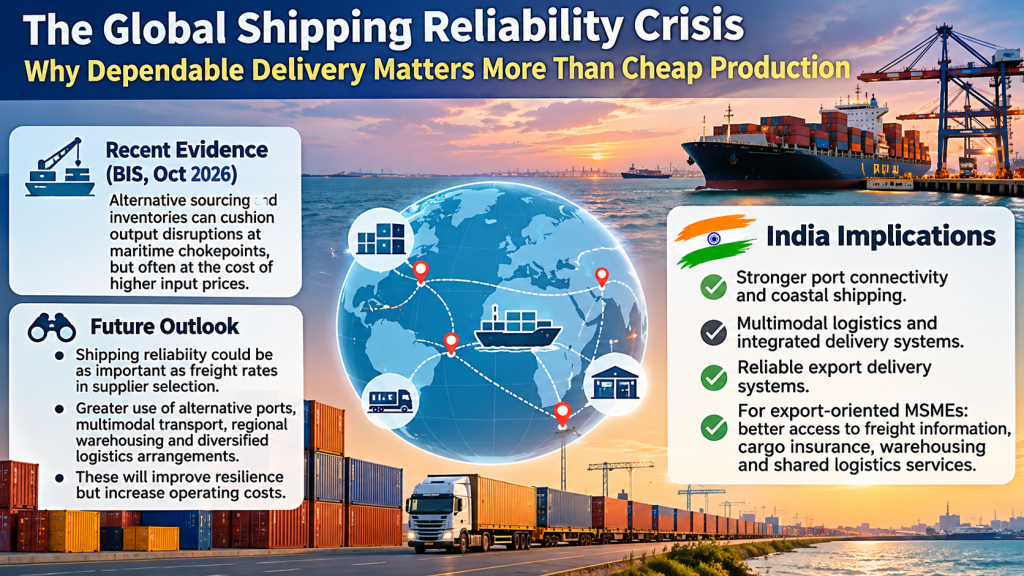
Why maritime chokepoints, supply chain disruptions and unreliable delivery systems could redefine international trade—and what India must do to protect its export competitiveness.
From Cheap Transportation to Reliable Transportation: A Fundamental Shift in Global Trade
For several decades, globalisation was built around a relatively simple economic principle: produce wherever costs are lowest and transport goods through the most efficient international routes. Companies reduced inventories, concentrated production in specialised locations and depended on predictable maritime transportation to connect suppliers with consumers.
This model helped reduce production costs, expand international trade and integrate developing economies into global value chains. However, it also created an important structural weakness. International production became increasingly dependent on a limited number of shipping routes, ports and maritime chokepoints.
The disruption of even one major shipping corridor can now affect manufacturing schedules, commodity prices, working capital requirements and delivery commitments across several continents.
The emerging challenge is therefore not simply the rising cost of shipping. It is the growing economic cost of unreliable shipping.
A low freight rate offers little advantage if raw materials arrive too late to sustain production or finished goods fail to reach buyers within contractual deadlines.
Historical Perspective: How Efficiency Created Vulnerability
The expansion of containerisation during the second half of the twentieth century transformed international commerce. Standardised containers, larger vessels, integrated port operations and digital logistics systems dramatically improved transportation efficiency.
The development of just-in-time production further encouraged manufacturers to minimise inventories and depend on continuous deliveries.
These innovations generated enormous productivity gains, but they also shifted risks from warehouses to transportation networks.
The COVID-19 pandemic demonstrated how quickly port congestion, container shortages and disrupted production could affect international supply chains. The obstruction of the Suez Canal in 2021 exposed the vulnerability of concentrated maritime routes. Subsequent disruptions around the Red Sea reinforced the importance of maritime security and alternative shipping corridors.
The underlying contradiction became increasingly visible: the global trading system had become highly efficient under normal conditions but potentially expensive when normal conditions disappeared.
This contradiction is particularly important for developing countries whose exporters depend on imported components, intermediate goods and time-sensitive access to overseas markets.
The New Economics of Maritime Chokepoints
Recent analysis by the Bank for International Settlements, reported in October 2026, highlights an important economic trade-off. Alternative sourcing arrangements and inventories can cushion the output effects of disruptions at maritime chokepoints, but such adjustments may increase input prices.
This finding challenges the conventional assumption that greater supply chain resilience necessarily improves overall economic efficiency.
When a major shipping route becomes unreliable, firms can respond by purchasing from alternative suppliers, increasing inventories, changing transportation routes or shifting production locations. These measures may help maintain output, but they also introduce additional costs.
Alternative suppliers may charge higher prices. Longer transportation routes consume more fuel and require additional shipping capacity. Larger inventories tie up working capital, while new logistics arrangements may require investment in warehousing, information systems and contractual relationships.
The result is an emerging economic dilemma: companies can reduce the risk of production interruptions, but they may have to accept permanently higher operating costs.
In effect, resilience is becoming an additional input into production.
This raises a critical question for international economics: Can global trade continue delivering lower consumer prices when businesses must increasingly pay a premium for reliability?
The Hidden Costs of Unreliable Shipping
Traditional measures of trade competitiveness emphasise production costs, freight charges, tariffs and exchange rates. However, unreliable transportation introduces several less visible economic costs.
Delayed imported inputs can interrupt production even when factories have sufficient labour, machinery and market demand. Exporters may incur penalties for late delivery or lose future orders because overseas buyers no longer consider them dependable.
Longer shipping times also increase the amount of working capital tied up in goods moving between suppliers and customers. For enterprises operating with limited financial resources, this can be particularly damaging.
Insurance premiums, inventory financing, emergency freight arrangements and uncertainty over delivery schedules may collectively become more important than the published freight rate.
This suggests that international competitiveness should increasingly be assessed through the total cost of dependable delivery, rather than transportation charges alone.
A country offering slightly higher manufacturing costs but consistently reliable delivery may become more attractive than a cheaper production location facing repeated logistics disruptions.
Future Outlook: The Emergence of Reliability-Based Globalisation
Over the coming decade, international supply chains may undergo a gradual transition from purely cost-based optimisation toward a combination of cost efficiency, delivery reliability and risk management.
Businesses could increasingly maintain relationships with multiple logistics providers, diversify ports of shipment, develop regional distribution centres and use multimodal transportation systems.
Digital cargo tracking, predictive logistics analytics and real-time freight information may become essential commercial capabilities rather than optional technological improvements.
Regional warehousing could help exporters maintain inventory closer to important overseas markets, while alternative transportation corridors could reduce dependence on individual maritime routes.
However, these adjustments will not eliminate disruption risks. Alternative ports may lack adequate capacity, multimodal transport can introduce coordination problems, and regional warehouses may increase inventory and financing costs.
There is also a larger economic concern. If every major company simultaneously increases inventories and duplicates logistics arrangements, the global trading system could become more resilient at the individual enterprise level while becoming more expensive overall.
The future of globalisation may therefore involve a difficult compromise between efficiency and security.
India’s Challenge: Export Competitiveness Beyond the Factory Gate
India’s manufacturing and export strategy has traditionally emphasised production capacity, infrastructure development, industrial incentives and access to international markets.
These remain important, but they are insufficient if exporters cannot guarantee dependable delivery.
India has made investments in ports, highways, dedicated freight corridors and logistics modernisation. Initiatives such as PM Gati Shakti, the National Logistics Policy and port-led development provide an institutional foundation for improving connectivity.
The next challenge is to convert these investments into measurable improvements in shipment reliability.
Port capacity alone does not guarantee efficient logistics. Export competitiveness depends on the integration of industrial clusters, inland transportation, customs procedures, warehousing, shipping services and international distribution networks.
A modern port offers limited economic benefit if exporters face unpredictable inland transit times, insufficient container availability, cumbersome documentation or weak connections between production centres and maritime terminals.
India must therefore move beyond treating logistics as an infrastructure sector and begin treating it as an essential component of industrial competitiveness.
Coastal shipping, rail-based freight movement, multimodal logistics parks and integrated digital information systems should be developed as complementary elements of a national export delivery network.
The MSME Disadvantage: Why Smaller Exporters Face Greater Risks
The implications are especially serious for India’s micro, small and medium enterprises.
Large multinational companies can negotiate long-term freight contracts, maintain overseas warehouses, diversify suppliers and invest in sophisticated logistics management systems.
Smaller exporters often lack these capabilities.
An MSME producing engineering components, garments, processed foods or specialised industrial products may depend on a limited number of shipping agents, freight forwarders and overseas buyers.
Unexpected freight increases or delayed shipments can therefore affect profitability disproportionately.
For such enterprises, logistics uncertainty is not merely an operational inconvenience. It can become a barrier to entering and remaining in international markets.
India’s industrial cluster development strategy offers an important opportunity to address this structural disadvantage.
Export-oriented clusters could establish shared logistics facilities, consolidated cargo services, common warehousing, collective freight negotiations and specialised export support centres.
Cluster-level logistics platforms could also provide timely information on freight rates, vessel schedules, port congestion, insurance options and alternative transportation routes.
Such arrangements would allow smaller enterprises to obtain some of the logistical advantages normally available only to large corporations.
The next generation of common facility centres should therefore extend beyond machinery, testing laboratories and production infrastructure to include shared export logistics and supply chain risk management services.
A New Policy Priority: Measuring the Reliability of Export Delivery
India’s logistics policy should increasingly focus on outcomes rather than only physical infrastructure creation.
Port turnaround times, container availability, customs clearance predictability, inland transit variability and on-time export delivery performance should become important indicators of competitiveness.
Government agencies, port authorities, logistics providers and industry associations could collaborate to develop sector-specific and cluster-specific delivery reliability benchmarks.
Such information would help identify whether delays arise from factory-to-port transportation, documentation, terminal operations, shipping schedules or overseas distribution.
It would also allow policymakers to distinguish between infrastructure shortages and failures of coordination.
This distinction matters because building additional infrastructure may not resolve problems caused by fragmented information, weak institutional coordination or unpredictable operating procedures.
For export-oriented MSMEs, affordable cargo insurance, access to trade finance and reliable freight information should be treated as integral components of export promotion.
The Larger Economic Question: Is Globalisation Becoming More Expensive?
The emerging shipping reliability crisis points toward a broader transformation in international economics.
Globalisation originally promised lower costs through specialisation, economies of scale and international production networks. These benefits remain substantial, but businesses are increasingly recognising the economic value of redundancy, flexibility and security.
The additional costs of resilience may gradually influence product prices, investment decisions, sourcing patterns and the geographical distribution of manufacturing.
Countries that can combine competitive production with reliable transportation may gain an advantage in attracting international buyers and long-term manufacturing investment.
For India, this creates both a risk and an opportunity.
The risk is that improvements in factory productivity could be undermined by weak delivery systems and expensive logistics uncertainty.
The opportunity is to position India not merely as an alternative manufacturing destination, but as a dependable production and export partner.
Achieving this will require stronger coordination between industrial policy, trade policy, transportation infrastructure, logistics services and MSME development programmes.
Conclusion: The Next Competitive Advantage Will Be Dependability
The next phase of international trade may not be defined exclusively by who produces at the lowest cost. It may increasingly be shaped by who can deliver consistently, predictably and competitively despite disruptions.
For India, the central lesson is clear: export competitiveness does not end when a product leaves the factory.
It extends through inland transportation, port operations, shipping networks, overseas warehousing and final delivery to international customers.
A country that improves production efficiency without improving delivery reliability may struggle to capture the full benefits of global supply chain diversification.
The defining competitive question of the coming decade may no longer be simply, “How cheaply can you produce?” It may increasingly become, “How reliably can you deliver?”
For India’s export-oriented MSMEs and industrial clusters, the answer could determine their position in the next generation of global value chains.
Evidence note: The October 2026 BIS finding is drawn from the research summary provided. The broader analysis and policy implications are original interpretations; the underlying BIS publication has not been independently verified here.
#GlobalTrade #SupplyChainResilience #MaritimeLogistics #IndianExports #MSMEs #IndustrialClusters #ExportCompetitiveness #GlobalValueChains #LogisticsPolicy


Leave a Reply