Can an economy continue growing while its people become poorer?
Yes. And the simultaneous rise in food and energy prices explains why.
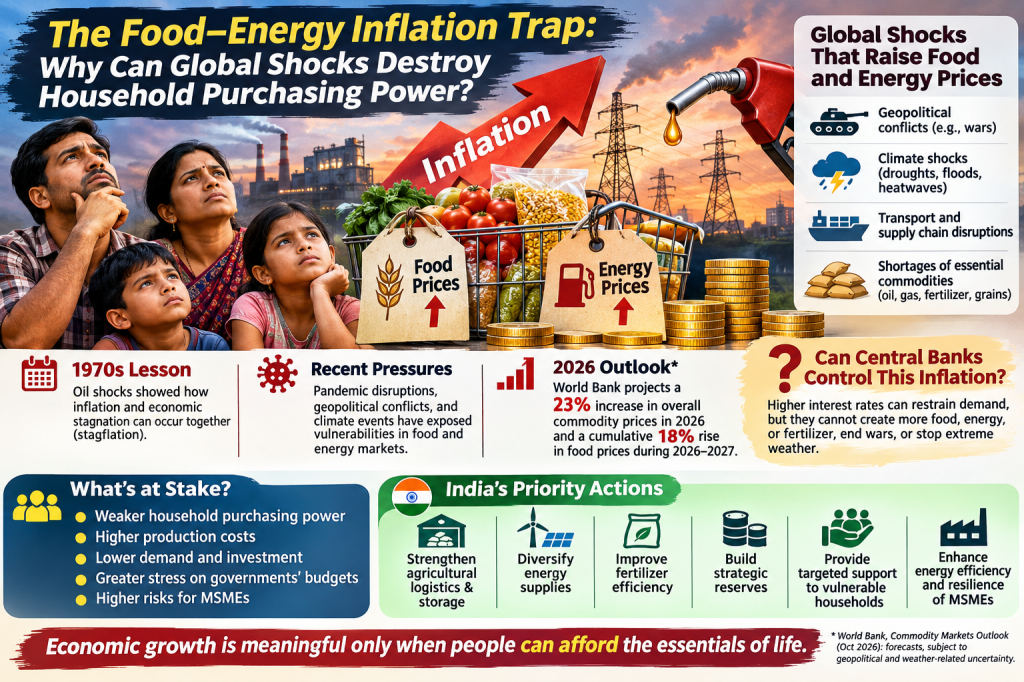
When oil prices increase, transportation and manufacturing become more expensive. When fertilizer and agricultural input costs rise, food prices follow. Households spend more on essentials and less on other goods and services. Businesses face shrinking margins, while governments struggle to balance subsidies, inflation control, and fiscal sustainability.
The oil shocks of the 1970s demonstrated how inflation and economic stagnation could coexist. Today, geopolitical conflicts, climate disruptions, fragile supply chains, and commodity-market uncertainty are creating similar vulnerabilities.
The World Bank’s October 2026 commodity outlook, according to the reported projections, anticipates a 23% increase in overall commodity prices in 2026 and a cumulative 18% rise in food commodity prices during 2026–2027. These forecasts remain subject to uncertainty.
But the deeper question is: Can central banks control inflation caused by wars, droughts, and supply shortages?
Higher interest rates can restrain demand, but they cannot produce additional food, restore disrupted energy supplies, or repair international shipping routes.
For India, the implications are significant.
India needs stronger agricultural logistics, diversified energy supplies, efficient fertilizer use, strategic reserves, and targeted household protection. MSMEs require energy-efficient technologies, better procurement systems, and protection against extreme input-cost volatility.
The future of inflation management must extend beyond monetary policy toward stronger economic resilience.
GDP growth means little to ordinary households if their purchasing power continues to decline.
The real measure of economic prosperity is not simply how much an economy produces, but how securely its people can afford the essentials of life.
What should governments prioritise during global commodity shocks: controlling inflation, protecting purchasing power, or strengthening domestic supply capacity?
#GlobalEconomy #Inflation #FoodSecurity #EnergySecurity #IndianEconomy #MSMEs #EconomicPolicy #Stagflation #PurchasingPower #EconomicResilience


Leave a Reply