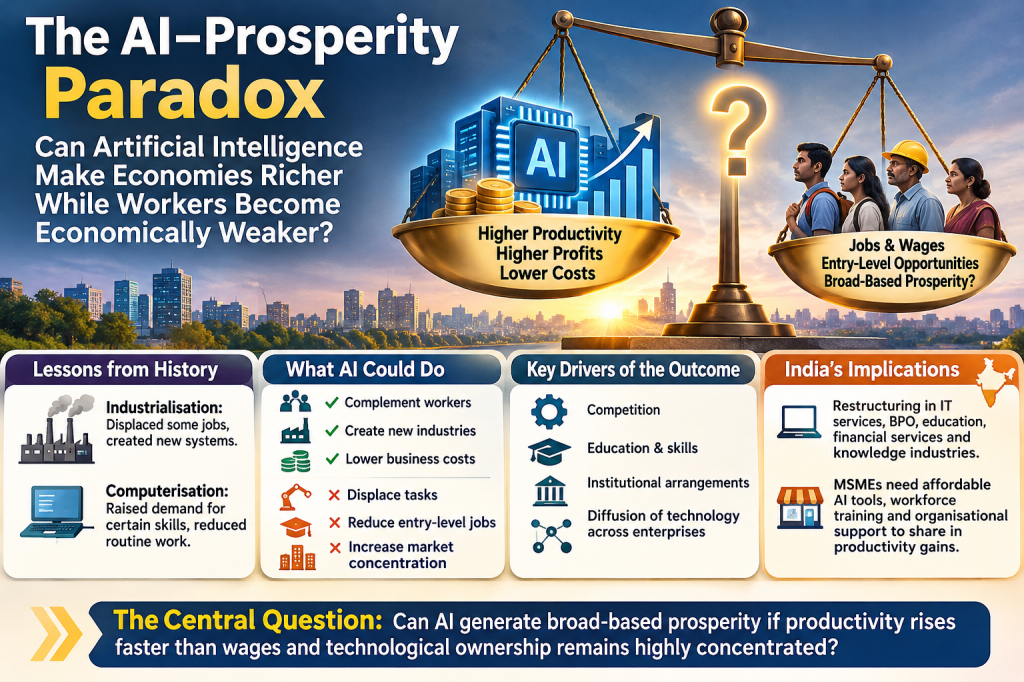
The next technological revolution may produce extraordinary wealth. The real question is whether that wealth will reach the people whose work, knowledge and economic opportunities are being transformed.
The Historical Promise of Technology: Greater Productivity, Unequal Rewards
Throughout economic history, technological progress has been celebrated as the foundation of prosperity. From the steam engine to electricity, from industrial machinery to computers, each major technological revolution has expanded the productive capacity of economies. Yet history also reveals a less comfortable reality: technological progress does not automatically translate into economic progress for everyone.
The Industrial Revolution transformed manufacturing by replacing labour-intensive production methods with mechanised systems. Productivity increased, production costs declined, and entirely new industries emerged. However, the immediate consequences for many workers included displacement, deteriorating bargaining power and difficult working conditions. Improvements in wages and living standards developed unevenly and were shaped by industrial organisation, labour institutions, education and public policy.
The computer revolution followed a different but equally revealing trajectory. Digital technologies increased the demand for highly educated professionals while automating many routine administrative and production tasks. The resulting economic transformation rewarded certain skills and enterprises disproportionately. Workers who could complement new technologies benefited, while others faced stagnant wages, occupational restructuring or declining employment opportunities.
Artificial intelligence represents the next stage of this historical process. But there is a fundamental difference. Earlier technologies primarily replaced physical effort or routine information processing. AI increasingly performs tasks involving language, analysis, coding, design, prediction and decision support—activities previously associated with skilled human labour.
This raises an uncomfortable economic question: What happens when technology begins competing not only with human muscle but also with human knowledge?
The Productivity–Wage Disconnect: When Economies Grow Without Sharing the Gains
Traditional economic reasoning suggests that improvements in labour productivity should eventually support higher wages and living standards. When workers produce more output per hour, enterprises can generate greater value, potentially allowing both profits and compensation to increase.
But the relationship between productivity and wages is neither automatic nor uniform.
Consider an enterprise that introduces AI systems capable of completing work previously requiring 100 employees with only 60 employees. Its productivity may increase substantially, and its operating costs may decline. Yet the economic gains could be distributed in several different ways. Workers might receive higher wages, consumers might benefit from lower prices, the enterprise might expand production and employment, or shareholders and technology providers might capture most of the additional profits.
The outcome depends on competition, market demand, bargaining power, ownership structures and institutional arrangements.
The danger is not simply that AI will eliminate jobs. The deeper concern is that AI could weaken the connection between economic growth and household income.
An economy may report rising productivity, increasing corporate profitability and expanding digital investment while large sections of its workforce experience uncertain employment and limited wage growth.
Such a development would challenge one of the central assumptions of modern economic development: that technological advancement ultimately improves the economic position of ordinary workers.
The Ownership Question: Who Will Capture the Wealth Created by AI?
Unlike many earlier technological revolutions, advanced AI development depends heavily on computational infrastructure, specialised semiconductor technologies, proprietary data, research capabilities and access to substantial capital.
These requirements can create significant barriers to entry.
A relatively small group of technology companies may control important parts of the infrastructure through which AI services are developed, distributed and monetised. Although open-source models and smaller specialised providers can challenge this concentration, access to computing resources and distribution networks remains economically important.
This creates the possibility of a new form of economic concentration in which many enterprises depend on technologies owned or controlled by relatively few providers.
The implications extend beyond conventional corporate profitability.
If millions of businesses use AI systems to increase their productivity but must continuously pay external providers for computing, software and digital services, a substantial share of the resulting economic value could flow toward technology owners.
The problem becomes especially important for developing economies.
Countries may adopt AI extensively without developing comparable domestic capabilities in model development, computing infrastructure, intellectual property or high-value digital services.
They could become highly productive users of technologies while remaining dependent on external suppliers for critical components of their digital economies.
The defining economic divide may therefore shift from who uses technology to who owns, improves and controls the technologies that generate value.
The Employment Paradox: More Efficient Enterprises, Fewer Entry-Level Opportunities?
The employment consequences of AI are likely to be more complicated than a simple prediction of widespread job losses.
AI can complement workers by reducing repetitive tasks, improving decision-making and allowing professionals to focus on more complex activities. It can also create demand for new services, occupations and business models.
However, AI may simultaneously reduce the labour required for particular activities.
One especially important concern involves entry-level employment.
Historically, young professionals developed skills through relatively routine work. Junior accountants prepared financial statements, analysts processed information, programmers wrote basic code, and legal assistants reviewed documents.
These activities were not merely sources of income. They were also the training grounds through which workers accumulated experience and progressed toward higher-skilled occupations.
If AI performs a growing proportion of these tasks, enterprises may reduce their demand for junior employees while continuing to recruit experienced professionals capable of supervising complex processes.
This could create a structural contradiction: employers demand experienced workers, but fewer opportunities exist for young people to acquire that experience.
The long-term consequence could be a weakening of the traditional relationship between education, employment and upward mobility.
Yet displacement is not inevitable. Falling production costs may expand demand, stimulate entrepreneurship and generate new work. Whether these effects compensate for displaced tasks will depend on how quickly markets expand and how effectively workers can transition.
India’s AI Challenge: A Knowledge Economy Facing Its Own Technological Disruption
India occupies a particularly interesting position in this transformation.
Over recent decades, the country has developed internationally competitive capabilities in information technology, business-process outsourcing, financial services, software development and knowledge-intensive business activities.
These sectors have supported employment, service exports, urban economic growth and the emergence of a substantial professional workforce.
But many of the activities underpinning these achievements are now becoming increasingly exposed to AI-enabled automation.
Routine software development, customer support, document processing, financial analysis, testing, research assistance and back-office operations may undergo substantial restructuring.
For India’s IT and business-services industries, the central challenge will not simply be adopting AI to reduce costs. It will be developing business models that generate greater value through specialised knowledge, complex problem-solving, industry expertise and proprietary technological capabilities.
A business model heavily dependent on billing clients for human working hours may face pressure as AI reduces the time required to deliver services.
This could encourage a transition toward outcome-based pricing, technology-enabled consulting, specialised digital products and intellectual-property-driven services.
However, the transition may also weaken employment creation if enterprises improve revenue and profitability without expanding their workforces proportionately.
For a country with a large young population entering the labour market, this possibility deserves serious attention.
India’s demographic advantage cannot be sustained through education alone. It requires a continuously expanding ecosystem of productive employment opportunities.
The Missing Link: Can India’s MSMEs Participate in the AI Revolution?
The discussion around artificial intelligence frequently concentrates on major technology corporations, multinational enterprises and sophisticated digital industries.
Yet the economic significance of AI will ultimately depend on whether its benefits spread across the wider productive economy.
For India, this means millions of micro, small and medium enterprises operating in manufacturing, trade, services, food processing, textiles, engineering and traditional industries.
Many of these enterprises face constraints involving managerial capabilities, working capital, technological knowledge, market access and workforce skills.
AI could help them improve inventory management, quality control, demand forecasting, product design, energy efficiency, marketing and customer relationships.
But access to AI software alone will not guarantee productivity improvements.
An enterprise with unreliable production data, weak organisational processes and limited technical skills may struggle to benefit from sophisticated digital applications.
This is where conventional technology-promotion policies often fall short. They measure the number of enterprises adopting a technology rather than the improvements in productivity, profitability, employment quality and competitiveness that adoption actually produces.
India therefore needs to move beyond isolated AI-awareness programmes toward practical enterprise-level transformation.
Cluster-based approaches could provide an effective institutional mechanism.
Industrial clusters can develop shared AI advisory services, common training facilities, sector-specific applications, digital infrastructure and collective access to specialised expertise. Such arrangements can reduce adoption costs while allowing smaller enterprises to learn from one another.
A textile cluster may use shared AI-supported design and demand-forecasting services. An engineering cluster may develop common quality-inspection and predictive-maintenance capabilities. A food-processing cluster may use digital systems for traceability, inventory planning and market intelligence.
The objective should not be to make every MSME an AI developer. It should be to enable smaller enterprises to become intelligent and competitive users of technology while progressively building their own capabilities.
The Future Economic Divide: AI-Rich Firms and AI-Poor Enterprises
By 2035, one possible economic divide may emerge not simply between developed and developing countries, but between enterprises that can reorganise production around AI and those that cannot.
Large enterprises with financial resources, skilled personnel and sophisticated data systems may experience substantial productivity improvements.
Smaller enterprises could struggle to match their efficiency, quality and responsiveness.
If this divergence persists, AI could accelerate market concentration, weaken smaller suppliers and reduce the competitiveness of labour-intensive business models.
However, the opposite outcome is also possible.
Affordable AI tools, competitive technology markets and accessible digital infrastructure could reduce some traditional disadvantages of small enterprises. Entrepreneurs may gain capabilities previously available only to large corporations.
The decisive factor will be the diffusion of technology.
An economy does not become broadly productive merely because its leading corporations adopt advanced technologies. It becomes productive when technological capabilities spread across enterprises, sectors, regions and workers.
This distinction is particularly important for India, where productivity differences between leading firms and smaller enterprises remain substantial.
Beyond GDP: The Need for a New Measurement of Technological Prosperity
AI may also expose weaknesses in the way economies evaluate development.
Rising GDP, higher corporate profits and increasing investment in digital infrastructure provide important information, but they do not reveal how technological benefits are distributed.
A more meaningful assessment would examine whether AI adoption produces higher real wages, better employment opportunities, stronger MSME competitiveness, lower consumer prices, improved public services and greater economic mobility.
It would also consider whether productivity improvements are concentrated in a narrow group of enterprises or spread across the economy.
This requires a shift in policy thinking.
The objective should not simply be to maximise AI adoption. It should be to maximise the economic and social returns from AI adoption.
Competition policy, education reform, workforce transition support, public digital infrastructure and technology diffusion will all influence these outcomes.
For India, investments in human capabilities must remain central. AI literacy alone will be insufficient. Workers will need domain knowledge, analytical capabilities, problem-solving skills and opportunities for continuous learning.
At the same time, social protection systems may need to become more adaptable to changing occupations and increasingly fragmented employment relationships.
The Defining Question for 2035: Technological Abundance or Economic Exclusion?
Artificial intelligence has the potential to transform economic development by lowering costs, accelerating innovation and expanding access to sophisticated capabilities.
It could help smaller enterprises compete internationally, improve healthcare and education, strengthen public administration and support entirely new industries.
But technological possibility should not be confused with economic inevitability.
A future in which AI generates enormous productivity gains while wages stagnate, employment opportunities narrow and technological ownership becomes increasingly concentrated would represent a serious development contradiction.
The central policy challenge is therefore not whether AI should be adopted. Its economic advantages make widespread adoption highly likely.
The real challenge is determining the institutions, incentives and capabilities through which its benefits can reach the wider population.
For India, this means building domestic technological capabilities while ensuring that MSMEs, workers, educational institutions and regional economies can participate in the transformation.
The success of the AI revolution should not be measured by how much human work machines can replace, but by how much additional prosperity human societies can create and share through intelligent technology.
The most important economic question of 2035 may not be whether artificial intelligence has made the world richer.
It may be whether the people living in that richer world have become more economically secure.
The central proposition: AI-driven productivity growth is an opportunity. Broad-based prosperity is an institutional, economic and policy choice.
#ArtificialIntelligence #EconomicDevelopment #FutureOfWork #IndiaEconomy #MSME #Productivity #IncomeInequality #DigitalTransformation #IndustrialClusters #InclusiveGrowth


Leave a Reply