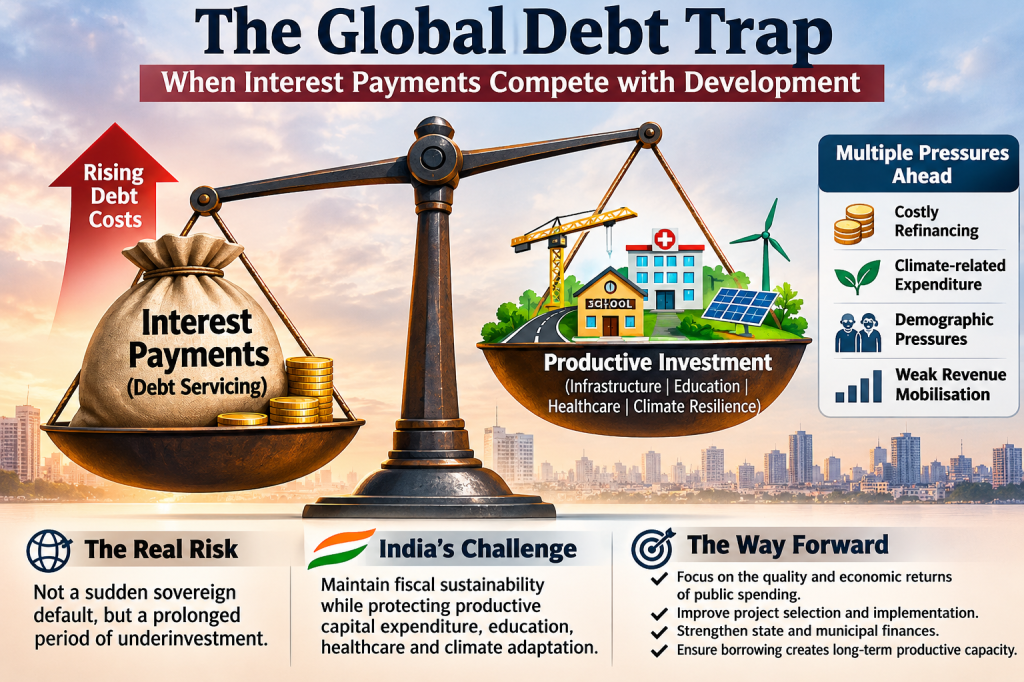
GLOBAL ECONOMIC CHALLENGES | NOVEMBER 2026
Can economic development remain sustainable when governments spend an increasing share of their revenues servicing yesterday’s debt rather than building tomorrow’s prosperity?
The Global Debt Trap: When Governments Borrow to Survive but Struggle to Invest in the Future
The Emerging Fiscal Contradiction: Governments Are Spending More but May Be Developing Less
For decades, public borrowing has been an important instrument of economic development. Governments have borrowed to construct highways, establish industries, expand education, strengthen healthcare systems, and build infrastructure that private investors were unwilling or unable to finance. When used productively, public debt can accelerate economic transformation by creating assets whose economic benefits extend across generations.
However, an increasingly troubling contradiction is emerging in the global economy. Governments need greater financial resources to modernise infrastructure, respond to climate change, support ageing populations, and strengthen economic competitiveness. Yet many are simultaneously facing rising debt-servicing obligations that reduce the resources available for these investments.
The fundamental question is no longer simply how much governments can borrow. It is whether borrowing today will create sufficient productive capacity and future public revenue to justify its financial burden.
An economy can continue expanding while its government gradually loses the fiscal capacity to support future development. This may become one of the most consequential economic challenges of the coming decade.
Historical Perspective: From Development Financing to Debt Dependence
The relationship between public debt and economic development has changed considerably over time.
Following the Second World War, many advanced economies carried substantial public debt. However, economic reconstruction, expanding industrial production, rising employment, and growing tax revenues helped several countries reduce their debt burdens relative to national income.
During the 1980s, numerous developing economies experienced debt crises as international interest rates increased, external financing became more expensive, and export earnings proved insufficient to meet repayment obligations. Structural adjustment programmes often required reductions in public expenditure, sometimes affecting infrastructure and essential social services.
The global financial crisis of 2008 brought another transformation. Governments borrowed heavily to stabilise financial systems and stimulate economic activity. The COVID-19 pandemic subsequently required extraordinary fiscal interventions to protect households, businesses, and healthcare systems.
For much of the period following 2008, relatively low global interest rates made public borrowing more affordable. But the subsequent rise in borrowing costs exposed the vulnerability of economies that had become accustomed to inexpensive financing.
The result is a new fiscal environment in which governments must simultaneously manage accumulated debt, expensive refinancing, and growing development expectations.
The Invisible Cost of Debt: Development Opportunities That Never Materialise
Public debt is generally discussed through familiar indicators such as the debt-to-GDP ratio, fiscal deficit, and interest payments. These indicators are important, but they do not fully capture the developmental consequences of indebtedness.
The most damaging cost of excessive debt may not be financial collapse. It may be the gradual disappearance of investments that would otherwise have improved productivity and living standards.
A government struggling with debt-servicing obligations may postpone railway modernisation, reduce maintenance of existing infrastructure, delay school improvements, or restrict investment in public health.
Each individual decision may appear fiscally prudent. Collectively, however, such decisions can weaken the economy’s long-term growth potential.
Poor infrastructure increases business costs. Inadequate education limits workforce productivity. Weak healthcare reduces human capabilities. Insufficient climate adaptation increases future economic losses.
A dangerous cycle can then emerge: debt servicing constrains productive investment, weaker investment reduces future growth, slower growth limits tax revenues, and inadequate revenues make debt management even more difficult.
The real danger is that governments may remain financially operational while becoming progressively less capable of promoting economic development.
Why the Next Debt Challenge May Be Different
Earlier sovereign debt crises were frequently associated with sudden defaults, exchange-rate collapses, and loss of access to international financial markets.
The emerging challenge could be more prolonged and less visible.
Countries may continue servicing their obligations but do so at the expense of public investment and social development. Governments may avoid default while accepting years of inadequate infrastructure, deteriorating public services, and limited fiscal flexibility.
Four structural pressures could intensify this problem.
First, refinancing existing debt at higher interest rates can increase debt-servicing costs even without major increases in new borrowing.
Second, climate change is creating additional expenditure requirements for flood protection, water management, disaster preparedness, and resilient infrastructure.
Third, demographic transitions are increasing pension and healthcare obligations in ageing societies, while younger economies require greater spending on education, employment, and urban infrastructure.
Fourth, weak tax mobilisation, informality, exemptions, and administrative inefficiencies constrain the ability of governments to generate sustainable revenues.
These pressures are particularly serious for countries that borrow in foreign currencies or depend heavily on volatile international capital flows.
Yet debt sustainability cannot be judged by one universal debt-to-GDP threshold. Interest rates, economic growth, currency composition, debt maturity, domestic savings, and institutional credibility all influence fiscal vulnerability.
The Productivity Paradox: Not All Government Expenditure Creates Equal Economic Value
An important weakness in conventional fiscal debates is the tendency to focus on the quantity of government spending rather than its economic returns.
Borrowing to finance productive infrastructure can strengthen long-term growth. Borrowing to sustain inefficient subsidies, poorly targeted transfers, or economically unviable projects may create financial liabilities without comparable productive benefits.
Even capital expenditure is not automatically productive.
A highway without sufficient economic activity, an industrial park without competitive enterprises, or a training centre disconnected from labour-market demand can generate impressive physical assets but limited economic returns.
Conversely, investments in primary healthcare, education, maintenance, and institutional capacity may generate substantial economic benefits even when classified as revenue expenditure.
The distinction that matters most is therefore not simply capital expenditure versus revenue expenditure.
It is expenditure that strengthens future productive capacity versus expenditure that creates limited or temporary economic value.
This requires governments to evaluate public investment through economic rates of return, utilisation, employment creation, productivity improvements, environmental resilience, and long-term maintenance costs.
India: The Challenge of Financing Development Without Weakening Fiscal Stability
India faces a particularly complex fiscal challenge.
Its development requirements remain enormous. Expanding cities need transport, water supply, sanitation, affordable housing, and climate-resilient infrastructure. Manufacturing requires efficient logistics, reliable energy, industrial facilities, and skilled workers. Rural areas need productive infrastructure, stronger agricultural value chains, and improved public services.
At the same time, the Union and state governments must manage substantial existing liabilities and interest obligations.
India possesses certain advantages, including a large domestic financial market, substantial rupee-denominated public borrowing, and a growing economic base. These characteristics reduce some vulnerabilities associated with external sovereign debt.
However, domestic borrowing does not eliminate the economic cost of debt. Interest payments still compete with other budgetary priorities, while fiscal pressures can limit governments’ ability to respond to future economic shocks.
The central policy challenge is therefore to maintain credible fiscal consolidation without sacrificing the investments required for long-term development.
For India, five strategic shifts deserve particular attention.
First, fiscal discipline must become more development-sensitive. Expenditure reductions should not disproportionately affect education, healthcare, infrastructure maintenance, and other investments with strong long-term economic returns.
Second, public investment must be evaluated by outcomes rather than announcements. Project completion, asset utilisation, productivity improvements, and measurable economic benefits should receive greater attention than expenditure allocations alone.
Third, state government finances require stronger scrutiny. States carry major responsibilities for education, healthcare, local infrastructure, and essential services. Weak state finances can therefore undermine national development even when Union-level fiscal indicators improve.
Fourth, municipal finance must become a central development priority. India’s urban growth will increasingly depend on financially capable local governments. Stronger property taxation, predictable transfers, accountable borrowing, and improved municipal governance can reduce pressure on higher levels of government.
Fifth, MSME and industrial-cluster development should be integrated into public investment decisions. Common infrastructure, testing facilities, technology services, skills development, and logistics improvements can generate wider productivity benefits when designed around actual enterprise demand.
India must move from merely expanding public expenditure to maximising the developmental value generated by every rupee spent.
Looking Towards 2035: Could Fiscal Space Become the New Measure of Economic Power?
The coming decade may redefine how economic strength is assessed.
Traditionally, countries have been compared through GDP, industrial output, exports, investment, and technological capabilities. Increasingly, another dimension may become decisive: the capacity of governments to finance future development without destabilising public finances.
Countries with stronger revenue systems, credible institutions, efficient public expenditure, and manageable debt structures may enjoy greater strategic flexibility.
They will be better positioned to respond to technological disruption, climate emergencies, demographic changes, and geopolitical shocks.
By contrast, highly indebted governments with weak revenue mobilisation may face a difficult choice between maintaining financial credibility and meeting development needs.
Artificial intelligence and automation could create new productivity opportunities, but realising these benefits will require investment in digital infrastructure, education, energy systems, and workforce adaptation.
Climate change will similarly demand substantial expenditure before many of its economic benefits become visible.
The danger is that governments may recognise the investments required for the future but lack the financial capacity to undertake them.
Conclusion: The Greatest Debt Crisis May Be the Development That Never Happens
Public debt is neither inherently harmful nor automatically beneficial. Its developmental consequences depend on the conditions under which governments borrow, the purposes for which resources are used, and the future economic capacity those expenditures create.
The world may be approaching a period in which the most serious consequence of high public debt is not necessarily widespread sovereign default, but a prolonged erosion of development opportunities.
For India, fiscal sustainability and inclusive development must not be treated as competing objectives. They must become mutually reinforcing priorities.
A financially sustainable government that fails to invest in human capabilities and productive infrastructure may undermine its future revenue base. Equally, a government that spends aggressively without generating sufficient economic returns may weaken its future fiscal capacity.
The challenge is to build a public finance system in which borrowing supports productive transformation, taxation grows alongside economic prosperity, and public expenditure delivers measurable improvements in people’s lives.
The defining fiscal question of 2035 may not be how much debt a country has accumulated, but how much future prosperity it has created with the resources it borrowed.
Economic development is not secured merely by a government’s ability to borrow. It is secured by its ability to transform today’s borrowing into tomorrow’s productive capacity.
Public Debt, Fiscal Sustainability, Interest Payments, Economic Development, India Economy, Public Investment, Debt Servicing, Infrastructure, Fiscal Policy, Inclusive Growth, Global Economic Challenges.


Leave a Reply