ECONOMIC PERSPECTIVES | SOCIAL PROTECTION & THE FUTURE OF WORK
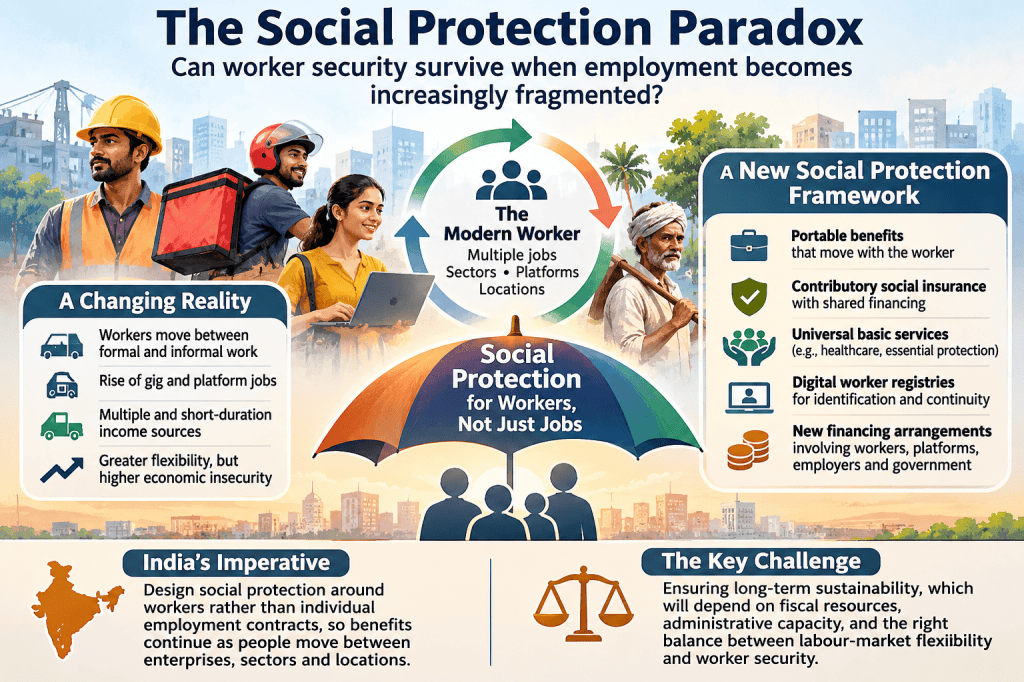
As economies embrace flexible employment, gig work, digital platforms and informal entrepreneurship, a fundamental contradiction is emerging: the labour market is becoming more flexible, but the institutions designed to protect workers remain tied to stable employment.
The Historical Bargain Between Employment and Security
For much of the twentieth century, economic development was associated with a relatively straightforward promise: industrialisation would create formal employment, formal employment would generate stable incomes, and stable incomes would provide access to pensions, healthcare, insurance and other forms of social protection.
This relationship became a defining feature of the modern welfare state. In several industrialised economies, particularly after the Second World War, governments developed social insurance systems around regular wage employment. Employers contributed to pension and insurance schemes, workers contributed a portion of their earnings, and governments provided regulatory support and supplementary financing.
The underlying assumption was that employment relationships would remain sufficiently stable for workers to accumulate benefits over time.
However, this model was never universal. In developing economies, including India, large sections of the workforce remained outside formal employment arrangements. Agricultural workers, street vendors, domestic workers, artisans, construction labourers and self-employed individuals often depended on family networks, community support and personal savings to manage economic insecurity.
The welfare state was therefore built around an employment structure that represented only part of the working population.
Today, that limitation is becoming increasingly important even in advanced economies.
The New Economic Contradiction: Flexible Labour Markets, Rigid Social Security Systems
The twenty-first-century labour market is undergoing a structural transformation.
Digital platforms connect workers directly with customers. Businesses increasingly outsource activities to contractors. Temporary employment, freelance services, remote work and multiple income sources are becoming more visible across economic sectors.
A worker may drive for a transport platform in the morning, undertake online assignments in the afternoon and operate a small business in the evening.
Economically, such arrangements may improve flexibility, expand market participation and reduce entry barriers.
But socially, they raise a difficult question: Who is responsible for protecting a worker who does not have a single, identifiable employer?
Traditional social insurance assumes that employers and employees can be clearly identified. Yet modern labour arrangements frequently distribute responsibility across platforms, contractors, intermediaries and customers.
The result is an institutional mismatch.
Businesses can reorganise production rapidly, but social protection systems often cannot follow workers across employment categories.
This creates what may be described as the social protection paradox: economies are becoming more efficient at organising flexible work while remaining inadequately equipped to protect the people performing it.
When Employment Grows but Economic Security Does Not
Employment statistics can conceal important differences in the quality of work.
Two individuals may both be classified as employed, yet their economic circumstances may be entirely different.
One may receive a predictable salary, paid leave, health insurance and retirement benefits. Another may earn a similar monthly income through irregular assignments without any protection against illness, disability or sudden loss of work.
From a conventional employment perspective, both are economically active.
From a social security perspective, they inhabit different worlds.
This distinction becomes particularly important when evaluating economic development.
An economy may generate millions of livelihood opportunities while simultaneously increasing the number of workers exposed to income volatility and financial shocks.
Digitalisation does not automatically resolve this contradiction. Indeed, technological platforms can make employment opportunities more accessible while shifting certain commercial risks from enterprises to individual workers.
The fundamental development question is therefore changing.
It is no longer sufficient to ask how many jobs an economy creates. We must also ask how much economic security those jobs provide.
India: The Challenge of Protecting Workers Rather Than Jobs
India represents one of the most important testing grounds for the future of social protection.
Its labour market combines formal enterprises, informal establishments, agricultural livelihoods, self-employment, casual wage work and rapidly expanding digital services.
Workers frequently move between these categories during their working lives.
A construction worker may become a delivery worker. A rural labourer may migrate seasonally to an industrial cluster. A self-employed artisan may temporarily accept factory employment before returning to independent production.
Yet social protection arrangements often remain fragmented across employment status, sector, eligibility rules and administrative jurisdictions.
India has undertaken significant initiatives, including the e-Shram portal for unorganised workers, the Employees’ Provident Fund, Employees’ State Insurance, PM-SYM and publicly financed health protection programmes.
These initiatives provide important institutional foundations. However, registration, eligibility and actual access to benefits are different outcomes. A worker’s inclusion in a digital database does not automatically guarantee insurance coverage, adequate benefits or timely payments.
India’s central challenge is therefore not simply expanding the number of registered beneficiaries.
It is creating a system in which social protection remains attached to the individual worker even when employment, occupation, employer or location changes.
This requires a fundamental redesign of the relationship between labour markets and welfare institutions.
Portable Social Protection: A New Economic Architecture
The future of social protection may depend increasingly on portability.
Under a portable system, workers would retain their accumulated entitlements when moving between employers, sectors, platforms and geographic locations.
A worker leaving a garment factory to become self-employed should not automatically lose access to essential protection. Similarly, a migrant labourer moving between states should not face repeated administrative barriers to receiving benefits.
Portable benefits could be supported by interoperable digital systems, individual social insurance accounts and financing arrangements involving workers, enterprises and governments.
However, portability is more complicated than creating a digital identification number.
It requires common standards for contributions, benefit eligibility, record transfers, dispute resolution and financial accountability.
There is also a significant danger that digitalisation may create an appearance of inclusion without delivering meaningful protection.
A sophisticated digital registry is not a substitute for adequate financing, accessible healthcare, reliable pension payments or effective grievance mechanisms.
Technology can connect institutions, but it cannot independently create the resources required to sustain them.
Who Should Finance Social Protection in the Platform Economy?
Perhaps the most difficult issue concerns financing.
Traditional employment-based systems rely heavily on employer and employee contributions.
But who should contribute when workers operate across multiple digital platforms or perform short-duration assignments?
One possibility is a shared contribution system in which platforms contribute according to economic activity, workers contribute according to their capacity, and governments finance a basic level of protection through general taxation.
Another possibility is to strengthen universal basic services, particularly healthcare and essential social assistance, thereby reducing dependence on employment-linked contributions.
Both approaches involve trade-offs.
High mandatory contributions may increase costs, discourage formalisation or reduce employment opportunities. Very low contributions may produce inadequate benefits and financially unsustainable insurance arrangements.
Government financing can improve inclusion but must compete with other priorities such as education, infrastructure and public health.
The challenge is to distribute the costs of protection without undermining the productive flexibility that new employment arrangements provide.
The question is not whether enterprises or governments should bear the entire burden.
It is how the economic benefits and risks of flexible production should be shared fairly and sustainably.
The Hidden Cost of Insecurity: Productivity and Economic Growth
Social protection is often treated primarily as a welfare expenditure.
This interpretation overlooks its potential economic contribution.
Workers facing severe income uncertainty may avoid investing in education, skill development or entrepreneurship because they cannot afford temporary income losses.
Households without adequate health protection may reduce consumption and savings when illness occurs.
Workers lacking retirement security may remain in low-productivity activities longer than they otherwise would.
In this sense, inadequate social protection can weaken the very productivity improvements that flexible labour markets are expected to generate.
Well-designed protection can potentially support labour mobility by reducing the personal risks associated with changing occupations, relocating or starting businesses.
This suggests an important economic proposition: social protection should be understood not merely as redistribution after growth, but also as an institution that can enable productive economic transformation.
However, these benefits depend on programme design, implementation quality and fiscal sustainability. Poorly structured systems can impose substantial costs without generating corresponding improvements in security or productivity.
The Future Outlook: From Employer-Based Welfare to Worker-Centred Security
By 2035, labour markets may become even more diverse as artificial intelligence, automation, digital platforms and changing business models reshape employment relationships.
Traditional full-time employment will remain important, but it may coexist with an increasingly complex range of independent, temporary and hybrid working arrangements.
Social protection institutions will need to adapt accordingly.
Future systems may combine tax-financed minimum guarantees, contributory social insurance, portable retirement accounts, digital worker registries and universal access to essential services.
For India, the most promising direction is not necessarily one uniform programme covering every risk.
It may be a coordinated framework that combines a basic level of protection for all eligible workers with additional contributory benefits reflecting earnings and employment circumstances.
Such a system would require stronger coordination between central and state governments, employers, platforms, financial institutions and worker organisations.
It would also require better measurement.
India should assess not only how many workers are registered but how many actually receive benefits, how quickly claims are settled, whether protection survives occupational mobility and whether vulnerable households experience greater financial resilience.
These are more meaningful indicators of social security effectiveness than administrative enrolment alone.
A New Development Question for India
India’s economic transformation is often discussed in terms of GDP growth, manufacturing competitiveness, digital innovation and employment generation.
Yet a deeper institutional question deserves equal attention.
Can India create a labour market in which workers can change occupations, migrate, acquire new skills and pursue entrepreneurship without repeatedly losing their social security?
The answer will influence not only welfare outcomes but also productivity, domestic demand, labour mobility and the long-term sustainability of economic growth.
The historical welfare state was largely organised around the stability of employment.
The emerging economy requires institutions capable of providing security amid employment mobility.
This is not an argument against flexible work. Flexibility can create opportunities, particularly for women, young people, migrants and small entrepreneurs. But flexibility becomes economically and socially fragile when individuals are expected to absorb risks that they have little capacity to manage.
The defining challenge of the next generation of social policy will be to separate the continuity of social protection from the continuity of a particular job.
An economy should not require workers to remain in one employment relationship merely to remain socially secure.
And a country aspiring to become a developed economy must recognise that development is not measured only by how many people participate in production, but also by how effectively its institutions protect them when economic circumstances change.
The ultimate test of India’s labour-market transformation may therefore be whether it can achieve something that industrial economies historically struggled to deliver: a flexible economy with portable, inclusive and financially sustainable social security.
Economic Perspectives | Future of Work, Labour Markets and Inclusive Development
Suggested SEO title: The Social Protection Paradox: Why India Needs Portable Benefits for a Changing Workforce
Meta description: Explore how gig work, informal employment and labour mobility are challenging traditional social security systems, and why India needs worker-centred, portable protection.
Social Protection, Informal Economy, Gig Workers, Platform Economy, Portable Benefits, e-Shram, Labour Market Reforms, Social Security India, Future of Work, Inclusive Economic Growth.


Leave a Reply