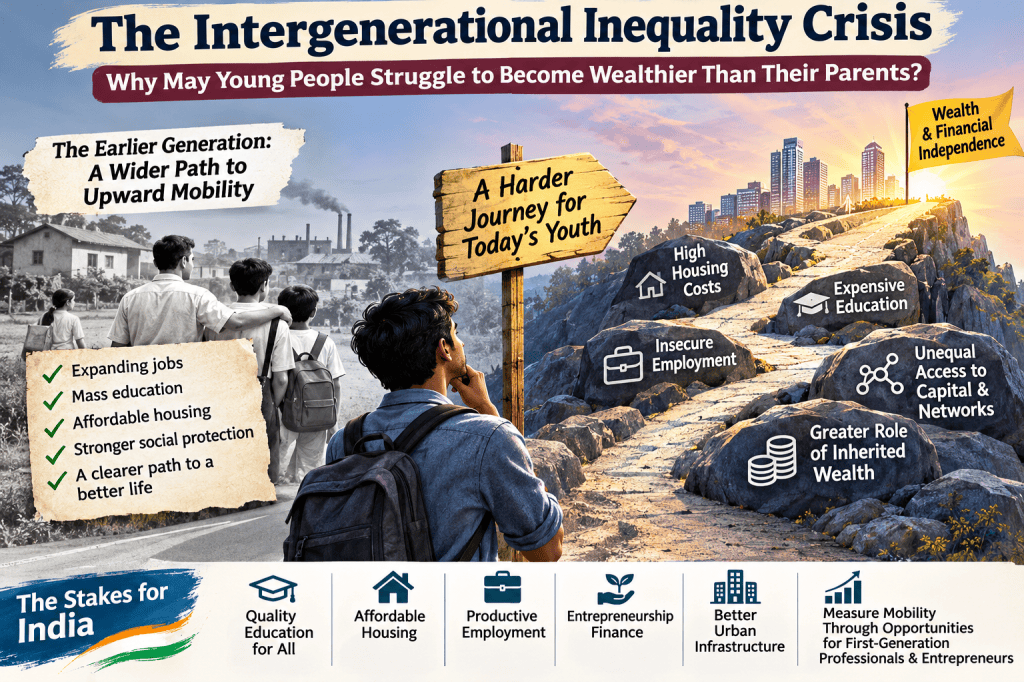
When hard work no longer guarantees upward mobility, economic growth risks losing its most powerful promise.
The Broken Promise of Economic Progress
For generations, economic development rested on a simple but powerful expectation: children would live better lives than their parents. A farmer’s son could become a teacher, a factory worker’s daughter could become an engineer, and a modestly paid employee could gradually purchase a home, educate children, and accumulate savings. Economic progress was not merely measured by rising national income. It was experienced through the expanding possibilities available to ordinary families.
That expectation is becoming increasingly uncertain.
Across many economies, young people are entering a world in which educational qualifications are more common, technology is more advanced, and national wealth is substantially greater than in previous generations. Yet obtaining a secure job, purchasing a home, accumulating assets, or establishing an independent household can be more difficult than these achievements were for their parents at a comparable age.
This creates one of the most troubling paradoxes of modern capitalism: societies may become wealthier while the economic starting position of younger generations becomes increasingly unequal.
The problem is not simply that young people earn too little. It is that the relationship between work, income, ownership, and wealth creation is undergoing a structural transformation.
From the Age of Opportunity to the Age of Ownership
The decades following the Second World War witnessed an extraordinary expansion of economic opportunities in several industrialised economies. Manufacturing employment, public investment, mass education, infrastructure development, and social protection helped create a broad middle class.
Industrial workers could often secure relatively stable employment. Public universities and subsidised education opened professional opportunities. Housing became accessible to many households through rising wages, mortgage finance, and government-supported construction.
These opportunities were never equally available to everyone. Race, gender, class, caste, and inherited privilege continued to influence economic outcomes. Nevertheless, economic growth created significant pathways for upward mobility, particularly in economies experiencing rapid industrial expansion.
From the 1980s onward, however, several structural changes began altering this arrangement.
Financial liberalisation increased the economic importance of asset markets. Globalisation and technological change transformed industrial employment. Housing in successful metropolitan regions became increasingly expensive. Labour markets shifted toward services, flexible contracts, and knowledge-intensive occupations.
Meanwhile, those who already owned property, equities, businesses, and financial assets benefited from periods of substantial asset appreciation.
The consequences are profound.
A household that purchased a reasonably priced urban property decades ago may now possess wealth far exceeding what its lifetime labour income alone could have generated. A young professional entering the same housing market may need decades of savings merely to afford the initial payment.
The economic advantage increasingly belongs not only to those who earn more, but also to those whose families acquired assets earlier.
This is gradually transforming wealth creation from a process driven primarily by employment and savings into one increasingly influenced by ownership, inheritance, and family circumstances.
The New Divide: Those Who Own Assets and Those Who Depend on Salaries
Traditional discussions of inequality concentrate on differences in income. But income inequality and wealth inequality are not the same.
Income represents the flow of earnings from employment, business, or investments. Wealth represents accumulated ownership of property, financial assets, businesses, and other resources, after deducting liabilities.
Two young professionals may receive identical salaries but face entirely different economic futures.
One may inherit a family home, receive financial assistance for education, and benefit from family investments. The other may support dependent parents, repay education loans, pay high urban rent, and attempt to build savings from the beginning.
Even if both work equally hard, their capacity to accumulate wealth will differ substantially.
The first professional can invest a larger share of income, take entrepreneurial risks, and withstand periods of unemployment. The second may have to prioritise financial survival over long-term wealth creation.
This reveals a fundamental weakness in the conventional understanding of meritocracy.
Merit and effort matter, but their economic rewards are shaped by the resources available at the starting line.
When inherited assets begin to determine who can afford to take risks, who can access prestigious education, and who can live near high-paying employment opportunities, inequality becomes self-reinforcing.
The danger is that economic class gradually becomes less a reflection of individual achievement and more a reflection of family history.
Housing: The Invisible Barrier to Generational Prosperity
Housing has emerged as one of the most important mechanisms through which intergenerational inequality is reproduced.
In many successful cities, property values have risen faster than wages over extended periods. Urban land scarcity, infrastructure concentration, restrictive planning, speculative investment, and growing demand have contributed to affordability pressures.
For older homeowners, rising property prices increase household wealth.
For younger non-homeowners, the same increase raises the cost of entering the property market.
This creates an unusual distributional conflict: what appears as prosperity for one generation can become an affordability crisis for another.
High housing costs also affect economic behaviour beyond homeownership.
Young workers may avoid relocating to productive cities because accommodation is unaffordable. Couples may postpone marriage or having children. Entrepreneurs may be reluctant to leave salaried employment because they cannot afford financial uncertainty.
An economy can therefore experience rising property wealth while simultaneously reducing labour mobility, entrepreneurship, and household formation.
The problem becomes particularly serious when property appreciation is driven more by land scarcity and speculation than by improvements in productivity.
In such circumstances, economic rewards increasingly flow toward ownership of existing assets rather than the creation of new productive capacity.
Education: From the Great Equaliser to a New Source of Inequality?
Education was historically regarded as the most powerful instrument of upward mobility.
A child from a low-income household could acquire qualifications, enter a professional occupation, and achieve a substantially higher standard of living than the previous generation.
Education continues to offer important opportunities. But its equalising power is weakened when educational quality depends heavily on household resources.
Affluent families can finance better schools, private tutoring, specialised training, overseas education, professional networks, and periods of unpaid career exploration.
Less affluent families may struggle with inadequate schooling, limited digital access, education expenses, and the need to enter employment early.
The inequality is therefore not confined to access to a degree. It extends to the quality of learning, institutional reputation, communication skills, internships, professional exposure, and the social networks that influence employment opportunities.
At the same time, the expansion of higher education has increased competition for desirable professional positions.
A degree that once provided a relatively clear pathway into middle-class employment may no longer guarantee economic security.
The critical question is whether education systems are creating productive capabilities or merely increasing the number of individuals competing for a limited supply of high-quality jobs.
When qualifications become more expensive but their employment rewards become less predictable, education can cease to function as a reliable ladder of economic mobility.
The Employment Paradox: More Skills, Less Security
Modern economies increasingly celebrate flexibility, entrepreneurship, digital platforms, and technological innovation.
These developments can create new opportunities, but they also expose workers to changing forms of economic insecurity.
Young workers may experience temporary contracts, platform-based employment, irregular earnings, limited social protection, and frequent occupational transitions.
Even in advanced service industries, the difference between headline salary and actual financial security can be considerable.
A professional earning a respectable income in a major city may still face high rent, transport costs, education-loan repayments, healthcare expenses, and limited retirement security.
The emergence of artificial intelligence adds another dimension.
AI may improve productivity and create new occupations, but it could also transform entry-level professional work and reduce demand for some routine cognitive tasks. The effects will vary across industries and depend heavily on how businesses reorganise work.
If productivity gains primarily increase corporate profits and asset valuations without proportionate improvements in labour earnings, younger workers may contribute to technological progress without receiving an equivalent share of its financial rewards.
This raises a difficult question for economic policy:
Can a society sustain confidence in capitalism when productivity continues to rise but the pathway from employment to asset ownership becomes increasingly narrow?
The Macroeconomic Cost of a Generation Unable to Accumulate Wealth
Intergenerational inequality is often treated as a social justice concern. In reality, it also has major implications for macroeconomic stability.
Young households are important drivers of housing demand, durable-goods consumption, entrepreneurship, innovation, and family formation.
When their disposable incomes are absorbed by rent, debt repayments, and essential expenses, their capacity to consume and invest becomes constrained.
Delayed homeownership can weaken household asset accumulation. Delayed family formation may contribute to lower fertility, although demographic decisions also depend on preferences, gender equality, childcare, and employment conditions.
Limited savings can reduce the ability to start businesses or invest in professional development.
The broader economy may become increasingly dependent on consumption and investment by established asset-owning households.
Over time, this could reinforce a two-tier economic structure: one group accumulating wealth through ownership and another struggling to accumulate assets despite participating actively in the workforce.
Such an economy may continue growing, but its growth becomes less socially inclusive and potentially less resilient.
There is also a political dimension.
When younger generations believe that established economic institutions no longer offer fair opportunities, confidence in markets, democratic institutions, and social mobility may weaken.
Economic frustration can then translate into demands for radical policy changes, political polarisation, or resistance to existing institutions.
Intergenerational inequality is therefore not merely a distributional problem. It can become a challenge to the legitimacy of the economic system itself.
India: A Young Economy Facing an Old Problem
India’s demographic structure gives it a major potential advantage. A large working-age population, expanding educational aspirations, digital connectivity, and growing entrepreneurial activity can support long-term economic transformation.
However, a young population does not automatically guarantee upward mobility.
India faces several interconnected challenges.
The first is the gap between educational attainment and productive employment. Increasing numbers of young people aspire to professional careers, but the supply of stable, adequately remunerated jobs does not always match their qualifications and expectations.
The second is the concentration of economic opportunities in a limited number of metropolitan centres.
Cities such as Bengaluru, Mumbai, Delhi NCR, Hyderabad, and Pune attract skilled workers and investment. Yet housing costs, commuting difficulties, and uneven urban infrastructure can absorb a substantial share of the economic benefits associated with better employment.
The third challenge is unequal access to family assets.
Young people from property-owning households may receive financial support, business premises, collateral, and inherited wealth. First-generation professionals and entrepreneurs often begin without these advantages.
The fourth is the limited ability of many small enterprises to generate sustained productivity improvements and high-quality employment.
India’s MSME sector provides livelihoods to millions, but large numbers of enterprises operate with constrained technology, finance, market access, and managerial capabilities.
For many young entrepreneurs, access to finance remains closely associated with collateral, family resources, or existing business relationships.
This creates an important contradiction.
India promotes entrepreneurship as a pathway to economic mobility, but the ability to undertake entrepreneurial risk may itself depend on inherited financial security.
A young entrepreneur with family capital can experiment, absorb losses, and wait for returns. Another with equal ability but no financial cushion may be forced to abandon a promising business after an initial setback.
The result is a potential misallocation of talent: entrepreneurial opportunities may flow toward those with resources rather than those with the strongest ideas.
Why India’s Development Strategy Must Move Beyond GDP Growth
India’s long-term development ambitions are frequently discussed in terms of aggregate GDP, manufacturing expansion, infrastructure investment, exports, and technological capabilities.
These indicators are important, but they do not reveal whether economic progress is strengthening opportunities for successive generations.
An economy can achieve impressive GDP growth while leaving significant sections of its young population unable to purchase housing, establish businesses, or build adequate retirement savings.
The more meaningful question is whether economic growth is expanding the capacity of individuals without inherited advantages to acquire productive assets and achieve financial independence.
This requires a different approach to measuring development.
India should increasingly examine how earnings, employment security, housing affordability, and asset ownership change across generations.
It should distinguish between young people entering the labour market with family support and those entering without property, capital, or professional networks.
It should also examine the long-term economic progression of first-generation graduates, skilled workers, and entrepreneurs.
The objective should not be to penalise families that have accumulated wealth through legitimate effort and enterprise. Rather, it should be to ensure that inherited advantages do not become overwhelming barriers to opportunity for everyone else.
Rebuilding the Ladder of Economic Mobility
Addressing intergenerational inequality requires more than expanding welfare programmes or offering temporary financial assistance.
The deeper challenge is to redesign economic institutions so that employment, skills, and entrepreneurship once again provide credible pathways toward wealth creation.
Affordable urban housing must become an essential component of economic policy rather than merely a real estate concern. Better land-use planning, rental housing, public transport, and infrastructure development can reduce the cost of accessing productive cities.
Education policy must focus on learning quality and employability rather than qualifications alone. High-quality public education, technical training, apprenticeships, and industry partnerships can reduce the dependence of career opportunities on household income.
Labour-market policy must place greater emphasis on productive employment, earnings progression, and social protection.
Entrepreneurship finance should increasingly evaluate business potential rather than relying excessively on inherited collateral.
MSME cluster development can play a particularly important role.
Well-designed clusters can provide shared technology, testing facilities, business-development services, market intelligence, training, and access to buyers. These institutional resources can help first-generation entrepreneurs overcome disadvantages associated with limited family capital and networks.
But cluster programmes must move beyond counting enterprises assisted or training sessions conducted.
Their success should be assessed through sustained improvements in productivity, business survival, profitability, employment quality, and the entry of new entrepreneurs from economically disadvantaged backgrounds.
Similarly, financial inclusion should be evaluated not merely by the number of bank accounts or loans issued, but by whether individuals acquire assets, build viable enterprises, and improve their long-term economic security.
The Future: Will Inheritance Become More Important Than Innovation?
Looking toward 2035 and beyond, intergenerational inequality could become one of the defining economic challenges of both advanced and emerging economies.
Three possible trajectories deserve attention.
In the first, technological progress generates substantial productivity gains, and governments and businesses successfully translate these gains into higher wages, affordable services, and broader asset ownership. Economic mobility strengthens despite demographic and technological change.
In the second, productivity improves but the gains remain concentrated among owners of capital, intellectual property, land, and financial assets. Younger generations become increasingly dependent on family transfers to achieve economic security.
In the third, economic insecurity combines with housing shortages, weak employment growth, and rising social frustration. Delayed household formation, declining confidence in institutions, and political tensions begin to undermine long-term economic stability.
None of these outcomes is inevitable.
The direction will depend on institutional choices concerning education, housing, competition, taxation, financial access, labour markets, and the distribution of productivity gains.
The central policy challenge is not to eliminate differences in wealth between generations. Some differences naturally reflect age, savings, and accumulated experience.
It is to prevent the circumstances of birth from becoming the dominant determinant of economic opportunity.
Conclusion: The Real Test of Economic Progress
The greatest achievement of modern economic development was not simply the creation of unprecedented national wealth. It was the belief that ordinary people could improve their circumstances through education, productive work, savings, and enterprise.
That belief helped sustain social mobility, economic aspiration, and confidence in institutions.
If younger generations increasingly discover that qualifications do not guarantee secure employment, salaries cannot purchase housing, and entrepreneurship requires inherited financial support, the foundations of that confidence may weaken.
For India, the challenge is especially significant.
A country aspiring to become a developed economy by 2047 cannot judge its success solely by the size of its GDP, the valuation of its corporations, or the number of billionaires it produces.
It must also ask whether a young person born into a modest household can obtain quality education, secure productive employment, establish an enterprise, purchase or rent adequate housing, and accumulate wealth without depending on inherited privilege.
The defining question of twenty-first-century development may no longer be whether the next generation will earn more than its parents. It may be whether the next generation can build an independent economic future without first inheriting one.
A society in which wealth grows but opportunity becomes hereditary may become richer in financial terms while becoming poorer in economic mobility.
And an economy that cannot offer its young people a credible prospect of progress risks weakening the very aspiration on which long-term development depends.
Suggested blog category: Global Economic Challenges | Inequality and Development | Future of Capitalism
Suggested SEO title: Intergenerational Inequality: Why Young People May Be Poorer Than Their Parents
Intergenerational inequality, wealth inequality, economic mobility, youth unemployment, housing affordability, inherited wealth, India economic development, MSME entrepreneurship, generational wealth, future of work.


Leave a Reply