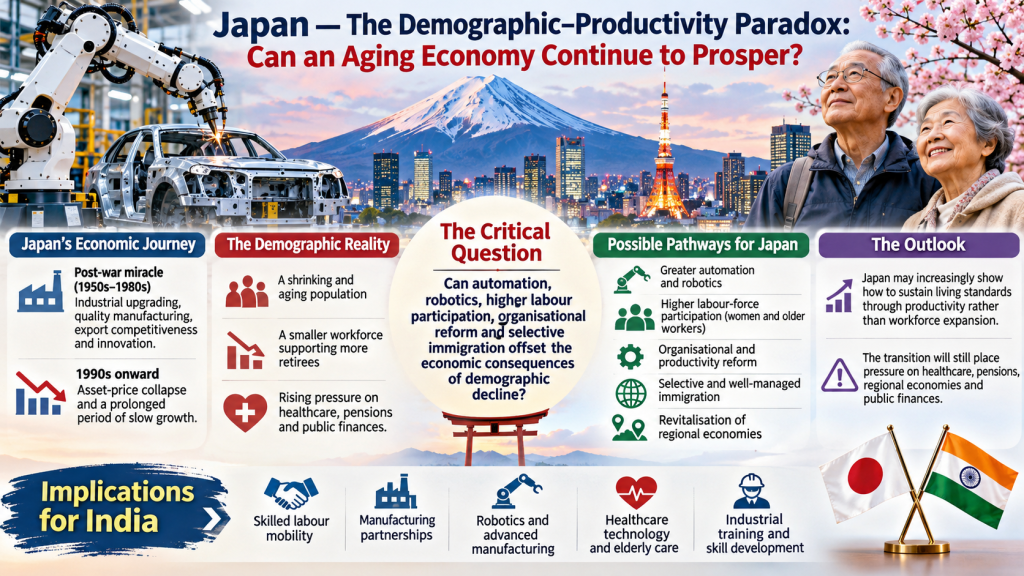
GLOBAL ECONOMIC CHALLENGES SERIES | JAPAN | NOVEMBER 2026
Can a country become economically stronger even as its population becomes smaller? Japan may provide one of the most important answers to this question in the twenty-first century.
The Paradox of a Rich Nation with a Shrinking Population
For much of modern economic history, population growth has been considered an important source of economic expansion. More people meant more workers, greater consumption, larger markets and an expanding tax base. Japan is challenging this conventional relationship between demography and economic prosperity.
Japan possesses some of the world’s most sophisticated manufacturing capabilities, advanced robotics, globally competitive corporations, efficient infrastructure and substantial accumulated wealth. Yet its population is declining, its workforce is aging, and many rural communities are gradually losing their economic foundations.
The contradiction is striking. Japan has the technological capacity to produce more with fewer workers, but it must simultaneously finance the increasing social and economic costs of an aging society.
The central economic question is therefore not simply whether Japan can reverse its demographic decline. It is whether an economy can sustain prosperity when the traditional engines of growth—population expansion, workforce growth and domestic market enlargement—are moving in the opposite direction.
Japan’s experience could fundamentally change how economists understand development, productivity and national prosperity.
From Post-War Economic Miracle to Demographic Maturity
Japan’s economic transformation after the Second World War remains one of the most remarkable examples of industrial development.
During the 1950s and 1960s, Japan combined industrial policy, technological adaptation, high domestic savings, investment in human capital and export-oriented manufacturing to achieve extraordinary economic growth. Japanese companies gradually moved from relatively simple manufactured products into automobiles, electronics, precision machinery and advanced industrial equipment.
Companies such as Toyota, Sony, Honda and Panasonic became international symbols of manufacturing quality and technological capability.
However, Japan’s success was not based on technology alone. Its industrial transformation depended on continuous organisational learning, supplier development, workforce discipline, production efficiency and strong relationships between large manufacturers and smaller enterprises.
The development of sophisticated supplier networks and industrial clusters was particularly important. Thousands of smaller enterprises became integral to the competitiveness of large Japanese manufacturers.
The asset-price collapse beginning in the early 1990s marked a major turning point. Japan entered a prolonged period of weak growth, low inflation and financial adjustment. Structural changes in domestic demand, corporate investment and demographics reinforced these difficulties.
Yet the conventional description of Japan’s experience as simply a story of economic stagnation is incomplete.
Japan continued to maintain considerable technological sophistication, infrastructure quality, social stability and high living standards. Its economic performance illustrates an important distinction between slow aggregate GDP growth and the erosion of productive capabilities.
An economy can grow slowly without becoming technologically backward. Equally, it can expand rapidly without developing comparable technological depth.
This distinction is increasingly relevant to developing economies pursuing ambitious GDP targets.
The Demographic Trap: When Fewer Workers Must Support More People
Japan’s demographic transformation is not a temporary economic fluctuation. It represents a long-term structural change.
Low fertility, increasing life expectancy and an aging population are reshaping the country’s labour market, public finances, consumption patterns and regional development.
A shrinking workforce creates several interconnected challenges. Businesses struggle to recruit workers, especially in healthcare, construction, agriculture, transport and smaller manufacturing enterprises. Meanwhile, increasing demand for pensions, medical services and elderly care places pressure on public expenditure.
The problem becomes particularly serious when the working-age population declines faster than the productivity of remaining workers increases.
A simplified economic relationship illustrates the challenge:
\text{GDP}=\text{Workers employed}\times\text{Output per worker}
If employment declines by 1% annually, labour productivity must increase by approximately 1.01% merely to prevent total output from falling, assuming other conditions remain unchanged.
However, maintaining aggregate output is not the same as maintaining prosperity. A country with fewer people can experience rising GDP per capita even when total GDP stagnates.
This raises a fundamental question: Should Japan’s economic success be measured primarily by total GDP, or by productivity, real income per person, quality of life and fiscal sustainability?
Traditional economic comparisons often overlook this distinction.
The Automation Paradox: Robots Can Replace Tasks, but Not Entire Economic Systems
Japan is among the global leaders in industrial robotics and advanced manufacturing automation. Its companies have developed sophisticated capabilities in machine tools, sensors, robotics, precision engineering and production management.
Automation provides an apparent solution to labour shortages. Machines can undertake repetitive operations, improve precision, reduce waste and allow fewer workers to produce greater output.
But there is an important limitation.
Robots can replace particular tasks, but they cannot automatically replace the economic functions of a growing population.
An industrial robot may improve factory productivity, but it does not independently generate household consumption, pay personal income taxes, raise children or sustain local communities.
Moreover, automation requires investment, technical skills, maintenance, organisational restructuring and access to finance. Large Japanese corporations may possess these capabilities, while smaller firms can face substantial barriers.
This creates the possibility of a two-speed economy: highly automated, internationally competitive corporations operating alongside smaller enterprises with limited productivity growth.
Japan’s real challenge is therefore not the number of robots installed. It is the extent to which technological improvements spread across the entire productive economy.
For industrial policy, the most important indicator should be the productivity improvement achieved by ordinary enterprises, not merely the technological sophistication demonstrated by leading corporations.
The Hidden Productivity Problem: Technology Is Not the Same as Efficiency
Japan’s technological achievements sometimes conceal weaknesses in organisational productivity, particularly in parts of its domestic service economy.
Advanced machinery does not automatically create efficient business processes. Traditional management practices, complex administrative procedures, fragmented digital systems and slow organisational restructuring can limit productivity gains.
This is particularly important because services account for a large proportion of employment in advanced economies.
Even spectacular productivity growth in automobile manufacturing cannot fully compensate for weak productivity across healthcare administration, retail, hospitality, logistics and other labour-intensive services.
Artificial intelligence and digital technologies offer new possibilities, but their economic value depends on complementary changes in skills, management, data systems and business organisation.
The next phase of Japan’s productivity transformation may therefore depend less on inventing sophisticated technologies and more on spreading existing technologies effectively.
This is a profound lesson for industrial development: The diffusion of technology may matter as much as its invention.
The Regional Development Crisis: When Economic Geography Shrinks
One of the most neglected consequences of demographic decline is its impact on regional economies.
Japan’s population and economic activity remain concentrated in major metropolitan areas, while many smaller towns and rural regions face declining populations, business closures, aging infrastructure and shortages of essential services.
As younger workers migrate toward larger cities, local enterprises lose employees and customers simultaneously. Falling demand reduces commercial viability, while declining tax revenues constrain local governments’ ability to maintain infrastructure.
This can create a self-reinforcing cycle of regional economic contraction.
Traditional regional development policies often assume that investment will attract businesses, businesses will generate employment, and employment will attract population.
But what happens when the population is structurally declining?
Japan may need a fundamentally different model of regional development—one based on economic viability rather than continuous expansion.
Smaller, better-connected settlements, shared public services, specialised industrial clusters, digital healthcare, local renewable energy systems and technology-enabled enterprises could become important elements of this transition.
The objective may no longer be to restore every region to its historical population size. It may instead be to maintain economic opportunity, essential services and acceptable living standards with fewer residents.
This challenges conventional regional planning, which often treats population growth as an unquestioned indicator of success.
Can Women, Older Workers and Immigration Change the Equation?
Japan’s demographic difficulties cannot be addressed through automation alone.
Higher labour-force participation among women, longer working lives, improved working conditions and selective international labour mobility can help reduce workforce shortages.
Japan has already experienced important increases in female and older-worker participation. However, greater participation does not automatically translate into proportionately higher productivity or better-quality employment.
Women may continue to face constraints arising from caregiving responsibilities, occupational segregation and unequal career progression. Older workers may require flexible employment arrangements, retraining and workplace adaptation.
Immigration presents another opportunity, but it also requires institutional preparation.
Attracting foreign workers is only the first stage. Sustainable labour mobility depends on language training, skills recognition, fair recruitment, worker protection, housing and social integration.
Japan’s experience demonstrates that labour-market reform is not simply a matter of increasing the number of available workers. It requires improving how human capabilities are developed and utilised.
The Fiscal Contradiction: Longer Lives, Greater Obligations and a Smaller Tax Base
Japan’s aging population places long-term pressure on pensions, healthcare and elderly care.
These commitments coexist with an already substantial public debt burden, creating difficult choices about taxation, expenditure priorities and intergenerational equity.
Japan has historically benefited from deep domestic financial markets, substantial domestic savings and borrowing in its own currency. Nevertheless, these advantages do not eliminate the economic costs of rising debt-service obligations or increasing social expenditure.
Higher productivity could expand taxable income and strengthen fiscal sustainability. But if productivity gains remain concentrated in a small number of corporations, their contribution to broad-based household income and public revenues may be limited.
The critical issue is therefore not merely how much additional output technology generates, but how its benefits are distributed among workers, businesses, consumers and the government.
An aging society requires a productive economy, but it also requires institutions capable of translating productivity into sustainable public finances.
Japan’s Future: Three Possible Economic Pathways
Japan’s economic future is unlikely to follow a single predetermined trajectory.
The first possibility is productivity-led prosperity. Automation, artificial intelligence, improved workforce participation and organisational reform could allow Japan to maintain or improve real living standards despite population decline. Total GDP growth might remain modest, while income per person, efficiency and service quality improve.
The second possibility is technological dualism. Leading corporations could become increasingly automated and internationally competitive, while smaller businesses, domestic services and declining regions experience persistent productivity weaknesses. National technological leadership would then coexist with growing economic disparities.
The third possibility is prolonged fiscal and structural pressure. If productivity improvements fail to offset workforce contraction and increasing age-related expenditure, Japan could face difficult adjustments involving public services, taxation, consumption and investment.
These possibilities are not mutually exclusive. Different industries and regions may experience different combinations of these outcomes.
The decisive variable will be the speed and breadth of productivity diffusion across Japan’s economy.
India and Japan: Complementary Demographies, Unequal Capabilities
Japan’s demographic challenges create significant opportunities for economic cooperation with India.
India possesses a comparatively young population and a potentially expanding workforce, while Japan has deep technological capabilities, industrial experience, advanced production systems and substantial institutional knowledge.
However, demographic complementarity does not automatically produce successful economic cooperation.
India must convert its labour-force potential into internationally competitive skills. Japan must develop institutions capable of integrating foreign workers and transferring knowledge effectively.
Industrial partnerships should move beyond conventional investment promotion toward joint technological development, supplier upgrading, industrial training and productivity improvement.
Japanese experience in precision engineering, lean manufacturing, robotics, quality management and supplier networks could be especially valuable for Indian MSME clusters.
Healthcare technology, assistive robotics, elderly-care services, medical devices and digital health systems also offer opportunities for collaboration.
Labour mobility could become another important area, particularly in healthcare, manufacturing, construction and technical services. But successful mobility requires credible certification, Japanese-language capability, ethical recruitment and pathways for career progression.
India should also learn from Japan’s regional experience.
While India continues to urbanise and expand economically, several regions already face migration-related imbalances, shortages of skilled workers and uneven industrial development.
Japan’s experience demonstrates that regional competitiveness cannot be sustained through infrastructure investment alone. It requires viable enterprises, productive employment, functioning institutions and strong local economic networks.
Most importantly, India should avoid confusing its demographic dividend with an automatic economic advantage.
A large working-age population creates potential. Only productive employment, education, technological capability and institutional effectiveness can convert that potential into prosperity.
Beyond GDP: The Emerging Economics of a Smaller Society
Japan may be approaching an economic reality that many other countries will eventually confront.
For much of the twentieth century, economic development was associated with expansion—more factories, more workers, more consumers, larger cities and greater aggregate production.
The twenty-first century may require a more complex understanding of prosperity.
An economy may become smaller in population but richer in productive capabilities. It may produce more output per worker while employing fewer people. It may need fewer physical facilities but more sophisticated public services.
The challenge is to ensure that these transformations strengthen rather than undermine economic security.
This also requires rethinking the relationship between productivity and employment. In a labour-surplus economy, automation can create concerns about displacement. In a labour-scarce economy, the same technology can become essential for maintaining production and services.
Thus, the economic consequences of technological change depend fundamentally on demographic conditions and institutional arrangements.
Conclusion: Japan May Redefine What Economic Success Means
Japan’s greatest economic challenge is not simply that its population is aging. It is that its institutions, business models, fiscal arrangements and regional development systems were largely constructed during an era when economic expansion and population growth reinforced one another.
That relationship is now changing.
Japan possesses considerable technological and financial resources to manage this transition, but technological sophistication alone will not guarantee success.
The country must improve productivity across ordinary enterprises, modernise domestic services, support workforce participation, integrate international talent and develop sustainable economic models for shrinking regions.
For India, Japan offers both a warning and an opportunity. Demographic advantages are temporary, and technological leadership is difficult to build. India must use its present demographic window to develop the productive capabilities that will sustain prosperity when its own population eventually ages.
The defining economic question of the coming decades may not be how many people an economy has, but how productively, inclusively and sustainably it uses the people and resources available to it.
Japan’s future could demonstrate that a shrinking population need not produce a shrinking standard of living. But it could equally reveal that even the world’s most sophisticated technologies cannot compensate for weak organisational adaptation and uneven productivity.
The ultimate test is not whether Japan can produce more with fewer people. It is whether it can create a society in which fewer people can continue to live better.
Global Economic Challenges Series — Japan: Demography, Productivity and the Future of Prosperity
Suggested SEO keywords: Japan aging population, Japan productivity paradox, demographic decline, Japan economic outlook, robotics and automation, Japan India economic cooperation, labour shortages, regional development, industrial competitiveness, future of economic growth.
#JapanEconomy #DemographicChange #Productivity #EconomicDevelopment #Robotics #IndustrialPolicy #MSME #IndiaJapanRelations #FutureOfWork #RegionalDevelopment


Leave a Reply