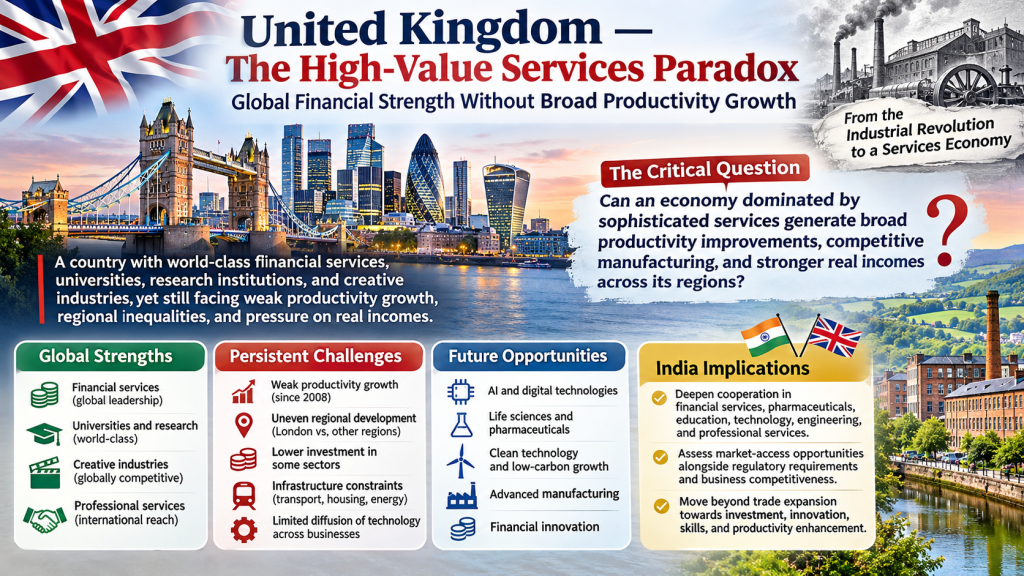
Global Financial Strength Without Broad Productivity Growth
How can a country that leads in global finance, scientific research, education, and professional services struggle to generate sustained productivity growth and prosperity across its regions?


The paradox of a sophisticated economy
The United Kingdom presents one of the most interesting contradictions in modern economic development. It possesses some of the world’s most sophisticated financial institutions, internationally respected universities, advanced research capabilities, globally competitive professional services, and influential creative industries.
London remains a major international financial centre, connecting global capital markets, insurance, banking, investment management, and professional advisory services. British universities contribute to advances in artificial intelligence, biotechnology, medicine, and scientific research.
Yet these strengths coexist with a persistent economic problem: the country’s internationally competitive sectors have not generated sufficiently broad productivity improvements across the wider economy.
The central challenge is not that Britain lacks technological or intellectual capabilities. Rather, it is that these capabilities are unevenly distributed across firms, industries, and regions.
This raises a fundamental question in development economics:
Can an economy become globally competitive in high-value services without becoming broadly productive?
Britain’s experience suggests that the answer is yes.
1. Historical perspective: From the world’s workshop to a services economy
Britain was the birthplace of the Industrial Revolution. During the eighteenth and nineteenth centuries, innovations in textile machinery, steam power, metallurgy, railways, and factory organisation transformed production.
Industrialisation generated enormous economic advantages. Manufacturing capabilities supported exports, technological leadership, urbanisation, and the development of modern financial institutions.
For much of the nineteenth century, Britain occupied a central position in global industrial production and international trade.
However, its economic structure changed substantially during the twentieth century.
Traditional industries such as textiles, coal, steel, and shipbuilding declined under pressure from technological change, international competition, and domestic restructuring.
From the 1980s onward, financial liberalisation, privatisation, and the expansion of business services accelerated Britain’s transition towards a predominantly services-based economy.
London emerged as an increasingly important centre for international finance, while several former industrial regions struggled to replace lost manufacturing employment with equally productive economic activities.
The transformation was not inherently undesirable. Advanced economies normally experience a rising share of services as incomes increase.
The difficulty arises when the decline of traditional manufacturing is not accompanied by sufficient investment, technological upgrading, and productivity growth in the sectors and regions replacing it.
Britain’s economic transformation therefore produced both extraordinary concentrations of global competitiveness and persistent regional disparities.
2. The productivity puzzle: Why excellence in a few sectors is insufficient
Productivity measures how efficiently an economy transforms labour, capital, technology, and other resources into economic output.
Sustained productivity growth is essential because it allows real wages, living standards, and public revenues to increase without depending entirely on longer working hours or rising debt.
Britain experienced relatively weak productivity growth following the global financial crisis of 2008.
Although the country continues to host highly productive enterprises, improvements in output per hour worked have been much slower than during earlier decades.
Three structural explanations are particularly important.
The concentration of high productivity
Highly productive firms often operate in finance, technology, pharmaceuticals, professional services, and other knowledge-intensive industries.
However, many businesses in retail, hospitality, construction, personal services, and traditional manufacturing operate with lower levels of capital investment and technological sophistication.
The productivity performance of an economy depends on the entire distribution of firms, not merely its internationally successful enterprises.
A small group of highly productive businesses cannot compensate indefinitely for weak productivity growth among millions of workers elsewhere.
The investment deficit
Britain has experienced prolonged concerns about relatively weak business investment, infrastructure constraints, and policy uncertainty.
Insufficient investment limits the adoption of advanced machinery, digital systems, organisational improvements, and workforce capabilities.
This creates a self-reinforcing problem.
Low investment constrains productivity, weak productivity limits expected returns, and uncertain returns discourage further investment.
The diffusion problem
Britain produces important scientific discoveries and technological innovations.
But invention and economy-wide adoption are different processes.
A technology developed at a leading university or research laboratory does not automatically improve productivity in a small engineering company, regional logistics enterprise, or construction business.
Commercialisation, management capability, finance, skills, and supporting institutions determine whether technological advances spread throughout the economy.
The challenge is therefore not simply generating innovation, but converting innovation into widespread productive capability.
3. The London paradox: A global economic powerhouse within an uneven national economy


London’s economic position is exceptional.
Its concentration of financial institutions, multinational headquarters, international law firms, technology businesses, research institutions, and highly skilled professionals creates powerful agglomeration advantages.
Firms benefit from access to specialised labour, sophisticated suppliers, international customers, and dense professional networks.
However, these advantages are not evenly distributed across Britain.
Several regions outside London and the South East face weaker investment, transport connectivity, skills constraints, and more limited access to high-productivity employment.
This creates a geographical development problem.
Workers may possess the ability to contribute to more productive activities but remain constrained by the absence of suitable firms, infrastructure, housing, or employment opportunities.
Meanwhile, London’s economic success generates its own challenges, particularly high housing costs, congestion, and pressure on infrastructure.
The result is an economy in which prosperity is concentrated geographically while economic opportunities remain uneven.
This is not merely a question of redistribution.
It is a question of where productive economic capabilities are created and whether regional economies can develop their own competitive specialisations.
Policies that improve regional productivity can expand national economic output rather than simply redistribute existing income.
4. Can high-value services replace manufacturing as an engine of development?
Traditional development economics placed considerable emphasis on manufacturing as a driver of structural transformation.
Manufacturing historically offered several advantages: economies of scale, technological learning, productivity growth, export opportunities, and strong linkages with suppliers.
Modern services can also generate these benefits.
Software, financial technology, engineering design, research, telecommunications, and professional services are increasingly tradable across borders.
Some possess substantial economies of scale and significant technological spillovers.
However, services differ considerably in their productivity characteristics.
A globally competitive financial institution and a small neighbourhood restaurant both belong to the services sector, but their capital intensity, technological capabilities, scalability, and international market access are very different.
Consequently, a rising services share in GDP does not automatically indicate an economy-wide productivity transformation.
The more relevant distinction is between high-productivity and low-productivity activities, irrespective of whether they are classified as manufacturing or services.
Furthermore, manufacturing and services are increasingly complementary.
Advanced manufacturing depends on software, engineering, logistics, design, finance, and research.
Similarly, sophisticated services often benefit from a strong domestic industrial base that creates demand for technical capabilities.
Britain’s future competitiveness may therefore depend less on choosing between manufacturing and services and more on strengthening the productive relationships between them.
5. The real-income challenge: Economic sophistication without sufficient household prosperity
One of the most important consequences of weak productivity growth is pressure on real household incomes.
In the long run, sustained improvements in living standards depend heavily on the economy’s ability to produce greater value per worker or hour worked.
When productivity growth remains weak, businesses face constraints on sustainable wage increases.
At the same time, households experience rising costs associated with housing, energy, transportation, and essential services.
This creates a politically and economically difficult situation.
A country may retain enormous financial wealth, internationally competitive corporations, and sophisticated capital markets while many households experience limited improvements in purchasing power.
Financial-market success and household prosperity are related, but they are not identical.
The critical issue is whether financial intermediation channels sufficient resources into productive domestic investment, enterprise development, infrastructure, and innovation.
An advanced financial system should not be judged only by trading volumes, international transactions, or institutional profitability.
It should also be evaluated by its contribution to long-term capital formation and productivity growth.
6. Future opportunities: Can Britain build a new productivity model?
Britain retains important advantages that could support a new phase of economic development.

Artificial intelligence and digital technologies
AI offers opportunities to improve productivity in financial services, healthcare, engineering, administration, and business operations. The challenge is ensuring adoption extends beyond leading technology companies.

Life sciences and biotechnology
Strong universities, pharmaceutical companies, and research institutions provide opportunities for innovation-led growth, provided scientific discoveries translate into commercial production and employment.

Clean energy and industrial transformation
Offshore wind, energy technologies, and low-carbon industrial systems could create new supply chains, engineering opportunities, and regional investment.

Advanced manufacturing
Aerospace, precision engineering, pharmaceuticals, and specialised industrial technologies offer opportunities to combine scientific knowledge with export-oriented production.
Yet these opportunities will not automatically resolve Britain’s productivity difficulties.
Their contribution will depend on complementary investment in transport, housing, energy infrastructure, technical education, workforce skills, and management capabilities.
The fundamental requirement is to move from isolated centres of excellence towards a more widely productive national economy.
7. What Britain teaches India
Britain’s experience offers important lessons for India’s development strategy.
India is experiencing rapid growth in digital services, information technology, financial technology, professional services, and research-intensive activities.
These sectors can generate substantial export earnings and internationally competitive capabilities.
However, India must avoid assuming that success in globally traded services automatically guarantees broad-based economic transformation.
Three lessons deserve particular attention.
First, high-value services must develop stronger linkages with domestic production. India’s technology, engineering, design, finance, and research capabilities should contribute directly to improving productivity in manufacturing, agriculture, logistics, and MSMEs.
Second, regional development requires productive ecosystems rather than isolated investments. Industrial clusters, universities, training institutions, infrastructure providers, and financial institutions must work together to build locally competitive economic capabilities.
Third, productivity diffusion deserves as much attention as technological innovation. Supporting a few globally competitive enterprises is insufficient if smaller firms remain technologically and organisationally weak.
For India’s MSME sector, the central objective should be to connect smaller enterprises with advanced technology, professional services, institutional finance, quality infrastructure, and international markets.
8. India–UK economic cooperation: Opportunities beyond market access
India and Britain possess complementary economic strengths.
Britain offers expertise in financial services, higher education, research, pharmaceuticals, engineering, professional services, and advanced technologies.
India offers a large domestic market, expanding digital capabilities, engineering talent, manufacturing opportunities, and a substantial entrepreneurial base.
The India–UK Comprehensive Economic and Trade Agreement, signed in July 2025, provides an important framework for expanding bilateral commercial engagement.
However, the benefits of trade agreements should not be measured solely by tariff reductions or projected increases in trade.
Actual gains depend on regulatory compliance, professional qualifications, standards, rules of origin, investment conditions, and the competitiveness of participating firms.
For Indian enterprises, particularly MSMEs, the opportunity lies in moving beyond simple export expansion towards deeper commercial and technological partnerships.
Collaboration in pharmaceutical research, financial technology, engineering design, education, advanced manufacturing, and professional services could strengthen capabilities in both economies.
The larger objective should be mutual productivity enhancement rather than trade growth alone.
9. The road to 2035: Three possible futures for Britain
Britain’s economic trajectory could evolve along three broad paths. Scenario Economic outcome Productivity revival AI adoption, investment, infrastructure improvements, and regional industrial upgrading support stronger productivity and real-income growth. Continued divergence London and leading knowledge-intensive sectors remain competitive, while weaker regions and firms experience limited productivity improvements. Prolonged stagnation Weak investment, fiscal constraints, infrastructure bottlenecks, and slow technological diffusion reinforce low growth and pressure on living standards.
These are possible scenarios rather than forecasts. The outcome will depend substantially on policy consistency, private investment, institutional effectiveness, and the ability of firms to adopt new technologies.
Conclusion: The real test of an advanced economy
The United Kingdom demonstrates that international economic sophistication does not necessarily produce broad national prosperity.
A country can host world-class financial institutions, leading universities, advanced research centres, and globally competitive corporations while struggling with weak productivity growth, regional inequalities, and stagnant living standards.
Britain’s central economic challenge is not simply to create more internationally successful enterprises.
It is to ensure that technological capabilities, investment, skills, and productive opportunities spread more widely across its economy.
For India, the lesson is equally significant.
The objective of development should not be confined to increasing GDP, expanding services exports, or creating globally recognised corporations.
It must also involve raising productivity across enterprises, strengthening regional economic capabilities, generating quality employment, and improving real household incomes.
The defining question for Britain—and increasingly for other advanced and emerging economies—is not how much economic sophistication a country possesses, but how widely that sophistication translates into productive prosperity.
Suggested reading and data sources: UK Office for National Statistics — Productivity; OECD — United Kingdom; The Productivity Institute; UK Government — India–UK Trade Agreement.
Editorial analysis | 1 November 2026


Leave a Reply