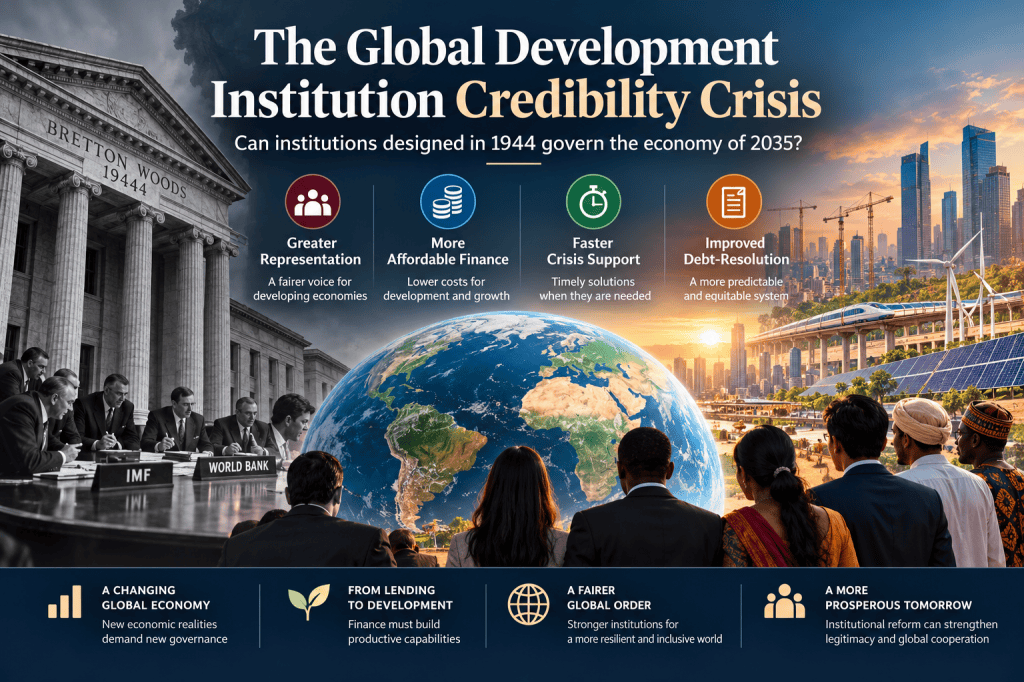
Can the World Economy Survive with Institutions Designed for Another Century?
25 October 2026 | Global Economic Governance, Development Finance and the Future of International Cooperation
The Emerging Crisis: When Global Economic Power Changes but Institutions Do Not
The international economic system is entering a period of institutional contradiction. The world economy has changed dramatically over the past three decades, but many institutions responsible for governing international finance, development assistance, debt restructuring and economic cooperation continue to operate through structures inherited from the middle of the twentieth century.
The International Monetary Fund (IMF), World Bank and other multilateral development institutions were established around an economic order in which industrialised Western countries controlled much of global production, finance, technology and international trade. Today, emerging and developing economies account for a substantially larger share of global output, manufacturing activity, population and future economic demand. Yet their influence over international economic decision-making has not expanded proportionately.
This imbalance is becoming more than a question of diplomatic representation. It is increasingly a question of economic legitimacy.
Countries facing debt distress, climate-related disasters, infrastructure deficits and external financial shocks are questioning whether existing international institutions can deliver timely, affordable and development-oriented solutions.
The central issue is no longer whether the world needs multilateral institutions. It is whether those institutions can remain credible without fundamentally changing how economic power, financial resources and decision-making authority are distributed.
From Bretton Woods to a Multipolar Economy: The Historical Contradiction
The modern international financial architecture emerged from the Bretton Woods Conference of 1944. Its principal objective was to prevent a recurrence of the financial instability, competitive currency devaluations and economic fragmentation that had contributed to the Great Depression and the political conflicts of the interwar period.
The IMF was designed to support monetary stability and address balance-of-payments difficulties, while the World Bank initially concentrated on postwar reconstruction before expanding its development-financing role.
These institutions performed important functions. They supported international economic cooperation, financed infrastructure, helped countries respond to external shocks and contributed to the expansion of global economic integration.
However, their governance structures reflected the distribution of economic power at the time of their establishment.
Voting rights were linked substantially to financial contributions and quota arrangements. Advanced economies consequently retained considerable influence over institutional priorities, leadership selection and major decisions.
The rise of China, India, Southeast Asia and other emerging economic centres has exposed the limitations of this arrangement.
A world in which developing economies are increasingly central to manufacturing, energy demand, trade and population growth cannot indefinitely rely on a governance system whose political foundations remain heavily influenced by the economic hierarchy of 1944.
The contradiction is particularly visible in the IMF, where major governance changes require an 85% voting majority, effectively giving the United States blocking power over those decisions.
The problem is not simply that Western countries possess substantial influence. It is that institutional authority and contemporary economic realities are becoming increasingly misaligned.
The Representation Deficit: Economic Contribution Without Equivalent Decision-Making Power
Developing countries have repeatedly demanded greater representation in the IMF, World Bank and other international financial institutions.
Their argument extends beyond national prestige. Representation influences the formulation of lending conditions, the assessment of debt sustainability, the allocation of financial resources and the institutional understanding of development priorities.
Countries with relatively limited voting power may find themselves subject to policy frameworks over which they exercise insufficient influence.
This creates a fundamental governance problem: institutions that require national governments to undertake politically difficult economic reforms must themselves demonstrate accountability, fairness and legitimacy.
Recent IMF quota reforms illustrate both progress and limitations. The Sixteenth General Review of Quotas approved in 2023 provided for a 50% increase in quotas, subject to implementation requirements, but did not redistribute quota shares among members.
Increasing institutional resources without substantially changing relative voting power may improve financing capacity, but it does not resolve the underlying representation problem.
The challenge is especially important for Africa, where many countries face severe development-financing constraints while possessing comparatively limited influence over the institutions that shape international financial rules.
For India and other emerging economies, the issue is equally significant. Greater economic weight should translate into meaningful participation in setting the rules of global finance, rather than merely increased financial contributions to institutions governed through older power arrangements.
The Development Finance Paradox: The Countries That Need Capital Most Often Pay the Highest Price
One of the deepest contradictions in the global financial system is that countries with the greatest development needs frequently face the highest borrowing costs.
Developing economies require substantial investment in electricity, transportation, healthcare, education, digital infrastructure, industrial modernisation and climate adaptation.
Yet access to affordable long-term finance remains highly unequal.
Advanced economies with strong reserve currencies and deep financial markets can generally borrow at lower rates than developing countries exposed to exchange-rate instability, limited domestic capital markets and higher perceived sovereign risk.
The result is a self-reinforcing development trap.
Countries need investment to improve productivity and strengthen economic resilience. But high financing costs reduce their capacity to undertake precisely those investments.
Debt servicing absorbs fiscal resources that could otherwise support infrastructure, human capital and productive transformation.
This is not merely a shortage of global savings. It is a failure to channel available international capital toward productive opportunities in countries where financing constraints are most severe.
Multilateral development banks were intended to help overcome such market failures. However, their lending capacity, operational procedures, risk frameworks and project-approval timelines are increasingly being questioned.
A development institution that takes years to prepare and approve critical infrastructure financing may find its economic relevance diminished in a world where technological and geopolitical conditions change rapidly.
The future credibility of development finance will depend not only on the volume of lending but also on affordability, speed, additionality and measurable development outcomes.
The Debt Crisis: When Financial Rescue Becomes a Development Constraint
Sovereign debt distress is emerging as one of the most difficult tests of international economic cooperation.
Countries facing unsustainable debt burdens often confront a complicated network of bilateral lenders, multilateral institutions, private bondholders and commercial creditors.
Unlike domestic corporate insolvency systems, the international financial architecture lacks a comprehensive and universally enforceable sovereign bankruptcy mechanism.
Debt restructuring therefore depends heavily on negotiations among creditors with different legal rights, financial interests and geopolitical objectives.
The G20 Common Framework for Debt Treatments represented an attempt to improve coordination among creditors, but experiences with restructuring have exposed persistent difficulties involving negotiation delays, creditor comparability and the treatment of different debt instruments.
For countries experiencing severe fiscal stress, time itself becomes an economic cost.
Delayed restructuring can weaken investor confidence, deepen currency pressures, reduce public investment and increase social hardship.
A country may technically reach a debt agreement after prolonged negotiations, yet emerge with damaged institutions, lower productive capacity and a reduced ability to achieve long-term development.
This raises a critical question: should international debt restructuring be judged primarily by creditor recovery and fiscal adjustment, or by the speed at which a country can restore sustainable economic growth?
Financial sustainability is essential, but debt resolution that undermines the productive foundations of an economy can become self-defeating.
Future reforms must address creditor coordination, transparency, predictable timelines and the protection of essential development expenditure.
The Conditionality Debate: Economic Discipline Versus Development Ownership
International financial assistance frequently comes with policy conditions intended to restore macroeconomic stability, strengthen fiscal management and reduce financial vulnerabilities.
India and the Global South: From Demanding Representation to Designing New Institutions
Such conditions can be necessary where governments face serious imbalances or institutional weaknesses.
However, the historical experience of structural adjustment programmes has generated continuing debate over the economic and social consequences of externally prescribed reforms.
Fiscal consolidation, subsidy restructuring, currency adjustments and public-sector reforms may improve selected macroeconomic indicators while imposing significant short-term costs on households, workers and domestic enterprises.
The problem is not that economic discipline is unnecessary. It is that stabilisation and development are not identical objectives.
A country can reduce its fiscal deficit while weakening public investment. It can improve external balances through import compression while damaging industrial production. It can achieve financial stability without generating sufficient employment or productivity growth.
International institutions therefore face a difficult balancing act.
They must maintain financial credibility while recognising that national economic structures, institutional capacities and social conditions differ substantially.
Standardised policy prescriptions cannot substitute for country-specific development strategies.
The future of conditionality may need to move away from excessive emphasis on uniform policy instruments toward measurable outcomes, institutional capability and nationally owned reform programmes.
Climate Finance: The New Test of Global Economic Fairness
Climate change has introduced an additional dimension to the legitimacy crisis.
Many developing countries face severe climate-related risks despite having contributed relatively little to historical greenhouse-gas emissions.
They require investment in climate-resilient infrastructure, water management, agricultural adaptation, disaster protection and cleaner energy systems.
Yet much international climate finance continues to involve loans rather than grants, while access to concessional resources remains insufficient relative to estimated needs.
This creates a difficult contradiction.
Countries already facing debt pressures may need to borrow more to protect themselves from climate-related damage, thereby increasing future fiscal vulnerability.
Climate adaptation is also different from conventional revenue-generating infrastructure. Flood protection, ecosystem restoration and disaster preparedness can produce substantial social benefits without generating direct financial returns capable of servicing commercial debt.
A financing system built mainly around conventional creditworthiness may therefore underprovide investment in activities essential for long-term economic survival.
International development institutions will increasingly be judged by their ability to distinguish between commercial investment, public development needs and global public goods.
Without this distinction, climate finance risks becoming another mechanism through which vulnerable countries accumulate liabilities while wealthier economies retain greater fiscal flexibility.
The Rise of Alternative Institutions: Competition or Fragmentation?
The changing global economy has encouraged the emergence and expansion of alternative financial institutions and cooperation arrangements.
The Asian Infrastructure Investment Bank, the New Development Bank established by BRICS countries and various regional financing mechanisms reflect demands for greater institutional diversity.
These institutions can provide additional sources of infrastructure finance, create opportunities for regional cooperation and increase competition within the development-financing system.
Their emergence also sends an important political signal: countries dissatisfied with existing governance arrangements are increasingly willing to build alternative institutional platforms.
However, alternative institutions are not automatically more equitable or effective.
They face their own challenges involving governance, financial sustainability, project quality, transparency, environmental safeguards and geopolitical influence.
A development bank dominated by a different group of powerful countries may reproduce many of the problems associated with traditional institutions.
The objective should therefore not be to replace one hierarchy with another.
The real opportunity lies in creating a more competitive, representative and accountable international financial architecture.
Institutional pluralism can improve financing options, but excessive fragmentation could increase transaction costs, complicate debt coordination and weaken common standards.
The future challenge is to combine institutional diversity with effective international cooperation.
The Hidden Crisis: Institutions Measure Financial Performance More Easily Than Development Transformation
An overlooked dimension of the credibility crisis concerns how international development institutions evaluate success.
Traditional performance indicators often emphasise loan commitments, disbursement levels, project completion, fiscal stability and repayment performance.
These measures are important, but they do not necessarily establish whether an economy has developed stronger productive capabilities.
A country may receive substantial development finance without significantly improving domestic technological capacity, industrial competitiveness or employment quality.
Infrastructure can be constructed without generating sufficient local supplier development. Foreign investment can expand without meaningful technology transfer. Export volumes can increase while domestic value addition remains limited.
This creates a distinction between financing development activities and financing economic transformation.
The future relevance of multilateral development institutions will increasingly depend on whether their interventions strengthen domestic productive systems.
For developing economies, the essential questions should include whether financing improves technological learning, increases domestic value retention, expands productive employment, reduces vulnerability to external shocks and creates sustainable fiscal capacity.
Development institutions must move beyond measuring how much money enters an economy toward assessing how much productive capability remains after the money has been spent.
India occupies an important position in this debate.
Its expanding economic scale, participation in global production networks and growing role in South–South cooperation provide opportunities to influence international economic governance.
However, greater representation should not be treated as an end in itself.
India’s strategic interest lies in shaping a development-financing architecture that supports industrial upgrading, technological capability, infrastructure investment, MSME competitiveness and resilient supply chains.
This requires moving beyond conventional demands for larger voting shares toward a more comprehensive reform agenda.
India could advocate faster financing for productive infrastructure, improved sovereign debt-resolution procedures, greater use of local-currency financing where appropriate, more effective guarantees for private investment and stronger links between development lending and domestic industrial capability.
For MSME clusters, the implications are particularly significant.
International development finance often operates through large national programmes and major infrastructure projects, while smaller enterprises struggle to access affordable technology, certification, working capital and market-development support.
A more effective development-financing architecture would recognise industrial clusters as important platforms for economic transformation.
Shared technology centres, testing laboratories, common infrastructure, energy-efficiency systems, workforce development and export-compliance facilities can generate benefits that individual small firms cannot finance independently.
The credibility of international development institutions should therefore also be tested at the level of productive enterprises and local economic systems, rather than exclusively through national macroeconomic aggregates.
The Road to 2035: Five Structural Reforms That Could Redefine Global Economic Cooperation
The next decade could determine whether international development institutions regain legitimacy or gradually lose influence.
Five reforms are likely to become increasingly important.
First, governance must reflect contemporary economic realities. Voting structures, leadership arrangements and institutional representation need periodic reassessment using transparent principles that recognise both economic weight and the interests of smaller, vulnerable economies.
Second, development finance must become more affordable and responsive. Multilateral institutions need to strengthen their capacity to mobilise long-term finance without transferring excessive debt and currency risks to borrowing countries.
Third, sovereign debt restructuring must become faster and more predictable. Clearer procedures, better creditor coordination and credible debt-sustainability assessments could reduce the economic damage caused by prolonged uncertainty.
Fourth, development financing must prioritise productive transformation. Lending should be evaluated not only through financial returns and disbursement efficiency but also through technological upgrading, employment quality, domestic value addition and economic resilience.
Fifth, global public goods require financing arrangements that recognise their wider benefits. Climate adaptation, pandemic preparedness and other cross-border challenges cannot be addressed adequately through conventional commercial lending alone.
None of these reforms is politically straightforward.
Countries holding substantial voting power may resist dilution of influence. Creditors may oppose restructuring arrangements that reduce recoveries. Borrowers may disagree over reform priorities, while new institutions may introduce additional geopolitical competition.
Institutional reform will therefore require negotiated trade-offs rather than a simple redistribution of authority.
The Future Risk: A World with More Financial Institutions but Less International Cooperation
The greatest danger is not necessarily the collapse of existing multilateral institutions.
A more plausible risk is their gradual loss of relevance.
Countries may increasingly rely on bilateral lending, regional development banks, sovereign investment arrangements and geopolitical financing partnerships.
Such diversification can create valuable alternatives. But if it occurs without effective coordination, the global financial system could become more fragmented, less transparent and more vulnerable to political influence.
Debt negotiations could become increasingly complicated. Financing standards could diverge. Smaller developing economies might face greater pressure to align with competing geopolitical blocs.
The result could be a paradoxical international system with more lenders, more institutions and more financing instruments, but weaker collective capacity to manage global crises.
This would be especially damaging in a world facing simultaneous pressures from climate change, demographic transitions, technological disruption, fiscal constraints and geopolitical fragmentation.
The future effectiveness of international economic cooperation will depend on whether institutions can provide credible solutions that countries cannot achieve independently.
The Real Crisis Is Not Institutional Survival but Institutional Relevance
The international development architecture stands at a historic crossroads.
The Bretton Woods institutions were created to stabilise a world emerging from war and economic fragmentation. Their future challenge is to support a world characterised by multipolar economic power, unequal financial capacity, climate vulnerability and increasingly complex production networks.
The institutions themselves remain important. They possess accumulated expertise, financial resources, convening power and the capacity to coordinate international responses.
But historical importance does not guarantee future legitimacy.
Credibility must be earned through representative governance, transparent decision-making, timely financing, fairer risk-sharing and demonstrable development outcomes.
For developing countries, the objective should not simply be to secure a larger place within the existing institutional order. It should be to help redesign that order around the economic realities and development challenges of the twenty-first century.
For advanced economies, meaningful reform should be understood not merely as a concession to emerging powers, but as an investment in the stability of the international system from which they also benefit.
The fundamental question is whether global institutions can redistribute influence without weakening cooperation, mobilise finance without deepening debt dependence, and promote stability without sacrificing development.
By 2035, the international economic system may not be judged primarily by how many institutions it possesses or how much money they lend.
It may be judged by whether those institutions help countries build productive capabilities, withstand crises and participate in global prosperity on more equitable terms.
The defining contradiction of global development governance is becoming clear: institutions created to manage economic interdependence risk losing credibility precisely when the world needs collective economic action the most.
And unless governance, financing and development outcomes evolve together, the next global crisis may expose not merely a shortage of financial resources, but a much deeper shortage of institutional trust.


Leave a Reply