Can Europe’s Industrial Powerhouse Reinvent Itself?
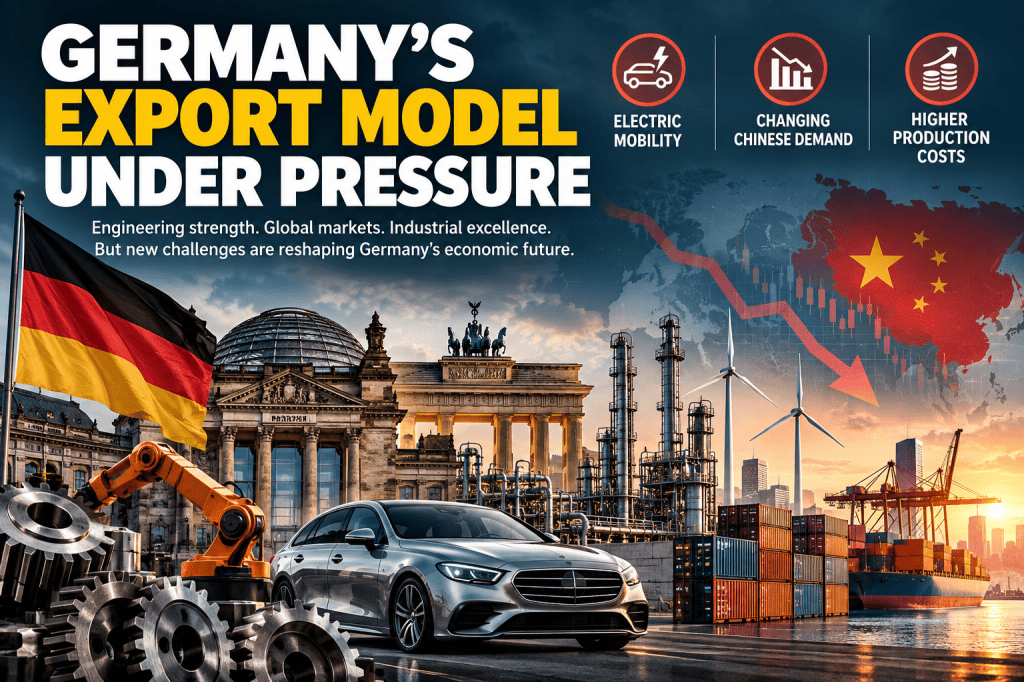
The German economic model was built on engineering excellence, industrial specialisation, export competitiveness and access to global markets. But the forces that made Germany an industrial giant are changing. Electric mobility, Chinese competition, expensive energy, technological disruption and geopolitical fragmentation are challenging not merely German exports but the economic philosophy behind them.
The Industrial Miracle That Became an Economic Dependency
For much of the post-war period, Germany represented one of the most successful examples of export-led industrial development. While several advanced economies gradually shifted towards finance, digital services and consumption, Germany maintained a strong manufacturing base. Its industrial success rested on automobiles, machinery, chemicals, electrical equipment and precision engineering.
The German economic miracle was not simply a story of large corporations. It was supported by the Mittelstand, a vast network of specialised medium-sized enterprises that developed exceptional capabilities in industrial components, machinery, tools and production technologies.
Companies such as Volkswagen, BMW, Mercedes-Benz, Siemens and BASF became global symbols of German industrial excellence. Behind these corporations stood thousands of suppliers, engineering firms, technical institutions and regional industrial clusters.
Germany developed a powerful economic formula: import raw materials and energy, transform them into sophisticated industrial products, and export them to international markets at premium prices.
For decades, this model generated productivity, employment, technological leadership and trade surpluses.
However, the same model also created structural dependencies. Germany became highly exposed to external energy supplies, foreign demand, global production networks and the technological direction of industries beyond its national control.
What once appeared to be the foundation of economic strength is increasingly becoming a source of vulnerability.
When Three Pillars of Industrial Competitiveness Weaken Together
Germany’s present industrial challenge is unusual because several pressures are emerging simultaneously.
The first is technological transformation. The second is the changing economics of energy-intensive manufacturing. The third is the restructuring of global trade and geopolitical relationships.
Traditionally, German competitiveness depended on superior engineering, skilled labour, efficient production systems and technological reliability. Higher domestic wages were compensated by higher productivity and premium product positioning.
But the competitive environment is changing.
Industrial leadership increasingly depends on batteries, semiconductors, software, artificial intelligence, digital platforms and access to critical minerals. These capabilities do not always emerge from the mechanical engineering strengths that Germany developed over generations.
The central question is therefore no longer whether Germany can manufacture sophisticated products. It is whether Germany can control the technologies, intellectual property and industrial ecosystems that will define the next generation of products.
This distinction is fundamental.
A country can remain an excellent manufacturer while gradually losing control over the most valuable functions of manufacturing.
The Automobile Industry: From Engineering Leadership to Technological Uncertainty
The automobile industry illustrates Germany’s structural dilemma more clearly than any other sector.
For decades, German manufacturers dominated important segments of the global premium automobile market. Their competitive advantages rested on internal combustion engines, transmissions, mechanical engineering, manufacturing quality and brand reputation.
Electric vehicles are changing the distribution of value within the automobile industry.
An electric vehicle requires fewer complex mechanical components than a conventional combustion-engine vehicle. Batteries, power electronics, software architecture and digital services account for an increasingly important share of its technological and commercial value.
This transformation threatens the established position of many German automotive suppliers.
Companies specialising in engine components, fuel systems, exhaust technologies and traditional transmission equipment face the possibility that their products will become less important as electric mobility expands.
Meanwhile, Chinese manufacturers such as BYD have developed substantial capabilities in electric vehicles, batteries and integrated production systems.
German manufacturers must therefore compete in technological areas where their historical advantages are less decisive.
The challenge extends beyond selling electric cars. It involves restructuring entire supplier networks, retraining workers, developing battery technologies, improving software capabilities and adapting industrial clusters.
Germany’s automobile transition is consequently not just a change in products. It is a transformation of the country’s industrial organisation.
China: From Germany’s Largest Opportunity to Its Most Complex Competitor
China played a central role in the expansion of German industrial exports during the early twenty-first century.
Rapid industrialisation, infrastructure investment, urbanisation and rising household incomes created enormous demand for German machinery, chemicals and premium automobiles.
German companies invested heavily in Chinese manufacturing and distribution networks. China became an important market, production location and source of industrial growth.
But the relationship has fundamentally changed.
Chinese companies are no longer simply customers of advanced German industrial technology. They are increasingly competitors in automobiles, machinery, chemicals, renewable-energy equipment and industrial automation.
China’s industrial upgrading has reduced dependence on imported technologies in several sectors. Domestic firms have developed their own research capabilities, production ecosystems and international brands.
This creates a double challenge for Germany.
German exporters face greater competition inside China, while Chinese manufacturers increasingly challenge German companies in third-country markets.
The traditional assumption that China’s industrial growth would automatically generate rising demand for German capital goods is becoming less reliable.
Germany must now manage a relationship in which China is simultaneously a customer, supplier, manufacturing partner, technology competitor and geopolitical risk.
The future of German exports will depend partly on how effectively firms diversify markets without unnecessarily abandoning economically valuable relationships.
Energy: The Hidden Foundation of Industrial Power
Germany’s industrial strength historically depended not only on engineering excellence but also on access to reliable energy at internationally competitive prices.
This was particularly important for chemicals, fertilisers, glass, metals and other energy-intensive industries.
The disruption of Russian gas supplies following the invasion of Ukraine exposed the vulnerability of this arrangement.
Although Germany diversified its energy sources and expanded alternative supply infrastructure, the adjustment highlighted a deeper structural issue: energy costs can influence the international location of industrial production.
For chemical manufacturers, electricity and natural gas are not merely operating expenses. They are fundamental inputs into industrial processes.
When energy becomes persistently expensive relative to competing production locations, even technologically sophisticated facilities can lose cost competitiveness.
This raises a difficult question.
Can Germany preserve its energy-intensive industrial base while pursuing decarbonisation, energy security and affordable production simultaneously?
Renewable energy expansion offers an important long-term opportunity, but the transition also requires grid investment, storage, flexible generation, industrial electrification and reliable energy infrastructure.
Until these systems mature, some industrial firms may find investment in overseas locations more commercially attractive.
The danger is not necessarily a sudden collapse of manufacturing. It is the gradual relocation of new industrial investment.
Existing factories may continue operating, while future capacity, research facilities and supplier ecosystems increasingly emerge elsewhere.
Over time, such decisions could weaken Germany’s domestic industrial depth.
The Mittelstand: Germany’s Greatest Strength and Its Emerging Vulnerability
Germany’s medium-sized industrial enterprises are among the most distinctive features of its economy.
Many are world leaders in highly specialised industrial niches. Their competitive advantages have been built through decades of accumulated engineering knowledge, customer relationships, technical training and continuous product improvement.
Yet the emerging industrial environment places new demands on these enterprises.
Digitalisation requires investment in software, data systems and cybersecurity. Decarbonisation requires changes in production processes and energy systems. Geopolitical uncertainty requires supplier diversification and compliance capabilities.
Simultaneously, demographic ageing and skilled-worker shortages are increasing pressure on the industrial workforce.
Large corporations can distribute these costs across international operations. Smaller specialised manufacturers may find the transition more difficult.
This creates the possibility of a widening technological gap between globally diversified industrial corporations and domestically rooted suppliers.
The future of Germany’s industrial model will depend heavily on whether its Mittelstand can move from traditional engineering excellence towards integrated digital, green and technology-intensive production.
The critical policy challenge is not simply to protect existing enterprises. It is to help them develop commercially viable capabilities for emerging markets.
The Export Surplus Paradox: When National Strength Conceals Structural Weakness
Germany’s trade surpluses have long been interpreted as evidence of exceptional competitiveness.
However, export performance alone cannot reveal the complete condition of an economy.
A country can maintain substantial exports while experiencing weak domestic investment, declining competitiveness in emerging technologies and insufficient development of new industries.
Traditional export indicators also conceal the distribution of value within global production networks.
A German company may sell an expensive industrial product internationally, but the ownership of software, electronic components, data systems or platform services can determine where the highest returns accumulate.
Similarly, exports produced through international manufacturing networks do not necessarily generate equivalent domestic employment or value addition.
This suggests that Germany needs to evaluate industrial competitiveness through a wider framework.
Domestic value retention, technological ownership, supplier capabilities, investment in new production systems, productivity growth and employment quality may become more revealing than gross export figures alone.
The future challenge is not simply to export more. It is to retain control over the functions that generate the greatest economic value.
Geopolitics Is Rewriting the Geography of German Manufacturing
The international economic environment that supported Germany’s export expansion is becoming more fragmented.
For decades, German companies benefited from relatively predictable international trade arrangements, access to expanding markets and globally distributed production systems.
Today, tariffs, sanctions, export controls, investment restrictions and industrial subsidies are influencing commercial decisions.
The United States is seeking to strengthen domestic manufacturing capabilities in strategic industries. China continues to develop its technological and industrial self-reliance. The European Union is pursuing greater economic security and strategic industrial capacity.
These developments create new pressures for German manufacturers.
Companies may need to establish production facilities closer to major markets, qualify alternative suppliers and maintain multiple regional production networks.
Such strategies can improve resilience, but they also increase costs and organisational complexity.
Germany’s historical model was built around the international competitiveness of highly productive domestic industrial capacity.
The emerging model may require German corporations to operate increasingly as multinational technology and production networks, with a larger proportion of manufacturing undertaken outside Germany.
This raises an important distinction between the international success of German companies and the industrial prosperity of Germany itself.
The two may not always move together.
Can Germany Become a Leader in the Next Industrial Revolution?
Germany retains substantial advantages.
Its engineering institutions, research organisations, industrial apprenticeship system, advanced manufacturing infrastructure and specialised supplier networks provide a strong foundation for technological transformation.
The challenge is to redirect these capabilities towards industries in which future demand and value creation are likely to expand.
Industrial artificial intelligence, robotics, advanced materials, precision automation, energy-efficient machinery, hydrogen technologies, medical engineering and specialised semiconductor equipment offer potential areas of growth.
However, entering new industries requires more than extending traditional manufacturing practices.
Software development, venture financing, digital entrepreneurship, research commercialisation and faster technology adoption will become increasingly important.
Germany’s industrial institutions were historically designed to support incremental innovation, technical precision and long-term industrial relationships.
Emerging technologies sometimes require rapid experimentation, shorter innovation cycles and a greater willingness to accept commercial failure.
The future success of German industry may therefore depend on combining its traditional engineering discipline with a more flexible innovation ecosystem.
Three Possible Futures for Germany’s Export Economy
Germany’s industrial transition could develop along three broad pathways. These are scenarios rather than forecasts.
Scenario 1: Industrial Reinvention
German firms successfully combine engineering strengths with electric mobility, industrial software, robotics and advanced energy technologies. The country retains substantial domestic production while developing new export specialisations.
Scenario 2: Global Corporate Strength, Domestic Industrial Weakness
German multinational companies remain internationally competitive, but progressively locate new production and investment abroad. Corporate profitability survives while domestic industrial employment and supplier ecosystems weaken.
Scenario 3: Gradual Industrial Erosion
High costs, slow technological adaptation and intensifying international competition reduce Germany’s position in established industries faster than new sectors can expand. Manufacturing becomes less central to domestic growth and regional industrial disparities increase.
The actual outcome may combine elements of all three scenarios, with substantial differences across sectors and regions.
What Germany’s Industrial Transition Means for India
Germany’s experience carries important lessons for India, particularly as the country seeks to expand manufacturing, develop industrial corridors and integrate MSMEs into global value chains.
The first lesson is that manufacturing competitiveness cannot be permanently secured through existing technological advantages.
India’s automobile, engineering, textile, chemical and machinery clusters must continuously invest in new capabilities rather than rely exclusively on cost competitiveness.
The second lesson concerns industrial ecosystems.
Germany’s success demonstrates the importance of specialised suppliers, technical training institutions, industrial associations and long-term cooperation between firms.
However, its present challenges also show that successful clusters can become vulnerable when they remain excessively dependent on established technologies and customers.
Indian cluster development policy must therefore move beyond infrastructure creation and common facility centres towards technology forecasting, supplier diversification, applied research and product innovation.
The third lesson concerns global industrial restructuring.
As German manufacturers reconsider production locations and supply chains, Indian enterprises could identify opportunities in precision components, engineering services, industrial electronics, chemicals and specialised machinery.
Yet such opportunities will not arise automatically.
Indian suppliers must meet demanding requirements for quality, delivery reliability, certification, intellectual property protection and technical collaboration.
India should also recognise that industrial relocation is not equivalent to technological transfer. Attracting factories without developing domestic engineering, design and research capabilities can create production growth without sustained technological independence.
The most important opportunity may lie in developing Indian firms as long-term technology and production partners rather than low-cost subcontractors.
The Larger Economic Question: Is the Old Export-Led Industrial Model Reaching Its Limits?
Germany’s industrial difficulties reveal a broader transformation in the international economy.
The traditional model of industrial development assumed that countries could achieve prosperity by building efficient manufacturing systems, specialising in high-quality products and expanding exports.
That model remains relevant, but it is becoming insufficient.
Future industrial competitiveness will depend increasingly on technological ownership, control over strategic inputs, energy security, digital infrastructure, resilient supply networks and the ability to respond quickly to changing markets.
Manufacturing excellence will remain essential, but the location of factories may become less important than the ownership of technologies, standards, software and customer relationships.
For advanced industrial economies, the challenge is to prevent established manufacturing strengths from turning into technological rigidity.
For emerging economies, the challenge is to avoid repeating an industrial model whose underlying assumptions are already changing.
Germany’s experience demonstrates that industrial success does not guarantee permanent competitiveness.
Conclusion: Germany Must Reinvent the Economic Logic Behind Its Exports
Germany is not simply facing a temporary slowdown in industrial demand. It is confronting a deeper question about the future structure of its economy.
The industrial system that created its prosperity was built around mechanical engineering, energy-intensive production, specialised suppliers and expanding global markets.
The next industrial era will place greater emphasis on software, advanced electronics, energy transformation, artificial intelligence, technological autonomy and flexible production networks.
Germany has the institutions, industrial knowledge and financial capacity to undertake this transition. But success will depend on how quickly these strengths are redirected towards new technological and commercial opportunities.
The central danger is not that Germany will suddenly stop exporting automobiles, chemicals or machinery. It is that the economic value of these exports could gradually shift towards technologies and production systems controlled elsewhere.
The most important question for Germany is therefore no longer how to preserve its position as an export powerhouse.
It is how to ensure that its next generation of exports continues to embody technological leadership, domestic value creation and industrial prosperity.
The defining industrial contest of the coming decade will not be between countries that manufacture more and countries that manufacture less. It will increasingly be between economies that control the future of manufacturing and those that remain dependent on the technologies of the past.
Editorial perspective | 24 October 2026
This article presents a structural economic analysis and forward-looking scenarios rather than a statistical assessment of Germany’s latest industrial performance.


Leave a Reply