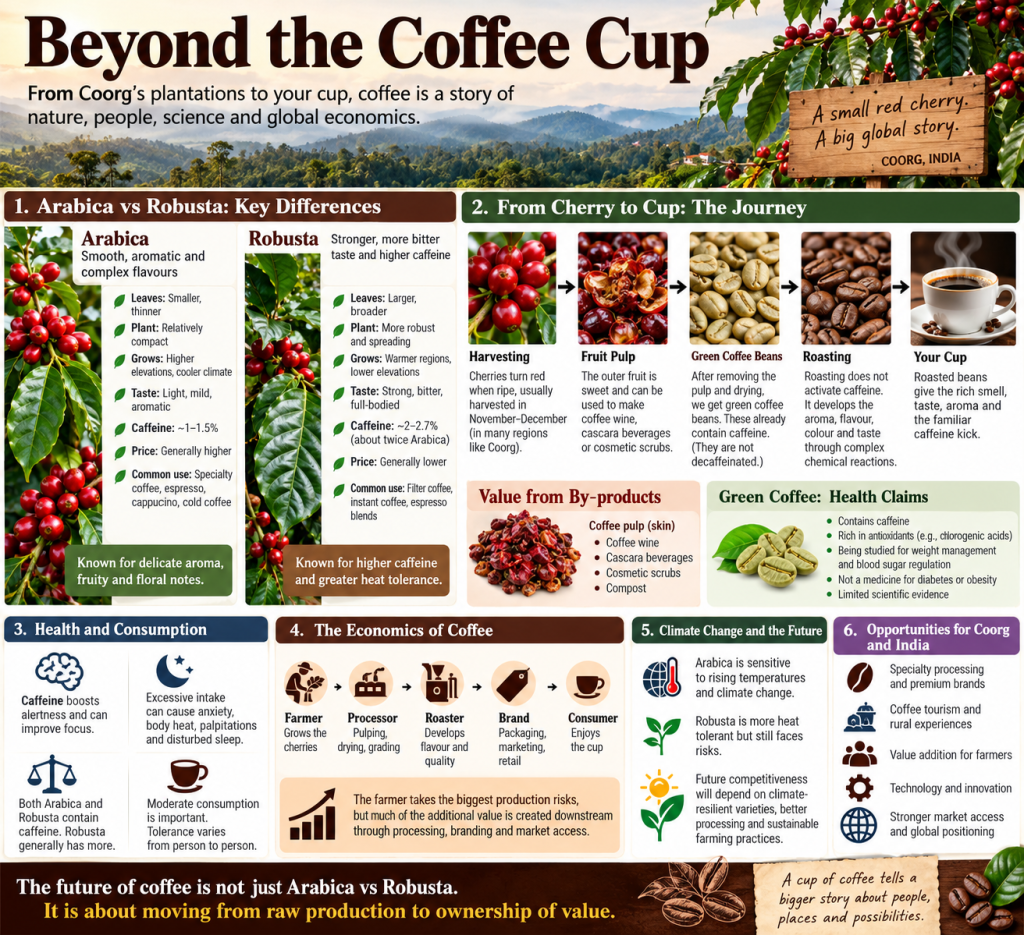
From the coffee plantations of Coorg to the global beverage industry, the story of coffee is not merely about taste and caffeine. It is about biodiversity, climate change, agricultural livelihoods, processing technology, branding and the unequal distribution of value between farmers and global corporations.
From a Red Cherry to a Global Industry
A visit to a coffee plantation in Coorg, Karnataka, reveals an interesting contradiction. What begins as a small red fruit growing on a tropical plant eventually becomes one of the world’s most widely consumed beverages. Yet the journey from coffee cherry to coffee cup involves much more than harvesting, drying and roasting. It represents a sophisticated agricultural and industrial value chain in which the greatest economic rewards do not necessarily go to those who cultivate the crop.
Coffee has travelled a remarkable historical distance. Its early cultivation and consumption developed around Ethiopia and Yemen before spreading through the Middle East, Europe and eventually the colonial plantations of Asia and Latin America. What was once a regional agricultural product gradually became an international commodity, a symbol of urban lifestyles and a powerful global business.
India entered this history through the Western Ghats, where coffee cultivation became established over several centuries. Karnataka subsequently emerged as the country’s principal coffee-producing state, with Coorg, Chikkamagaluru and Hassan becoming important centres.
Today, however, the future of coffee is being reshaped by climate change, changing consumer preferences, biotechnology, premiumisation and the growing influence of international brands.
Arabica and Robusta: Two Plants, Two Economic Models

Arabica coffee
Known for aromatic complexity and generally lower caffeine content.

Robusta coffee
Known for stronger bitterness, higher caffeine and greater heat tolerance.
The distinction between Arabica and Robusta is often explained simply as mild coffee versus strong coffee. But this difference is much more significant.
Arabica generally grows best in relatively cooler conditions, often at higher elevations. Its beans are valued for their aromatic complexity, acidity and diverse flavour characteristics. Depending on the variety, growing conditions and processing methods, Arabica can produce floral, fruity, chocolate-like or nutty flavours.
Robusta, scientifically known as Coffea canephora, generally tolerates warmer conditions and lower elevations. It contains substantially more caffeine and often produces a stronger, more bitter beverage with a heavier body.
The caffeine concentration in green Arabica beans commonly ranges around 1–1.5%, compared with approximately 2–2.7% in Robusta, although actual concentrations vary.
Neither coffee is naturally caffeine-free.
Interestingly, caffeine is not simply a substance that stimulates human beings. It is also part of the plant’s natural chemical defence system.
The economic distinction is equally important. Arabica has traditionally commanded a premium in many international markets, while Robusta has been associated with instant coffee, mass consumption and cost-efficient blending.
However, this hierarchy is beginning to change. Improvements in Robusta cultivation, processing and roasting are creating opportunities for high-quality specialty Robusta. At the same time, rising temperatures are increasing pressure on Arabica-growing regions.
The coffee industry may therefore be entering a period in which climatic adaptability becomes as important as traditional flavour preferences.
The Red Cherry: Where Coffee Processing Begins


Coffee is not originally a brown bean. It begins as a fruit, commonly called a coffee cherry.
As the cherry ripens, it generally changes from green to red or yellow, depending on the variety. In many coffee-growing areas of Karnataka, harvesting takes place during the cooler months, although the precise season differs by region and species.
Selective harvesting of ripe cherries is important because fruit maturity influences sweetness, fermentation and final cup quality.
Once harvested, the fruit passes through several possible processing routes. In washed processing, the skin and pulp are removed, followed by fermentation or mechanical mucilage removal, washing and drying. Natural processing dries the whole cherry, while honey processing retains varying amounts of mucilage.
The dried coffee is subsequently hulled and graded to produce green coffee beans.
The discarded fruit material also offers opportunities for economic diversification. Coffee pulp and husk can potentially be converted into compost, carefully processed beverages, bio-based materials and other products, subject to appropriate food-safety and environmental standards.
For coffee-growing regions, this raises an important question: Why should plantation economies depend almost entirely on the sale of beans when additional value may be created from agricultural by-products?
Roasting: Where Chemistry Creates Commercial Value
The transformation from green coffee to roasted coffee is among the most fascinating stages of food processing.
Green coffee beans already contain caffeine. Roasting does not activate it. Instead, heating triggers complex chemical changes, including Maillard reactions and caramelisation-related processes, which contribute to the development of colour, aroma and flavour.
Roasting can create hundreds of volatile aromatic compounds. Different temperature profiles and roasting durations influence acidity, bitterness, body and sensory complexity.
Light roasting often preserves more of the bean’s original flavour characteristics, while darker roasting develops stronger roasted notes and greater bitterness.
This process illustrates a wider principle of industrial economics: the value of an agricultural product increasingly depends on the knowledge and technology applied after harvesting.
The farmer produces the biological raw material, but the roaster controls a significant part of its final sensory identity.
The brand then converts that sensory identity into consumer perception, packaging, retail positioning and pricing power.
Consequently, two cups of coffee made from beans grown in the same region may sell at dramatically different prices.
The difference is not necessarily agricultural productivity. It may be processing expertise, quality consistency, market access and brand ownership.
The Health Question: Beyond the Myth of Strong and Mild Coffee
Coffee is frequently marketed through claims about energy, alertness, metabolism and weight management.
Caffeine can temporarily improve alertness and reduce the perception of fatigue. However, its effects depend on dose, individual sensitivity, timing and habitual consumption.
Robusta generally contains more caffeine than Arabica, but neither variety is inherently healthier.
Arabica can also disturb sleep, increase anxiety or cause palpitations in sensitive individuals. Excessive caffeine consumption from either variety can produce undesirable effects.
Green coffee extracts have attracted interest because of compounds such as chlorogenic acids. Nevertheless, evidence supporting their use for weight loss or diabetes management remains insufficient to treat them as established medical therapies.
The more meaningful distinction is between moderate, individually appropriate consumption and excessive intake.
The future of coffee consumption may therefore involve greater attention to caffeine transparency, personalised nutrition, decaffeinated options and evidence-based health claims.
The Invisible Economics of a Cup of Coffee
The global coffee economy exposes a familiar structural problem in agricultural trade.
Farmers undertake the risks associated with land, labour, rainfall, pests, disease and fluctuating harvests. Yet substantial downstream value is created through grading, roasting, blending, packaging, marketing, distribution and retail services.
A premium cup sold in an international café incorporates many costs and services, so its retail price cannot be compared directly with the farm-gate price. Nevertheless, the distribution of income and bargaining power across the value chain remains an important development question.
Coffee-producing regions frequently participate in global markets without controlling the consumer-facing brands.
This is not unique to coffee. Similar patterns can be observed in cocoa, tea, spices, natural ingredients and many traditional agricultural products.
The central economic challenge is therefore not simply increasing production. It is strengthening the ability of producing regions to retain more value through processing, quality assurance, product development and direct market relationships.
For Coorg, this could mean moving beyond its identity as a coffee-growing region toward becoming a recognised centre for specialty processing, roasting, coffee education, tourism and premium regional branding.
Climate Change Could Rewrite the Arabica–Robusta Relationship
Climate change may become the most disruptive force in coffee production over the coming decades.
Arabica is particularly sensitive to temperature stress and changes in rainfall patterns. Rising temperatures can alter flowering, fruit development, pest pressures and the suitability of established growing regions.
Robusta generally tolerates higher temperatures, but it is not immune to extreme heat, drought, irregular rainfall or disease.
The traditional assumption that Arabica is premium and Robusta is ordinary may therefore become increasingly inadequate.
Future competitiveness will depend on climate-resilient varieties, shade management, soil conservation, water efficiency, disease monitoring and improved post-harvest processing.
Scientific research may also increase interest in less-commercialised coffee species and new hybrids.
For India, this creates an opportunity to connect plantation agriculture with agricultural universities, biotechnology institutions, climate research and specialised food-processing enterprises.
However, such a transition cannot be achieved through plantation-level investments alone. Small growers need accessible extension services, collective infrastructure, affordable finance and reliable market information.
Coffee Tourism: From Plantation Visits to Rural Economic Transformation
Coorg already demonstrates the potential of linking agriculture with tourism.
A plantation visit can introduce tourists to Arabica and Robusta plants, cherry harvesting, pulping, drying, roasting and tasting. But the economic possibilities extend much further.
Coffee tourism can support local guides, homestays, cafés, transport providers, traditional food businesses, handicraft producers and small-scale roasters.
With better organisation, these activities can create an integrated rural experience economy.
However, tourism should not become merely a commercial attraction detached from the plantation economy.
A more productive model would connect visitor experiences with local product sales, farmer-owned brands, processing demonstrations, coffee education and digital marketing.
The objective should be to ensure that tourism generates measurable additional income for growers and surrounding communities.
India’s Next Coffee Opportunity: From Commodity Exports to Knowledge-Based Products
India possesses several competitive advantages: established plantation regions, a diversity of growing environments, a domestic coffee culture, access to skilled professionals and a growing premium beverage market.
Yet building a globally competitive coffee industry requires more than expanding cafés or promoting regional names.
India needs stronger systems for traceability, consistent quality, sensory evaluation, roasting expertise, geographical branding, export compliance and direct buyer relationships.
Small growers could benefit from shared processing and roasting facilities, common testing laboratories, collective marketing platforms and digital traceability systems.
Cluster-based institutions could play a particularly important role in reducing the costs of technology adoption and international market entry.
The critical measure of success should not be the number of coffee-related schemes or promotional events. It should be the increase in grower income, domestic value addition, market diversification and resilience to climate shocks.
Looking Towards 2035: Who Will Own the Future Coffee Economy?
By 2035, the international coffee industry could be shaped by five interacting forces: climate resilience, scientific innovation, advanced processing, consumer health preferences and digital control over market access.
Coffee brands may increasingly compete on traceable origins, verified sustainability, precise roasting profiles and differentiated consumer experiences.
Artificial intelligence and sensor technologies could improve crop monitoring, quality sorting, roasting consistency and supply-chain forecasting.
But technology alone will not determine who benefits.
If growers remain dependent on commodity traders while downstream enterprises control quality data, product design, customer relationships and branding, the traditional imbalance in value capture may persist.
Conversely, farmer enterprises and regional clusters that acquire processing capabilities, market intelligence and direct commercial relationships could capture a larger share of the value generated from their produce.
The future of coffee is therefore not simply a competition between Arabica and Robusta.
It is a competition between two development models: one in which producing regions remain suppliers of agricultural raw materials, and another in which they become centres of innovation, processing, branding and knowledge-intensive enterprise.
The larger lesson from Coorg is that the real economic value of coffee does not end with the red cherry or even the roasted bean. It grows through knowledge, technology, institutions and market power. The challenge for India is to ensure that more of this value remains with the people and regions where the coffee journey begins.
Coffee Economy, Coorg, Arabica, Robusta, Coffee Processing, Climate Change, Agricultural Value Chains, Rural Tourism, MSMEs, Cluster Development, Value Addition, Indian Exports.


Leave a Reply