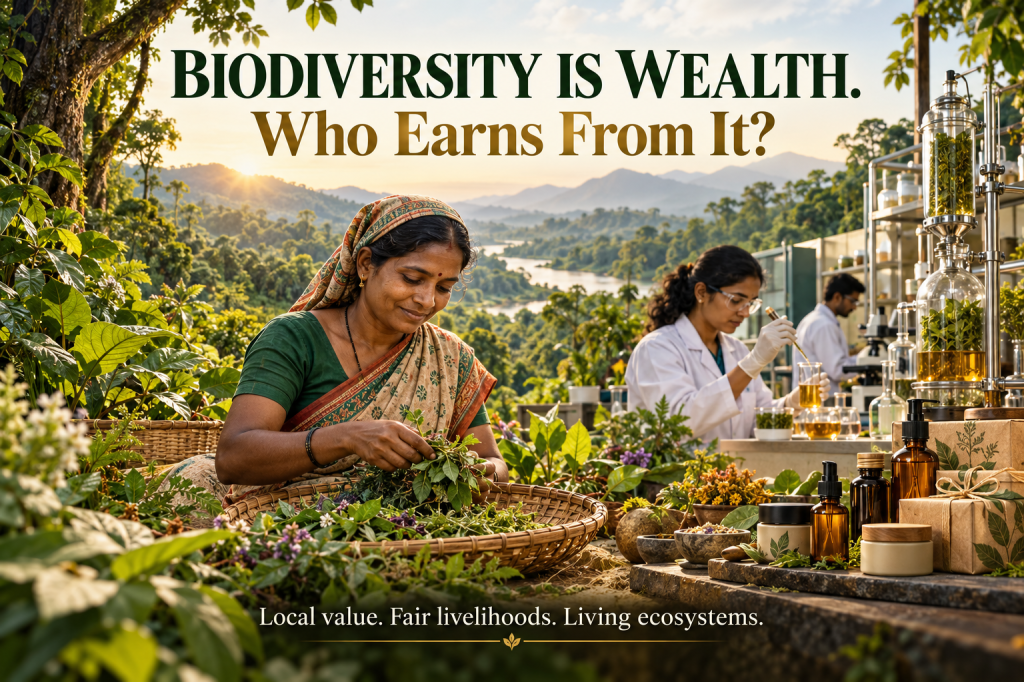
The forest and the balance sheet. A country may possess extraordinary biological wealth and still occupy the least rewarding position in global trade. Its farmers grow the plants, its communities preserve knowledge, and its collectors gather the materials. Yet the larger commercial rewards may emerge elsewhere—in laboratories, formulations, brands and distribution networks. Nature provides the starting point. The organisation of production and markets determines who earns from it.
UN Trade and Development’s October 2026 Global Trade Update brings this imbalance into focus. Global biodiversity-based exports reached nearly US$3.8 trillion in 2024, with developing countries accounting for around 35%. The report connects greater value capture to productive capacity, standards, finance and market access. These figures describe a broad trade category; they should not be read as evidence that all such exports are sustainable.
The development question is therefore more demanding than how to export more natural products. It is how to retain more income while protecting the living systems that make those products possible.
An old trade structure in green packaging. Historically, commodity trade separated the places supplying resources from the places controlling processing and commercial relationships. The biodiversity economy risks reproducing that structure with more attractive language. A product can carry images of forests, traditional knowledge and rural livelihoods while leaving its original producers with little bargaining power.
Consider the commercial distance between a dried botanical ingredient and a finished personal-care product. That distance includes testing, extraction, formulation, safety assessment, packaging, marketing and access to customers. Each activity requires capability, absorbs risk and can command payment. A producer who supplies only the initial material participates in only a small part of that commercial system.
This does not mean every village enterprise should launch an international brand. Branding can consume scarce capital without creating dependable demand. For some clusters, the stronger route may be supplying consistent, tested ingredients under long-term contracts. For others, specialised processing or formulation may offer a realistic next step. Upgrading should begin with a credible buyer requirement and a viable business model.
India needs to organise capability around its resources. For Indian natural-product, food, AYUSH and forest-based clusters, the practical challenge is to connect scattered producers with reliable technical and commercial services.
A small enterprise may know its raw material well but struggle to demonstrate batch consistency, identify contamination or provide records acceptable to a buyer. Purchasing sophisticated equipment independently may be uneconomic. Shared testing, processing and documentation services can make these capabilities accessible—provided they are professionally operated.
A common facility should therefore begin with the service it must deliver. Which tests do prospective buyers require? What processing volumes are available through the year? Who will operate the machinery? How quickly must results be returned? What fees can enterprises afford? A building and an equipment list cannot answer these questions.
Different products also need different pathways. A food ingredient, an aromatic extract and an AYUSH preparation cannot share an identical market-entry strategy. Product identity, intended use and destination requirements should shape the cluster’s investment decisions.
Traceability must reach the producer’s income. Traceability can make origin and handling visible, but visibility alone does not ensure fairness. A system may record every transaction while leaving the collector exposed to low prices, delayed payment and unpredictable purchasing.
A stronger cluster strategy would connect sourcing records with transparent quality grading, prompt payments and clear purchasing commitments. Where community knowledge contributes to commercial value, arrangements for recognising that contribution should be addressed from the beginning.
Otherwise, there is a risk of building a sophisticated information system around an unchanged distribution of power. Producers supply the material and the data; others retain control over customers and margins.
Processing can add value—and increase pressure. The uncomfortable possibility is that successful market development can damage the resource on which it depends. Higher prices may encourage excessive harvesting. New processing capacity may create demand beyond what local ecosystems can regenerate. Cultivation may reduce pressure on wild stocks in some circumstances while introducing land, water or chemical-use pressures in others.
For this reason, additional processing should never be treated as automatic proof of environmental progress. Sustainable sourcing needs product-specific evidence: how much can be harvested, from where, in which season, and under what regeneration conditions?
Circular products require the same discipline. Agricultural residues may offer useful feedstock, but some already serve as fodder, fuel or soil cover. Calling a material waste does not establish that its removal has no cost. Commercial feasibility must include its existing local functions.
Measure what stays behind. Export promotion should ask what remains in the producing region after a shipment leaves. Did producer earnings improve? Did local firms acquire a new processing capability? Were rejection rates reduced? Did enterprises secure repeat orders? Was the resource base maintained?
Export value alone cannot answer these questions. A rise in sales may coexist with depleted resources, imported processing inputs or profits concentrated outside the cluster. Conversely, a modest increase in exports could represent meaningful progress if local enterprises retain more income and producers gain more dependable demand.
Public support should therefore reward verified improvements in local value addition, enterprise performance and resource stewardship. The evidence described in the report helps identify opportunities and constraints; it does not establish that a particular investment will automatically deliver inclusive or sustainable growth.
The next advantage must be built. Biodiversity gives developing countries a foundation for diversification. Turning that foundation into durable prosperity requires scientific capability, functioning institutions and stronger commercial relationships.
For India, the ambition should be to build clusters that can supply products with consistent quality, credible sourcing and dependable delivery—and negotiate a better share of the resulting value.
The real test of the biodiversity economy is whether commercial success makes conserving nature and sustaining local livelihoods economically worthwhile. If exports grow while ecosystems weaken and producers remain poorly paid, the trade figures will record expansion while concealing the loss of wealth.


Leave a Reply