The present crisis, the next economic shock, and the possibility of a fundamentally different Middle East by 2035
A Region Rich in Wealth but Poor in Economic Security
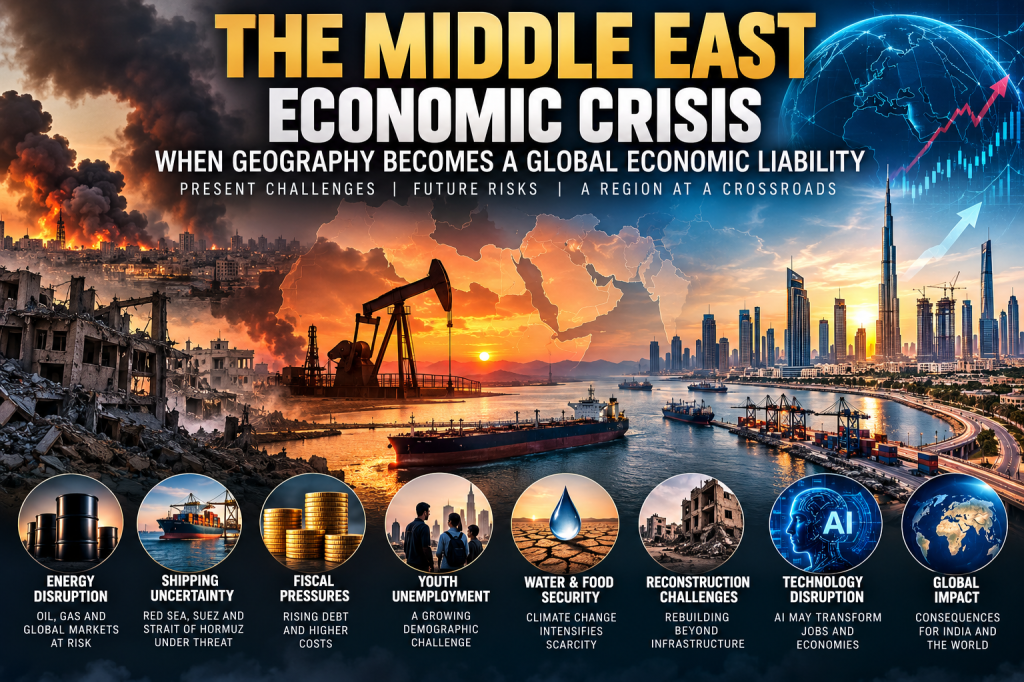
The Middle East is entering one of the most consequential economic periods in its modern history. A region that has supplied the world with energy, accumulated enormous financial wealth and occupied the crossroads of international commerce is increasingly exposed to a dangerous combination of geopolitical conflict, fiscal pressures, demographic imbalances, water scarcity and technological disruption.
The greatest economic contradiction of the Middle East is that some of its countries possess extraordinary financial resources while others struggle to provide electricity, employment, housing and basic public services. The same geography accommodates sovereign wealth funds managing vast assets and populations dependent on humanitarian assistance.
For decades, the region’s economic importance was largely defined by its oil reserves and strategic location. Today, these traditional advantages are becoming sources of vulnerability. Energy infrastructure can become a military target. Shipping routes can become geopolitical bargaining instruments. International investors can withdraw confidence faster than governments can restore stability.
The emerging crisis is therefore not simply another oil-price shock or a temporary consequence of war. It is a deeper structural problem involving the relationship between political power, economic diversification, population growth and the changing geography of global production.
The central question is no longer whether the Middle East will experience further economic crises. It is whether the region can develop institutions and economic systems capable of preventing geopolitical disturbances from becoming prolonged economic disasters.
From Oil Wealth to Economic Fragility: The Historical Contradiction
The modern economic history of the Middle East was shaped by three developments: the discovery of petroleum, the creation of new political boundaries and the strategic involvement of external powers.
During the twentieth century, oil transformed Saudi Arabia, Kuwait, Qatar, the United Arab Emirates and other Gulf economies into important centres of global capital. Petroleum revenues financed infrastructure, education, healthcare and extensive public-sector employment.
However, the same model created a dependence on government spending and hydrocarbon income. In several countries, public employment became a mechanism for distributing national wealth rather than a reflection of productive economic demand.
Meanwhile, countries such as Egypt, Jordan, Lebanon, Syria, Iraq and Yemen followed different economic trajectories. Their challenges included limited fiscal resources, rapid population growth, political instability, external debt and weak industrial competitiveness.
The oil crises of 1973 and 1979 demonstrated the region’s capacity to influence global economic conditions. The Gulf War of 1990–91 showed how military conflict could disrupt energy markets. The Arab uprisings beginning in 2010–11 exposed the social consequences of unemployment, inequality and weak political institutions.
More recently, repeated conflicts, pandemic-related disruptions and changing energy markets have revealed that neither natural-resource wealth nor strategic location automatically guarantees economic resilience.
The historical lesson is uncomfortable: the Middle East has repeatedly converted natural-resource wealth into infrastructure and consumption, but much less consistently into diversified productive institutions.
The Present Crisis: Several Economic Emergencies Within One Region
The Middle East should not be treated as a single economy. Its current difficulties are deeply unequal.
The Gulf economies generally retain stronger financial buffers, substantial investment capacity and better access to international capital. Nevertheless, their fiscal positions and growth prospects remain exposed to oil prices, production policies, regional security and the costs of ambitious diversification programmes.
Saudi Arabia faces the challenge of balancing major economic transformation projects with public expenditure, fiscal sustainability and private-sector employment creation. The UAE is building its position in finance, logistics, tourism, technology and advanced services, but remains sensitive to international trade flows and regional confidence. Qatar continues to benefit from its natural gas position while confronting the long-term uncertainty of energy transition.
Iran faces a different combination of pressures, including sanctions, inflation, currency weakness, investment constraints and geopolitical risk. Iraq remains highly dependent on petroleum revenues while facing electricity shortages, governance difficulties and limited employment opportunities outside the public sector.
Lebanon illustrates the consequences of financial-system collapse, institutional paralysis and lost confidence in banking. Syria and Yemen face far more severe problems associated with conflict damage, displacement, weakened state capacity and disrupted production.
Egypt confronts persistent pressures involving debt servicing, foreign exchange, import dependence and the need to generate productive employment. Jordan faces related constraints, compounded by resource scarcity and regional instability.
The Palestinian economy, particularly Gaza, faces extraordinary destruction of productive assets, infrastructure, housing and economic institutions. Reconstruction cannot be understood merely as a financial exercise; it depends fundamentally on security, access, governance and the restoration of economic life.
These differences matter. A decline in oil prices may weaken the fiscal position of an exporting state while benefiting an importing economy. A rise in oil prices can produce the opposite outcome, although conflict-related disruptions may overwhelm that advantage.
The Middle East does not face one economic crisis. It faces several interconnected crises operating at different speeds.
The Energy Paradox: Oil Can Finance Stability and Create Instability
Energy remains the most immediate channel through which Middle Eastern instability can affect the global economy.
The Strait of Hormuz is one of the world’s most important energy corridors. Disruption to shipping, insurance, port operations or energy infrastructure can influence oil and gas prices far beyond the region.
Yet the relationship between conflict and petroleum prices is not straightforward. A conflict-related supply interruption can increase export earnings for producers able to maintain shipments. At the same time, it can raise transport costs, reduce investor confidence and damage domestic infrastructure.
For oil-importing Middle Eastern economies, higher energy prices can worsen inflation, fiscal deficits and external financing needs.
The longer-term danger is different. The global energy system is gradually diversifying through renewable power, electrification, efficiency improvements and alternative energy technologies. Hydrocarbons will remain economically significant, but future demand and prices will be shaped by increasingly complex technological and policy forces.
Oil-producing countries therefore face a difficult transition. They must use hydrocarbon revenues to finance economic diversification while preparing for a future in which those revenues may become less dependable.
If diversification investments fail to generate internationally competitive enterprises, the region could eventually possess impressive infrastructure without an equally impressive productive economy.
The Shipping Crisis: When Strategic Location Becomes a Cost
The Red Sea, Suez Canal, Bab el-Mandeb and Strait of Hormuz connect the Middle East to the world’s most important trade networks.
Historically, this geography generated substantial commercial advantages. Ports, shipping services, logistics centres and transit revenues benefited from the movement of goods between Asia, Europe and Africa.
But the same concentration creates systemic vulnerability.
When security risks rise, shipping companies may reroute vessels, increase insurance coverage, introduce surcharges or delay cargo movements. Longer routes increase fuel consumption, tie up vessels and complicate inventory management.
Egypt is especially exposed because Suez Canal receipts provide foreign exchange and support the country’s external accounts.
The consequences also extend to international manufacturers. European importers, Asian exporters and developing-country enterprises may face higher logistics costs even when they have no direct commercial relationship with the conflict zone.
The future risk is that businesses begin permanently redesigning supply chains to reduce dependence on politically vulnerable routes.
If that happens, some Middle Eastern logistics hubs could lose not only temporary shipping revenue but also part of their long-term strategic advantage.
Geography creates economic opportunity only when accompanied by dependable security and institutional trust.
The 2026 Shock: For the First Time, Oil Wealth Is Not Enough
The economic consequences of the conflict that began in February 2026 have exposed an especially important weakness in the Middle Eastern economic model.
According to the World Bank’s October 6, 2026 assessment, the broader Middle East, North Africa, Afghanistan and Pakistan region is projected to contract by 2.1% in 2026, compared with growth of 3.3% in 2025. Gulf Cooperation Council economies are projected to contract by 4.3%, largely because disruption around the Strait of Hormuz has reduced hydrocarbon export volumes. These are forecasts, not final recorded outcomes.
World Bank October 2026 projections — percentage change in real GDP
This is an important departure from earlier oil crises. Historically, rising energy prices often benefited Gulf exporters. In 2026, higher prices have not fully compensated for the loss of export volumes and damage to production and transport infrastructure.
The IMF reported on October 1 that rerouting supplies and emergency measures helped prevent an even larger global shock. Nevertheless, it warned that damaged facilities, weaker non-oil activity and reduced investor confidence could delay recovery.
The economic lesson is profound. A country may possess valuable natural resources and still be unable to convert them into income when the routes connecting production to international markets become insecure.
The Coming Fiscal Crisis: When Governments Can No Longer Buy Stability
The next economic challenge may emerge from public finances.
Across the Middle East, governments are expected to perform several expensive functions simultaneously: maintain security, subsidise essential services, finance infrastructure, create employment, attract investment and protect households from inflation.
These responsibilities become increasingly difficult when revenue growth slows or borrowing costs rise.
The IMF’s October 2026 warnings about rising global debt and financing costs suggest that heavily indebted countries have limited room to respond to another major shock.
In oil-exporting countries, the danger is that large public investment commitments become difficult to sustain during prolonged revenue interruptions. In oil-importing countries, higher food and fuel bills can widen fiscal deficits and increase pressure on exchange rates.
Austerity can reduce deficits but may also weaken consumption, employment and social stability. Continued subsidies can protect households temporarily but worsen debt sustainability.
This creates a political-economic trap: governments need economic reform to restore stability, but poorly designed reform can itself produce instability.
The region will increasingly need to replace indiscriminate subsidies and state-dependent employment with targeted social protection, competitive enterprises and productive taxation.
The Youth Employment Crisis: A Demographic Opportunity Becoming a Liability
One of the least visible economic dangers is the mismatch between the aspirations of young people and the capacity of national economies to create productive jobs.
Large public-sector establishments, construction projects and consumption-driven services cannot indefinitely absorb growing numbers of educated workers.
Several countries have expanded higher education faster than their private sectors have developed demand for specialised skills.
The result is a contradiction: economies may experience unemployment among graduates while simultaneously depending on imported technical expertise and migrant labour.
Artificial intelligence could deepen this mismatch. Routine administrative and service jobs may face automation pressures even as demand increases for engineering, digital infrastructure, healthcare and advanced technical capabilities.
The World Bank’s October 2026 analysis suggests AI could improve productivity in a significant share of regional employment, but the benefits will depend on electricity, connectivity, skills and institutional capacity.
By 2035, the economic divide may no longer be simply between oil-rich and oil-poor countries. It could increasingly separate countries capable of developing productive human capital from those unable to create employment beyond government expenditure and low-productivity services.
The Water, Food and Climate Crisis: The Region’s Long-Term Economic Emergency
Water scarcity may ultimately prove more economically destructive than a temporary interruption in oil production.
Much of the Middle East already experiences severe freshwater constraints, high temperatures and dependence on food imports.
Population growth, urban expansion and climate change could increase demand for water and electricity precisely when supplies become more expensive to secure.
Desalination provides an important technological response, especially in the Gulf, but it requires energy, capital, reliable infrastructure and continuing maintenance.
Agriculture faces particularly difficult trade-offs. Expanding domestic food production may improve food security but increase pressure on scarce water resources. Greater reliance on imports can conserve water but expose consumers to international prices and transport disruptions.
Future food security will therefore depend less on achieving complete agricultural self-sufficiency and more on building resilient combinations of domestic production, diversified imports, strategic storage and efficient distribution.
Water infrastructure, agricultural technology and energy systems must increasingly be treated as components of national economic security.
The Reconstruction Trap: Rebuilding Without Creating an Economy
The Middle East may face one of the world’s most difficult reconstruction challenges over the next decade.
Physical destruction in conflict-affected economies creates enormous requirements for housing, electricity, roads, hospitals, schools and industrial facilities.
However, rebuilding physical assets does not automatically restore economic activity.
A reconstructed industrial estate cannot function without reliable power, working capital, transport access, customers and enforceable contracts. A rebuilt residential area cannot become economically sustainable without employment and functioning public services.
Reconstruction finance may also become a source of political competition. External donors, regional investors and national authorities may disagree over governance, ownership, procurement and priorities.
The central danger is that reconstruction becomes a cycle of externally financed construction rather than a process of rebuilding domestic productive capacity.
Future reconstruction programmes should measure success not simply through money spent or buildings completed, but through enterprises restored, employment generated, household incomes recovered and local supply chains reconnected.
Three Possible Economic Futures, 2027–2035
Scenario One: Stabilisation and Recovery
Conflict intensity declines, shipping routes progressively normalise and energy exports recover. Investment confidence improves, tourism rebounds and reconstruction accelerates. The World Bank’s conditional forecast of 7.8% regional growth excluding Iran in 2027 illustrates the potential for a substantial rebound, although much would reflect recovery from depressed production levels.
Scenario Two: Permanent Economic Uncertainty
Military tensions remain unresolved, but major escalation is avoided. Shipping costs stay elevated, private investment becomes more selective and governments maintain expensive security arrangements. Gulf economies recover unevenly while fragile states fall further behind. This may be the most damaging scenario for long-term productivity because uncertainty becomes a permanent cost of doing business.
Scenario Three: A Wider Regional Economic Breakdown
Renewed conflict damages major energy infrastructure, restricts shipping and weakens financial confidence. Inflation accelerates, fiscal reserves diminish and reconstruction requirements increase. Debt-distressed economies confront currency and social pressures. The consequences extend to Europe, Asia and Africa through energy prices, supply chains, migration and international capital flows.
These are analytical scenarios rather than predictions. Their outcomes depend on political decisions, security developments, economic reforms and the ability of governments to cooperate.
The Global Consequences: Why the Middle East Crisis Will Not Remain in the Middle East
The global economy cannot isolate itself from prolonged Middle Eastern instability.
India, China, Japan and South Korea remain exposed to regional energy and trade disruptions. European economies depend on stable shipping connections and energy markets. African countries can face higher food, fuel and fertiliser costs, while migrant workers and remittance-dependent households may experience employment and income uncertainty.
For India, the consequences are particularly important. Energy import costs, inflation, the current account, Gulf employment opportunities, remittances and trade logistics can all be affected.
Indian exporters in textiles, engineering goods, pharmaceuticals, food processing and consumer products may face increased freight costs, delayed payments and changing demand across Gulf markets.
Yet disruption can also create opportunities for competitive suppliers of reconstruction materials, machinery, healthcare products, water technologies, renewable-energy equipment and digital services.
The strategic requirement is to distinguish temporary crisis demand from durable economic opportunities.
Beyond Oil: The Middle East Must Build an Economy That Can Survive Conflict
The region’s future cannot depend solely on larger sovereign wealth funds, more spectacular infrastructure or the construction of new global cities.
It requires a different development philosophy.
Economic diversification must move beyond investment announcements toward measurable improvements in productivity, exports, technological capabilities and private-sector employment.
Regional industrial cooperation should become more important than competing national prestige projects. Shared electricity networks, water technologies, logistics corridors, food-storage systems, industrial standards and research institutions could create economic interdependence that makes prolonged conflict increasingly costly.
Smaller enterprises must become central to this transformation. A sustainable regional economy cannot be built entirely around state enterprises, multinational corporations and mega-projects.
The region needs competitive manufacturing clusters, supplier development, vocational skills, technology transfer, access to finance and stronger links between universities and enterprises.
Most importantly, economic policy must become less dependent on geopolitical optimism. Governments should design investment systems, public finances and essential infrastructure that remain functional under repeated external shocks.
The Final Contradiction: The Middle East Can Finance the Future but May Struggle to Secure It
The Middle East has the capital, geographical position, energy resources and entrepreneurial potential to become one of the world’s most influential economic regions.
Yet it also faces an unusual concentration of risks: military conflict, resource dependence, water scarcity, youth unemployment, fiscal stress, fragile institutions and growing technological inequality.
The present crisis demonstrates that natural wealth cannot substitute for economic security. Future crises may demonstrate that financial reserves cannot substitute for productive capacity.
By 2035, the region could emerge as a diversified centre of energy, logistics, finance, advanced manufacturing and digital technology. Alternatively, it could become increasingly divided between highly capitalised but security-exposed economies and countries trapped in reconstruction, debt and institutional weakness.
The decisive variable will not be the quantity of oil beneath the ground or the scale of investment announced by governments. It will be the capacity to create institutions, enterprises and regional relationships that continue generating prosperity even when the political environment deteriorates.
The twentieth century made the Middle East strategically important because of what lay beneath its soil. The twenty-first century will judge its economic success by what it can build above that soil—and whether those achievements can survive the next crisis.
Economic perspective as of 14 October 2026. Current forecasts are distinguished from longer-term scenarios. Principal references: World Bank October 2026 MENAAP Economic Update and IMF October 2026 GCC assessment.
Sources: World Bank, 6 October 2026 · IMF, 1 October 2026


Leave a Reply