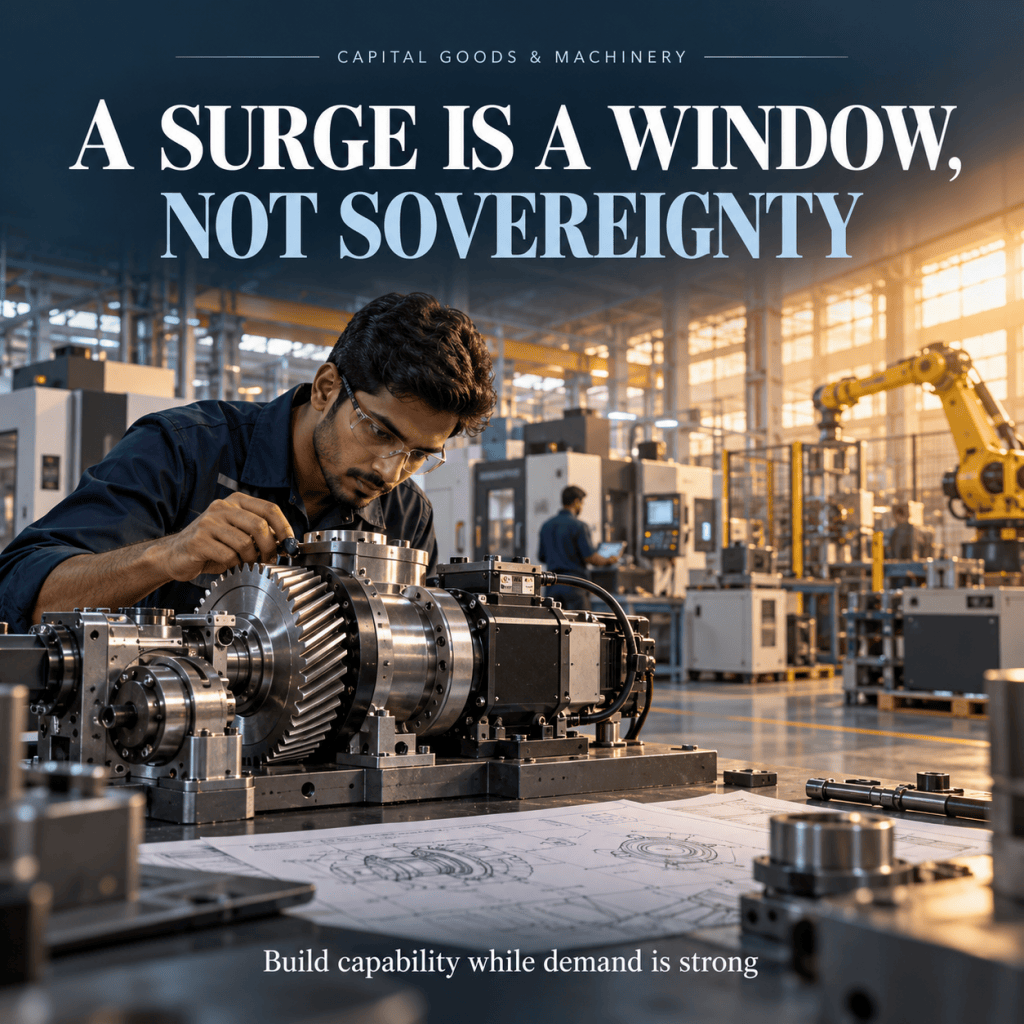
A busy factory can create a dangerous sense of security. Machines are running, order books are filling and expansion suddenly looks sensible. Yet a country can produce more equipment without gaining much control over the technology inside it. India’s capital-goods opportunity lies in what manufacturers do with the present demand: whether they simply enlarge capacity or acquire capabilities that survive the next slowdown.
When the machine cycle turns. Capital goods occupy a special place in industrial history. They shape what other industries can produce, how accurately they can produce it and at what cost. A better machine can improve thousands of products over its working life. Weakness in machinery therefore spreads far beyond the machinery industry.
India recognised this after independence through investment in heavy engineering, technical education and public research. Liberalisation later widened access to advanced equipment and international production networks. But access to technology and the ability to develop it are different achievements. Buying a sophisticated machine does not automatically teach a company how to redesign its most critical parts.
The August 2026 figures provide encouraging evidence of industrial momentum. Capital-goods production increased 16.9% over a year earlier, while overall industrial production rose 8% and manufacturing 9%. Electrical equipment expanded 30.9%, motor vehicles 25.2% and other transport equipment 25.3%. These industry groups and the capital-goods category are different statistical classifications; their growth rates should not be added together. The broader picture also matters: capital-goods output grew 16.3% during April–August. August’s quick estimates had an 88% weighted response rate and remain subject to revision.
There is therefore more substance here than a single strong month. Nevertheless, production growth cannot establish technological independence. The index measures output; it does not reveal who owns the design, supplies the critical controller or has the right to modify the software.
More output can conceal imported intelligence. Consider a machine fabricated and assembled locally but dependent on imported sensors, precision bearings, servo motors and control systems. Its production supports Indian employment and business income. Those gains are real. Yet its manufacturer may still need an overseas supplier to resolve a technical failure, approve a modification or replace a discontinued component.
The strategic weakness may sit in a small part of the machine rather than its largest or most expensive structure. A low-cost component with no qualified substitute can stop an entire production line. Domestic value addition, measured only as a percentage of the selling price, can miss this vulnerability.
This makes selective technological depth essential. India does not need to manufacture every component within its borders. It needs to understand where dependence becomes difficult to manage, where alternative suppliers exist and where domestic design capability would materially improve resilience.
Imported technology can help build that capability when contracts, engineering partnerships and internal learning support adaptation. Dependence becomes more persistent when each new order repeats the same assembly process without expanding what the local firm can independently solve.
The boom can finance tomorrow—or mortgage it. Strong demand gives engineering MSMEs a rare combination of cash flow, customer access and confidence. It also creates pressure to deliver immediately. Development work is postponed because production is urgent. Engineers spend their time clearing orders rather than improving designs. Another machine is purchased because its output is easier to calculate than the return on testing or research.
Each decision may appear reasonable. Together, they can leave a cluster with more capacity but little differentiation.
When demand weakens, firms offering similar fabrication compete increasingly on price. Loan repayments continue while bargaining power declines. The business that looked strong during the expansion discovers that customers valued its available capacity more than its distinctive capability.
An upgrading strategy should therefore begin while orders are healthy. Firms should reserve resources for reducing defects, developing selected subsystems, documenting designs, training service engineers and qualifying alternative components. These investments may produce fewer visible headlines than a new factory shed, but they can determine whether the business remains competitive after the surge.
Qualification is the missing bridge. A local supplier may be able to manufacture a component and still be unable to sell it to a demanding equipment producer. Commercial acceptance requires evidence: consistent dimensions, material performance, reliability, traceability and predictable delivery.
Engineering clusters in Pune, Rajkot, Coimbatore, Chennai, Bengaluru, Ahmedabad and Hyderabad should build their strategies around this gap. Component-level opportunity maps should identify actual buyers, required specifications, testing costs and realistic qualification periods. A list of imported products, by itself, is insufficient.
Shared facilities can make precision measurement, materials testing, electromagnetic compatibility testing and reliability assessment affordable to smaller firms. However, the success of a common facility should be judged by suppliers qualified, rejection rates reduced and commercial orders secured. Purchasing laboratory equipment is only the beginning.
Anchor companies also have responsibilities. Supplier development becomes credible when buyers share technical requirements, support trial batches and provide timely feedback. Repeatedly asking MSMEs to invest without any development commitment transfers the cost of industrial learning to firms least able to absorb it.
Public support and development finance should help bridge this stage through verified technical milestones. Otherwise, suppliers face a circular problem: they need qualification to win an order, but need an order to finance qualification.
The next export is a working relationship. Machinery competitiveness continues long after dispatch. Installation, operator training, spare parts and response times influence whether a buyer places the next order.
Indian equipment exporters should build service capability into their market strategy from the start. Several smaller manufacturers could share overseas service partners, technician training and spare-parts arrangements. Such cooperation can make distant markets commercially manageable.
Connected equipment creates another opportunity. With customer agreement and appropriate security, operating data can help manufacturers diagnose failures, improve designs and reduce downtime. But this requires clear rights to access data and maintain software. A manufacturer dependent on an inaccessible control system may struggle to deliver the service it has promised.
The emerging competition will increasingly concern the lifetime performance of equipment. Energy consumption, maintenance costs, repairability and reliable operation can matter more to the buyer than a modest saving on the purchase price.
Sovereignty must mean the ability to respond. Industrial associations should look beyond production growth and track qualification success, critical imported dependencies, repeat export orders, payment delays, warranty claims and service income. These measures would show whether the expansion is creating stronger firms or simply busier ones.
Policy should also recognise that localisation has costs. Replacing a reliable imported component with an inferior domestic substitute can weaken every downstream manufacturer using that machine. Support should reward improvements in quality, competitiveness and supply resilience, with clear performance expectations.
The future Indian factory will gain strength from its ability to understand, modify, repair and improve the technologies it uses. It will need trusted international suppliers alongside deeper domestic engineering capability. Its resilience will depend on having workable alternatives when a supplier, technology or trade route becomes unavailable.
The present surge offers demand against which to test new capabilities and revenue with which to develop them. That opportunity will not remain equally favourable throughout the cycle.
The decisive question is what India will know how to do when the boom is over.
CapitalGoods #Manufacturing #MSMEs #ClusterDevelopment #Technology #ExportCompetitiveness


Leave a Reply