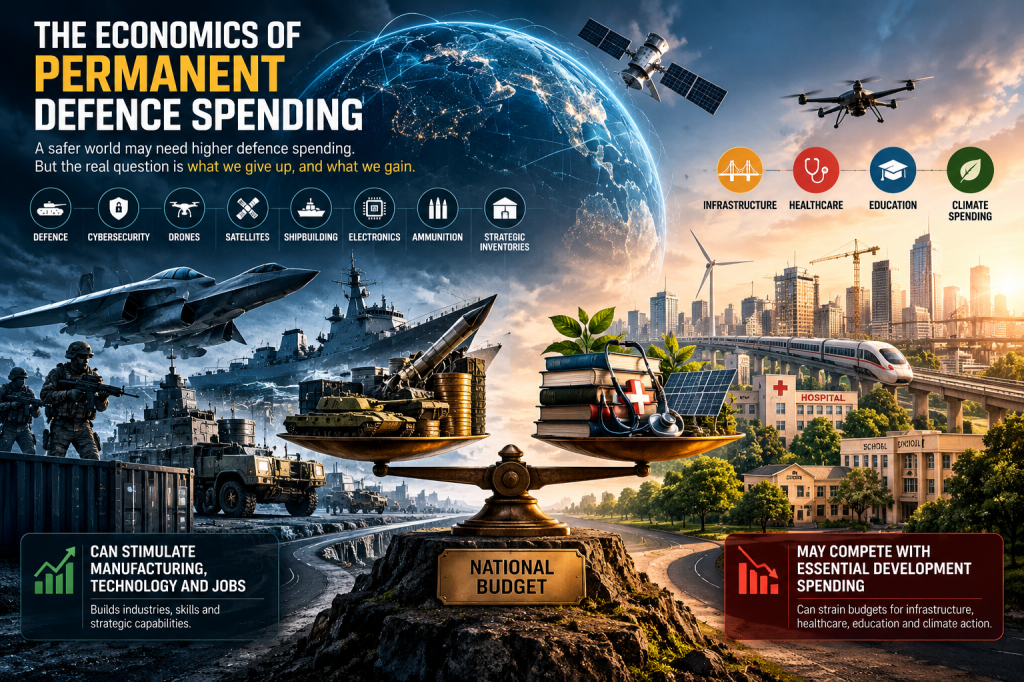
When Security Becomes a Permanent Economic Sector
From Peace Dividend to Security Dividend — For nearly three decades after the Cold War, much of the world behaved as though defence spending could gradually become less central to economic policy. Governments spoke about the peace dividend. Capital could move toward highways, hospitals, universities, telecommunications and social protection instead of tanks, ammunition and military infrastructure. Globalisation itself was expected to reduce the economic logic of conflict because countries connected through trade and investment supposedly had more to lose from confrontation. That assumption is weakening. The emerging world economy may have to live with something very different: permanently elevated security expenditure. Defence is no longer being treated simply as emergency spending during a war. It is becoming a structural component of industrial, technological and fiscal policy.
The Security Budget Is Becoming Much Bigger Than the Defence Budget — The conventional defence budget tells only part of the story. Modern security expenditure increasingly extends into cybersecurity, semiconductors, artificial intelligence, drones, satellites, communications, shipbuilding, electronics, surveillance systems, energy security, critical minerals, strategic inventories and resilient infrastructure. Even ports, power grids, undersea cables, cloud systems, data centres and telecommunications networks are acquiring strategic importance. The economic boundary between civilian infrastructure and national-security infrastructure is therefore becoming blurred. A country may officially increase its military budget by a certain amount while simultaneously spending billions more on cyber resilience, semiconductor capacity, strategic stockpiles and supply-chain security. The real security economy can consequently grow much faster than the published defence budget suggests.
History Is Returning, but Technology Has Changed the Battlefield — Earlier military-industrial cycles were dominated by steel, ships, aircraft, vehicles and ammunition. The emerging cycle will be considerably more technologically complex. A modern defence ecosystem requires software engineers, satellite networks, advanced sensors, precision electronics, secure communications, artificial intelligence, robotics, cybersecurity and sophisticated materials. This creates an unusual economic situation. Technologies developed for civilian markets increasingly acquire strategic applications, while defence technologies migrate into civilian industries. The factory producing an advanced sensor may supply automobiles today and drones tomorrow. The semiconductor used in industrial automation may also become strategically sensitive. Defence industrial policy and technology industrial policy are therefore beginning to merge.
Defence Spending Can Build Factories, but That Does Not Make It Free — There is a powerful economic argument in favour of higher defence expenditure. Large and predictable procurement programmes can create manufacturing scale, encourage research, develop engineering capabilities, generate skilled employment and strengthen domestic supply chains. Shipyards can support entire ecosystems of engineering enterprises. Aerospace programmes can deepen precision manufacturing. Electronics procurement can strengthen semiconductor and sensor industries. Defence demand can also provide smaller manufacturers with long production runs that justify investments in technology and quality systems. Countries capable of converting defence procurement into broader technological capability may therefore receive an industrial dividend from higher security expenditure.
But there is a dangerous temptation to treat every additional defence rupee or dollar as an investment simply because it creates production. Economic activity and economic productivity are not the same thing. A missile creates manufacturing output, employment and technological knowledge, but it does not transport commuters, educate children or increase agricultural productivity. A hospital, railway, power grid or university can generate economic returns for decades. Some defence assets primarily provide insurance against events society hopes will never occur. Security is indispensable, but its opportunity cost remains real.
The Coming Battle Will Also Be Inside Government Budgets — This may become one of the defining fiscal tensions of the 2030s. Governments already face enormous demands from ageing populations, healthcare, pensions, climate adaptation, energy transition, urban infrastructure and technological transformation. Permanent increases in security expenditure will arrive on top of these commitments rather than replacing them automatically. Something eventually has to adjust: taxes, borrowing, welfare expenditure, infrastructure investment or fiscal deficits. The geopolitical competition between countries may therefore quietly become a competition between domestic budget priorities.
The problem becomes more serious for developing economies. Wealthy countries may be able to sustain large defence, technology and social budgets simultaneously. Lower- and middle-income countries have far less fiscal space. Every major defence acquisition can compete directly with railways, schools, irrigation, public health or urban infrastructure. Security choices that appear strategically rational can therefore produce developmental consequences that emerge only years later.
The New Military-Industrial Economy Could Become Politically Permanent — Temporary expenditure has a tendency to create permanent constituencies. Once factories, research centres, suppliers, workers and regions become dependent on defence procurement, reducing expenditure becomes politically difficult. Companies invest on the assumption of future orders. Governments begin viewing defence manufacturing as employment policy. Regions compete for military plants. Technology companies discover that national-security contracts provide large and stable markets. The defence economy can therefore develop its own political momentum.
This creates a subtle risk. Governments may gradually move from spending because security threats require it to defining economic strategy around the expectation that threats will remain permanent. Security becomes not merely a response to geopolitics but an economic ecosystem dependent on geopolitical tension.
Strategic Inventories Will Change the Economics of Efficiency — For decades, businesses and governments pursued lean inventories, just-in-time manufacturing and globally dispersed sourcing. The new security economy rewards redundancy. Countries increasingly want reserve capacity in energy, food, medicines, critical minerals, semiconductors and essential industrial components. Economically, redundancy often looks inefficient during normal times. Strategically, however, it represents insurance.
This means that the old definition of efficiency may itself change. A supply chain designed purely around the lowest cost may no longer be considered efficient if it collapses during geopolitical disruption. Future economic policy may therefore place a price on resilience just as environmental economics eventually placed a price on pollution.
The Real Winners Will Be Countries That Make Defence Technology Economically Porous — The critical question is not simply how much a country spends on defence. It is how effectively that expenditure spreads knowledge into the wider economy. History shows that strategic research can generate enormous civilian spillovers. But such spillovers are not automatic. A closed defence ecosystem can absorb vast resources while remaining disconnected from commercial manufacturing.
The more intelligent model will connect defence procurement with universities, startups, MSMEs, research laboratories and civilian manufacturers. A drone ecosystem developed for security can strengthen agricultural mapping and infrastructure inspection. Satellite capability can support logistics, telecommunications and disaster management. Cybersecurity investment can protect banking and industrial systems. Advanced materials can migrate into automobiles, renewable energy and medical devices. Defence expenditure becomes economically powerful when technology escapes the defence boundary.
The Most Dangerous Arms Race May Be Fiscal Rather Than Military — If major powers permanently increase security expenditure, other countries may feel compelled to follow even when their own fiscal positions are weak. This creates a security paradox. A country can strengthen military capability while weakening the economic foundations that ultimately sustain national power. Excessive borrowing, neglected infrastructure, weak education and deteriorating healthcare can become strategic vulnerabilities themselves.
A nation cannot purchase long-term security by slowly eroding the economy that finances it.
The Future Question Is Not Guns Versus Butter Anymore — The traditional economic debate framed defence spending as a choice between guns and butter. That framework is becoming too simple. The emerging choice is between different forms of national resilience: military resilience, technological resilience, economic resilience, climate resilience and social resilience. All are necessary, but governments cannot maximise all of them without limits.
The strongest countries of the next twenty years may therefore not be those that simply spend the most on defence. They may be those that design security expenditure so intelligently that it strengthens technology, manufacturing, skills and civilian infrastructure rather than merely consuming fiscal resources.
Permanent defence spending is probably becoming part of the new economic landscape. The real danger is not that countries will spend more on security. The danger is that security becomes an excuse for spending without asking what productive capabilities remain after the money has been spent.
The next global arms race may therefore be decided not by who builds the largest arsenal, but by who can build security without hollowing out the society and economy that the arsenal is supposed to protect.
DefenceEconomy #Geopolitics #Manufacturing #IndustrialPolicy #Technology #MSME #EconomicSecurity #FutureEconomy


Leave a comment