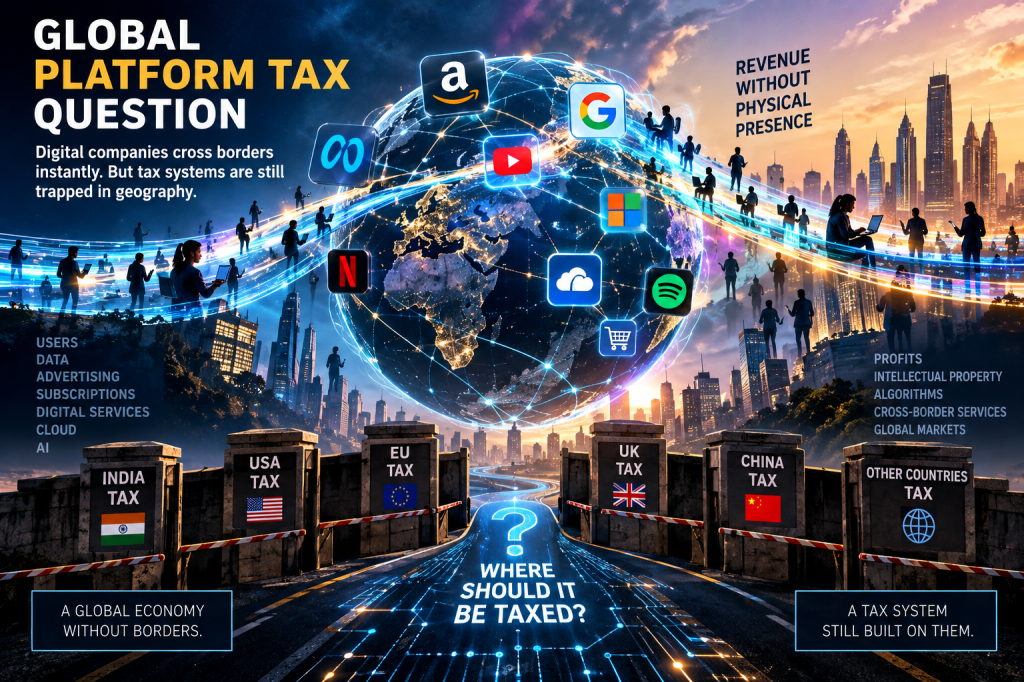
The tax system was built for an economy that had an address. For most of modern economic history, taxation followed physical geography. A factory stood somewhere. A bank had branches. A retailer had shops. Employees worked from identifiable offices and warehouses. Governments could therefore connect economic activity with territory: if a company had a substantial physical presence within a country, that country acquired a basis for taxing part of its income. The twentieth-century international tax architecture grew around this relationship between profit, presence and place. The platform economy is steadily weakening all three connections.
The company can now enter before the company arrives. A digital platform can acquire millions of users in a country, sell advertising to its businesses, collect subscription payments, facilitate transactions or provide cloud and software services without building the physical infrastructure once required for comparable market access. A hotel chain traditionally needed hotels; a retailer needed stores; a newspaper needed distribution; a taxi company needed vehicles and operating infrastructure. Platforms can participate in these same economic spaces through software, algorithms, data and networks. Economic presence has therefore begun to separate from physical presence. Tax rules designed around yesterday’s geography are being asked to govern an economy increasingly organised around invisible assets.
This is not merely a technology problem—it is a problem of defining where value is created. Suppose a platform is incorporated in Country A, owns intellectual property in Country B, operates servers across several jurisdictions, employs software engineers in Country C and earns substantial revenue from customers in Country D. Which country created the value? The traditional answer emphasised capital, employees, intellectual property and corporate residence. The digital economy introduces another claimant: the market itself. Users, customers, merchants, data and network effects can contribute materially to the commercial value of a platform even when the company has little conventional physical presence there.
That changes the political economy of taxation. Market countries increasingly ask a simple question: if our consumers generate the revenue, why should the associated taxable profit largely appear somewhere else?
The deeper battle is therefore over profit allocation, not simply tax rates. Public discussion often reduces international corporate taxation to whether rates should be higher or lower. The more difficult issue is deciding which jurisdiction has the right to tax which portion of profit. A company may generate ₹1,000 crore of revenue in a market without reporting anything close to ₹1,000 crore of taxable profit there. Expenses, intellectual-property payments, transfer pricing, corporate structures and the location of intangible assets can determine where accounting profit ultimately appears. In an economy dominated by factories, inventories and machinery, identifying the location of productive assets was relatively straightforward. In an economy dominated by software, brands, algorithms and intellectual property, value can be geographically much harder to pin down.
Intangibility creates a new kind of tax mobility. A steel plant cannot easily be moved from one country to another because the tax rate changes. Intellectual property can be legally located far more easily. This asymmetry matters enormously. As corporate value shifts from machines and buildings toward patents, software, databases, algorithms and brands, governments may discover that the fastest-growing parts of their tax base are also among the hardest to locate geographically. The future tax competition between countries may consequently become less about attracting factories and increasingly about attracting—or legally hosting—intellectual capital.
Digital taxes are symptoms of a larger institutional lag. Faced with this mismatch, countries have experimented with digital-services taxes, withholding mechanisms, significant-economic-presence concepts, indirect taxes and other approaches. International negotiations have simultaneously tried to develop more coordinated rules for allocating taxing rights and limiting incentives for profit shifting. Yet the underlying tension remains difficult because governments occupy different economic positions. Large consumer markets naturally place greater emphasis on where revenues and users are located. Countries hosting multinational headquarters or intellectual property may place greater emphasis on residence, investment and innovation. Developing economies often worry that rules created by advanced economies may not allocate them a sufficient share of the tax base generated within their markets.
The dispute is therefore not simply government versus Big Tech. It is also market country versus headquarters country, large economy versus small economy, importer of digital services versus exporter of intellectual property, and national sovereignty versus international coordination.
The next disruption may be larger than social-media platforms. Artificial intelligence, cloud computing, remote professional services, digital finance, online education, virtual design, gaming, software subscriptions and machine-to-machine services will make cross-border economic activity even less dependent on conventional establishment. A company may eventually serve a market using AI systems developed elsewhere, cloud infrastructure distributed globally and only a small number of employees. Revenue could expand dramatically while local employment and physical investment remain minimal.
This creates an uncomfortable possibility: economic participation may become increasingly local while taxable presence becomes increasingly global—or nowhere obvious at all.
The AI economy could intensify the problem further. If an autonomous digital system designs products, provides consulting, writes software, manages advertising and serves customers across dozens of countries, determining where the underlying value was created becomes conceptually difficult. Was it created where the model was trained, where computing infrastructure is located, where intellectual property is registered, where customers pay, or where the data contributing to the system originated? Existing tax vocabulary may prove inadequate for economic structures that barely existed when much of international tax doctrine was developed.
Developing countries face a particularly difficult bargain. Digitalisation allows foreign platforms to reach their consumers and businesses without making proportionate local physical investments. This can bring enormous productivity benefits, but it can also create an unusual economic structure: domestic consumption generates revenue, data and network effects while high-value intellectual property and significant portions of taxable profit remain abroad. Governments must therefore protect legitimate taxing rights without turning digital taxation into a barrier against technology adoption, entrepreneurship or cross-border services.
India and other large emerging markets consequently have interests on both sides. They want taxation that reflects the economic importance of their markets, but they also want their own technology and service companies to expand globally. Rules designed aggressively against foreign platforms today could eventually apply to successful domestic platforms operating abroad tomorrow.
The danger is the fragmentation of the digital economy. If international coordination fails, countries may increasingly construct their own digital taxes, withholding rules, data requirements and definitions of taxable presence. Businesses could then confront dozens of overlapping regimes. Double taxation could increase, compliance could become disproportionately expensive for smaller companies, and tax disputes could spill into trade retaliation. The internet may remain technically global while its fiscal architecture becomes increasingly national.
This would be particularly damaging for smaller digital enterprises. Large multinational platforms can employ armies of tax specialists. A small Indian SaaS company selling into twenty countries cannot easily maintain twenty sophisticated tax-compliance systems. Poorly coordinated digital taxation could therefore unintentionally strengthen the largest platforms by raising the fixed cost of internationalisation.
The real question is moving from where is the company to where does economic participation occur? The nineteenth-century economy taxed land and physical commerce. The twentieth century increasingly taxed corporations, wages, factories and financial income. The twenty-first century must determine how to tax economic activity whose most valuable components—software, data, algorithms, networks and intellectual property—may have no meaningful physical location.
The eventual solution is unlikely to come from simply stretching old definitions of permanent establishment until they cover the digital world. A more durable architecture may have to recognise several dimensions simultaneously: where intellectual property is developed, where employees and capital operate, where customers generate revenue, where users contribute to network effects and where commercially valuable data is created.
That will inevitably involve negotiation over who receives what share.
The coming struggle is ultimately about fiscal sovereignty in an intangible economy. Governments once controlled taxation partly because economic activity could not easily escape geography. Platforms have changed that relationship. Markets remain national, but digital businesses increasingly operate across them as integrated global systems.
The great tax question of the next decade may therefore not be how much should digital companies pay?
It may be something much more fundamental:
When economic value exists simultaneously across many countries, who owns the right to tax it?
Until the international system can answer that question convincingly, platform taxation will remain more than a technical dispute over corporate tax. It will be one of the central battles over how the gains, costs and fiscal sovereignty of the intangible global economy are divided.
DigitalEconomy #PlatformEconomy #GlobalTax #DigitalTax #ArtificialIntelligence #IntangibleEconomy #InternationalTrade #TaxPolicy #DigitalServices #GlobalEconomy


Leave a comment